
A scholarship award on a resume should identify a scholarship you actually received: its official name, issuing organization and documented year. The important distinction is an earned award versus an application, nomination, tuition discount or funding arrangement. This guide shows how to write a compact entry without inflating selection criteria, inventing a rank or disclosing unnecessary financial details. Every example below uses fictional institutions and is for formatting only.
Start with what the scholarship actually represents
A scholarship belongs on a resume when you received it and it adds meaningful evidence of academic work, service, leadership or another job-relevant quality. CareerOneStop notes that scholarships can fit in a student’s education record; it does not mean every financial-aid item deserves a line. The first question is not the cash value but what the award represents. Was it selected through documented academic performance, community service, a competitive portfolio, a research proposal or financial need? Never substitute a broad claim of merit for an award whose published basis was different. Keep the emphasis on truthful recognition rather than a dollar figure.
Verify recipient status before writing the line
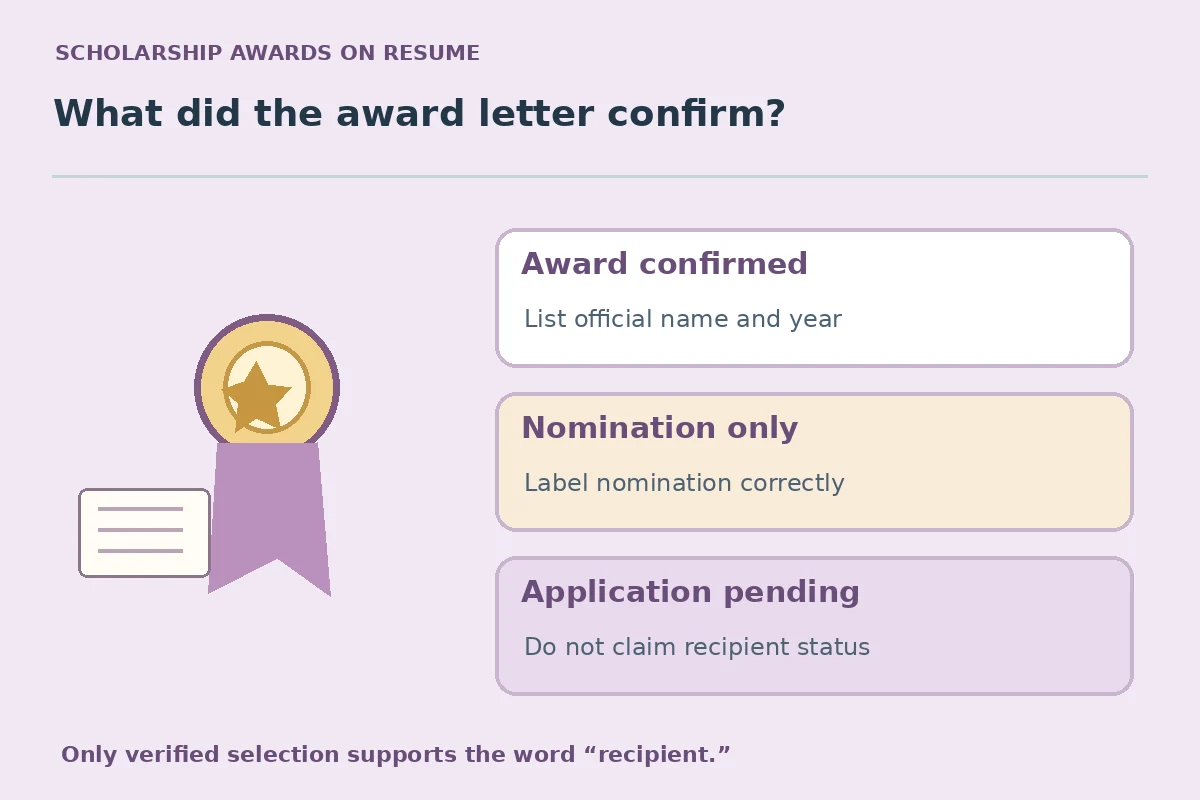
Check your actual scholarship letter or the issuing organization’s recipient notification. If you applied but have not heard back, you are not yet a recipient. If you were nominated or shortlisted, those are different distinctions and should be labeled as such if worth mentioning. If the award was offered but declined, avoid suggesting funding you received. Likewise, a tuition discount or need-based financial-aid package is not necessarily a competitive academic honor. When the status is ambiguous, choose conservative wording rather than assuming an impressive title. The reader should be able to understand exactly what happened.
Record the official title and organization
Use the award name as the issuer presents it; do not convert a local grant into a national prize or rename an institution. A useful hypothetical example is “Community Service Scholarship — Example Community Foundation, 2026.” A short parenthetical may describe verified selection criteria, such as “selected for documented community-volunteer leadership,” if the official award terms support that description. Avoid invented applicant counts, acceptance rates or rankings. If a person reading the entry could not verify the award, ask the issuer for the correct name rather than composing a prestigious-sounding substitute.
Decide whether it belongs under Education or Honors
For a student with one or two awards, a short line beneath the related degree or high-school education may be easiest to read. If you have several distinct distinctions directly relevant to the role, an Honors and Awards section can make more sense. Avoid repeating the same scholarship in both places. CareerOneStop and Harvard career resources encourage selecting education achievements based on relevance rather than copying every school activity. An established professional may omit an older undergraduate scholarship if recent accomplishments demonstrate the same skills more clearly.
Use the selection basis rather than the award amount
An award that recognizes research communication can be relevant to a research-assistant job; an award for organizing a community event can support an operations application. Explain the basis only when you can substantiate it from criteria, a letter or official announcement. Avoid exposing financial-aid amounts or family circumstances. A need-based scholarship may still be a legitimate received award, but it should not be described as an excellence prize unless it truly was. In a scholarship-funded degree program, the degree record and the funding decision serve different functions on the resume.

Edit inflated award claims into defensible entries
Weak hypothetical entry: “National Merit Scholar and scholarship winner (application pending).” This invents status. Accurate alternative: “Applicant, Community Service Scholarship, Example Community Foundation” is usually not worth resume space; instead list relevant service work that actually occurred. If the person did receive the scholarship, an appropriate sample is “Community Service Scholarship, Example Community Foundation — recipient, 2026.” In either case, verify the issuer and date from a real record. This distinction protects against implying selection while still preserving substantive accomplishments.
| Item to check | What the resume should show |
|---|---|
| Issuer | Who made the award |
| Recipient status | Evidence of selection |
| Award year | The documented date |
| Criteria | Only a verifiable reason for selection |
Avoid confusing scholarships with fellowships or employment
Some awards pay tuition only; others come with teaching, research or service obligations. A fellowship with actual paid research duties may warrant separate experience bullets, while a scholarship without work requirements belongs under education or honors. If the award included a project, describe the project separately only when you did it; do not transform financial support into a job title. Review the program’s letter to clarify whether you were a student recipient, research assistant, employee, fellow or trainee. The correct label affects both credibility and the reader’s understanding of your experience.
Prepare evidence without sharing private documents widely
The official award letter, school portal record or public recipient announcement may support the entry. Store these privately rather than linking to financial-aid statements that contain sensitive information. If a hiring manager legitimately requests proof, confirm the request through an official employer channel and provide the minimum necessary document. You may also ask a school awards office how to verify the title. Do not assume that winning a scholarship proves a professional license, employment qualification or software proficiency; describe those separately.

Review relevance for the target job and the final PDF
Prioritize the award that best connects to the position rather than the one with the largest financial value. For an early-career applicant, one recognized scholarship can help show an academic or service pattern. For experienced applicants, it may be secondary to recent measurable work. Check names, dates, punctuation and capitalization in the exported resume. If you use the same scholarship on a separate academic CV, ensure the wording is consistent. The safest summary is a compact statement of the actual award, issuer, date and verifiable selection basis if that basis matters.
How We Research Education and Credential Guidance
JobAsk checked these education, career-service and occupational sources on November 17, 2026: CareerOneStop explains how to list education, training, awards and study in progress without misrepresenting a degree. Harvard career guidance recommends choosing relevant coursework, honors and academic projects for the target job. CareerOneStop outlines evidence for education without a degree, short courses, significant awards and completed credits. We compared guidance on education records with the distinctions that an applicant must verify with a real provider, school or regulator. Requirements vary by employer and jurisdiction; a cited educational resource is not proof that a particular applicant has a credential. All example schools, award names, documents and people in this article are hypothetical and are not evidence of a real award, employer endorsement or employment outcome. We do not promise hiring, testing results or acceptance by an applicant tracking system. There is no claimed paid partnership in this article. Read our affiliate disclosure for relationship transparency.
More Resume and Cover Letter Guides
Not as an award. A pending application is not recipient status; highlight the real work or service behind the application instead.
Usually the award name and what it recognizes matter more. Consider privacy and relevance before adding any amount.
They can be listed as received financial awards when relevant, but do not relabel them as competitive academic honors without evidence.
Under Education for one or two relevant awards, or in Honors and Awards when there are several; avoid duplicating entries.
Use the official award name and recipient status. Do not invent a designation unless the issuing program actually grants it.