
For final interview with a client stakeholder, expect to go beyond the first conversation and explain what you personally did, how you made decisions, and which questions remain open about the work. A later-round invitation is not a promise of an offer. The format may include a manager, a panel, a work example or a practical case, depending on the employer. This guide focuses on hear the request, check the scope and confirm owner rather than memorized confidence claims. Use only genuine employment history in answers about your background; any sample situation here is hypothetical and must be adapted to your real authority and evidence. Before participating, confirm the invitation, time zone, participants and any approved presentation or work-sample instructions.
Find out what the client is evaluating
Some consultancies, agencies and service providers involve a client stakeholder in late-stage interviews because the role will interact with that person’s team. This does not necessarily mean the client controls hiring or can independently authorize a job offer. Ask your recruiter who will attend and whether the conversation is about project work, communication or a practical scenario. Prepare to explain how you would confirm requirements, handle conflicting feedback and recognize decision authority. Do not research confidential client information outside approved public channels or assume that a friendly client discussion means you have the position.
Learn the brief without pretending you know the contract
Use the public job description and materials supplied for the interview. Make a simple list of deliverables, dependencies, deadlines and unknowns. If the organization has not shared its actual contract, label your questions as questions; do not assume billing terms, service levels or scope-change procedures. In a real job, the client-facing professional may gather needs but have no authority to approve cost, schedule or contractual changes. Your interview answer should reflect that distinction. A useful phrase is “I would confirm the requested outcome and take any change in scope to the person authorized to approve it.”
Tell one story about competing feedback
Choose a real example in which different stakeholders wanted different things. Describe the request and the observable constraints, then show how you documented the disagreement and obtained a decision. The point is not that everyone was pleased; it is that the requirements became clearer and no one unknowingly promised a change. If your experience involved internal stakeholders rather than external clients, say so. A hypothetical example could involve a report whose audience requested new fields after review. Clarify what information you collected, who assessed the work and who signed off. Never disclose named customer datasets to prove the example.
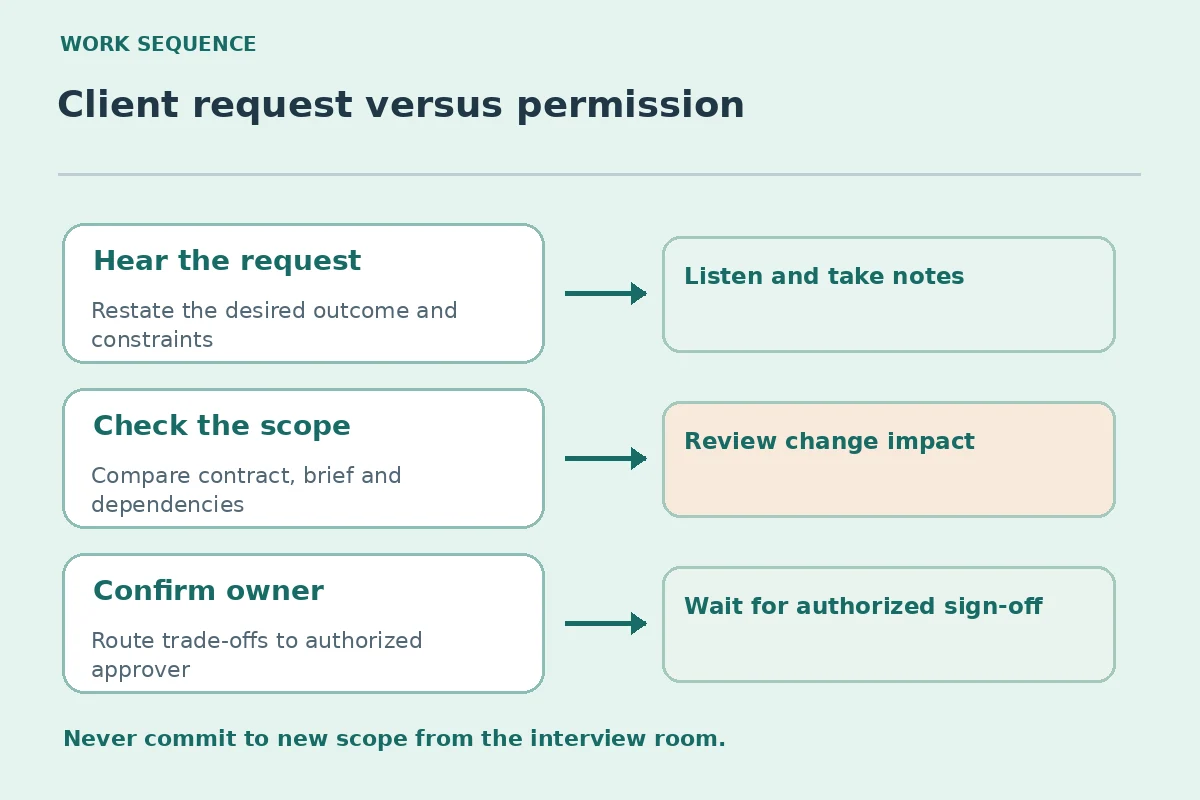
Walk through the request-to-approval path
The diagram below treats listening, scope checking and authorization as three separate actions. If a client asks for a feature that might delay a launch, the candidate can acknowledge the goal, write down the change and ask the project owner to assess consequences. That is different from agreeing to a new deadline on behalf of the employer. Practice an answer in which you offer options only after you have enough facts. Mention uncertainty rather than guessing effort. The best interview answer protects trust on both sides: the client hears a clear explanation, while the employer retains the approvals it has assigned.
Explain how you handle an unhappy client
A client may challenge the timing, quality or completeness of a deliverable. First confirm the specific gap and ask for a usable example. Review what was actually promised before defending anyone’s work. Record the concern in the approved channel, identify the reviewer and explain when the customer can expect an update if an authorized owner can confirm one. Avoid blaming colleagues or promising immediate remediation outside your role. If the discussion involves data privacy, licensing or regulated services, escalate appropriately. In the interview, show how you can remain calm while still distinguishing customer feedback from approved project requirements.
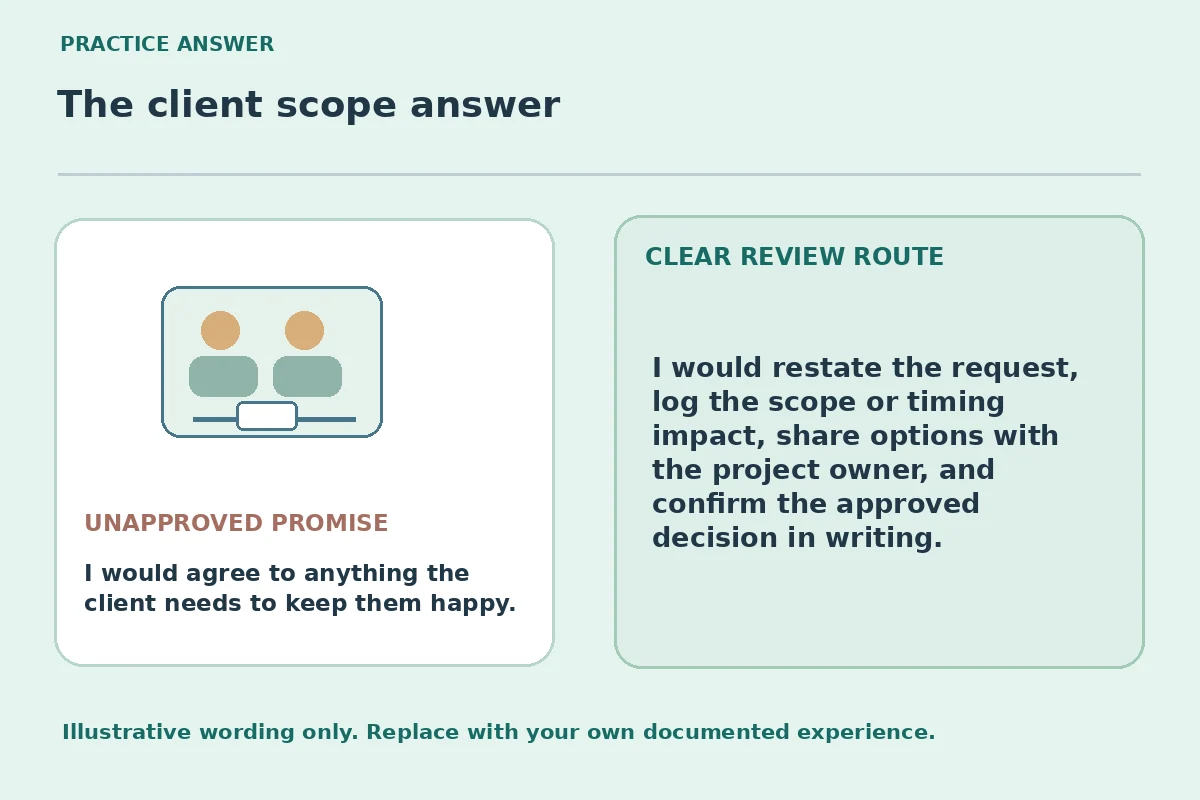
Make a short fictional response practice
A weak answer says “The customer is always right, so I would do whatever they ask.” A stronger hypothetical response says “I would confirm the change they are requesting, document the impact on the current brief, and ask the accountable lead to approve the option before communicating a commitment.” Replace that illustration with your own experience when answering questions about your background. The Office of Personnel Management recommends job-related questions with clear descriptions of actions and results. Note who owned the actual result and which part you performed. Do not borrow a client name or revenue amount to make the story more compelling.
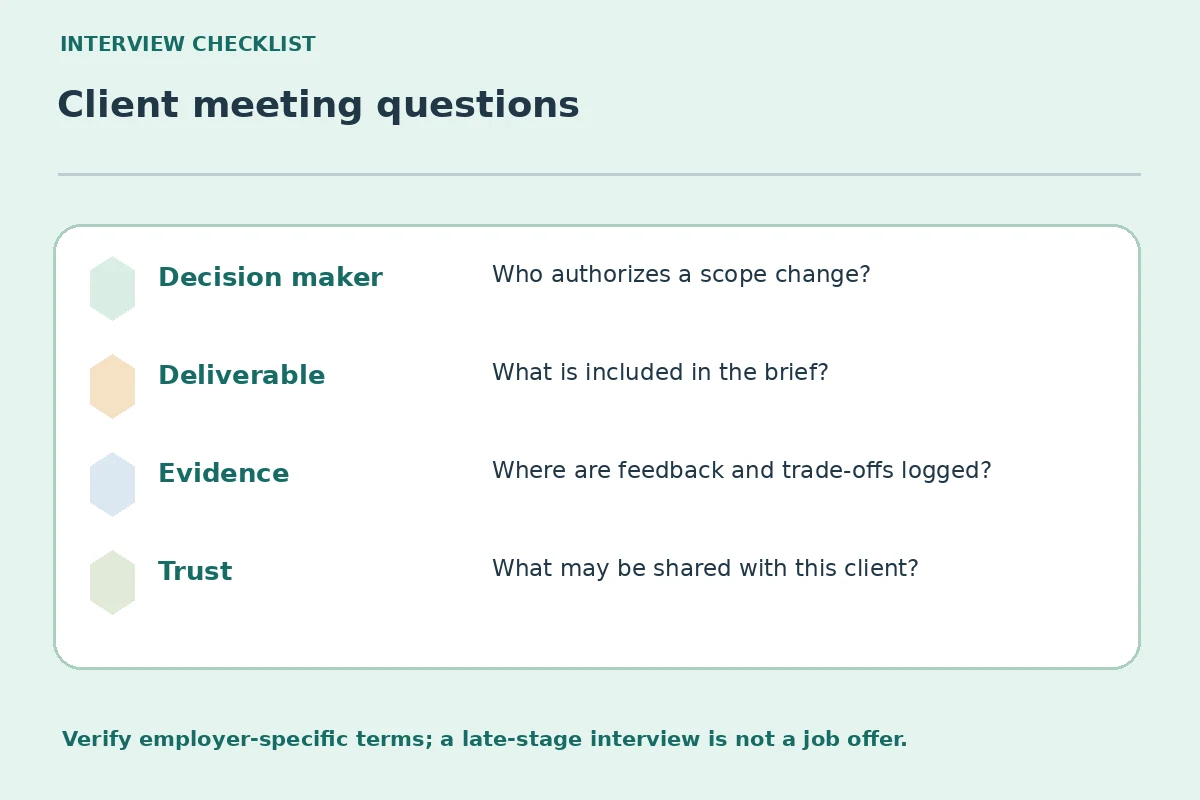
| Decision area | What to confirm |
|---|---|
| Decision maker | Who authorizes a scope change? |
| Deliverable | What is included in the brief? |
| Evidence | Where are feedback and trade-offs logged? |
| Trust | What may be shared with this client? |
Ask the client useful questions with boundaries
Questions such as “What makes a handoff useful to your team?” or “Who provides consolidated feedback?” can reveal real work preferences without crossing confidentiality boundaries. Ask whether there are decision forums or documented approval paths when priorities conflict. Avoid asking the client to reveal contract terms or internal grievances that your future employer has not authorized them to discuss. If the client asks a question that belongs with your hiring manager, it is professional to say that you would want to check the team’s process before committing. The interview is mutual evaluation, not an opportunity to secure informal promises.
Follow the employer contact path afterward
After the meeting, write down the public, job-relevant themes and anything you still need to clarify. Send a thank-you message through the designated recruiter or coordinator unless the employer explicitly permits direct contact. Do not independently send a proposal, pricing plan or confidential sample to win favor. A final-round interview may still be followed by internal review, another candidate meeting or no offer. Keep any next-step date supplied by the employer and follow up respectfully if that date passes. If you receive a written offer, evaluate the employment terms separately from anything discussed informally with the client.
How We Research Second and Final Interview Advice
JobAsk reviewed these occupational, government and university sources on November 17, 2026: University of Chicago explains that second-round interviews probe work experience and can involve supervisors, other staff, panels and assessments. U.S. OPM explains competency-based questions and the distinction between behavioral and situational interviewing. University of Iowa explains follow-up interviews and why employers involve later-stage decision makers or practical exercises. Notre Dame notes that on-site and later-stage interviews are used for mutual evaluation of employer and applicant, including virtual arrangements. These sources describe typical interview formats or real occupational duties; they do not establish what any individual employer will ask or how a hiring decision will end. We checked that this scenario answers a more specific reader question than general interview preparation, while the employer remains the final source for its own hiring process. Examples in this guide are hypothetical and must not be presented as actual employer results or client outcomes. No affiliate approval, employment offer, guaranteed interview score or hiring outcome is implied. Read the JobAsk affiliate disclosure.
More Interview Preparation Guides
No. It is another assessment stage, and the employer must communicate any formal offer separately.
No. Clarify scope, effort and who approves commitments before promising a delivery date.
Only with permission and proper redaction; a hypothetical or anonymized example is usually safer.
Acknowledge the goal, name the constraint accurately and propose a documented decision route.
Follow the invitation or recruiter instructions; do not contact a client privately without authorization.