
Finding jobs at small businesses often means looking beyond one big job board. Start with local employers whose products or services you understand, check whether each actually has a vacancy, and contact them through an established channel. A business being nearby does not mean it is hiring. The useful skill is separating a verified application from a polite inquiry, then matching your evidence to the specific day-to-day work.
Build an employer list from work you can describe
Instead of searching “any local job,” identify industries that fit your abilities and transportation: print shops, independent retailers, repair offices, service businesses, specialty suppliers or local professional practices. The examples are categories, not a list of current vacancies. Think about the kinds of tasks you could learn safely and reliably, not merely businesses that are visible on a map.
Create a small ledger with employer name, official website, business address, customer-facing contact channel, role of interest, vacancy status and date checked. A business directory can be a discovery tool, but confirm the organization independently before trusting a listing or handing over documents.
Distinguish a posted job from exploratory outreach
A published vacancy names a role, application method or hiring contact. Exploratory outreach asks whether there is a suitable opening, without implying the employer owes you an interview. Those are different situations. If the site has a careers form, use it. If no vacancy is listed, look for an appropriate general business contact and keep the inquiry brief.

Do not show up during a rush period and demand to speak to the owner. If a store says applications are online only, follow that process. Good outreach respects the employer’s workload and privacy; it does not replace a required application with repeated unsolicited messages.
Search role duties rather than guess a company title
A small business may combine scheduling, customer service, supply ordering or document support in one role. Read the required tasks and identify which you can honestly perform. O*NET profiles describe broad job tasks but cannot establish what a particular shop assigns. Never infer that “assistant” includes financial approvals or unrestricted access to customer files.
For example, “front counter associate” could involve greetings and order entry but not account reconciliation. Ask where training and manager review begin. An employer-specific question demonstrates better judgment than a resume claiming universal experience with every tool used by small firms.
Use a low-pressure outreach message with real evidence
Hypothetical note: “Hello, I am interested in customer and inventory support opportunities at your shop. I have helped organize supplies for a community event and can work weekday afternoons. I did not see a current vacancy on your careers page; is there an approved way to ask about future openings? Thank you.” Replace these details with true information.
Avoid sending a full resume to every public email address. Send only to a legitimate hiring channel, and do not include government identification numbers, bank records, or information about previous employers that you are not allowed to share. An inquiry is not a job application until the employer says how to apply.
Verify the small employer without unfair assumptions
Some legitimate employers maintain simple websites or use email rather than complex hiring platforms. That alone does not make them unreliable. Check that the business, contact and location are coherent, and confirm the vacancy with an independent source if a recruiter approaches you unexpectedly. The FTC notes that scammers can impersonate real companies and build convincing fake websites.

Treat requests for upfront fees, transfers or check deposits as warning signs. An unfamiliar shop may still be reputable, while a polished logo can belong to a scam. Ask what job the employer is offering, what the application steps are, and whether the person contacting you actually represents the company.
Compare job scope, training and supervision
Smaller teams often require clear handoffs because one absent person can affect customers and work queues. Ask who trains new hires, what tasks require approval, and how busy periods are scheduled. Do not assume an entry-level position means unstructured work or that the new hire must learn everything without help.
A practical question for an office-services opening: “Which records would I update independently, and which changes need a manager to review?” That respects confidentiality and the difference between preparing information and authorizing a decision. Ask similarly about equipment, cash handling and access permissions.
Follow up once, and respect the answer
If the employer invites applications, submit the requested materials and note the date. If you sent a general inquiry and receive no response, one polite follow-up after a reasonable period may be enough. Do not call repeatedly at peak business hours. If the business says there is no opening, thank them and move to other leads.
Track posted openings separately from possible future contacts. Otherwise a list of twenty neighborhood businesses may look like twenty active applications when only two were hiring. Use the ledger to make realistic decisions about where your time should go.
Select leads by access and verified fit, not just distance
A job near home can still be unsuitable if the shift ends after your available transportation stops. Confirm location, required attendance, physical tasks and expectations before accepting. If you can work early shifts but the business needs evening coverage, record it as a mismatch rather than treating the employer as unresponsive.
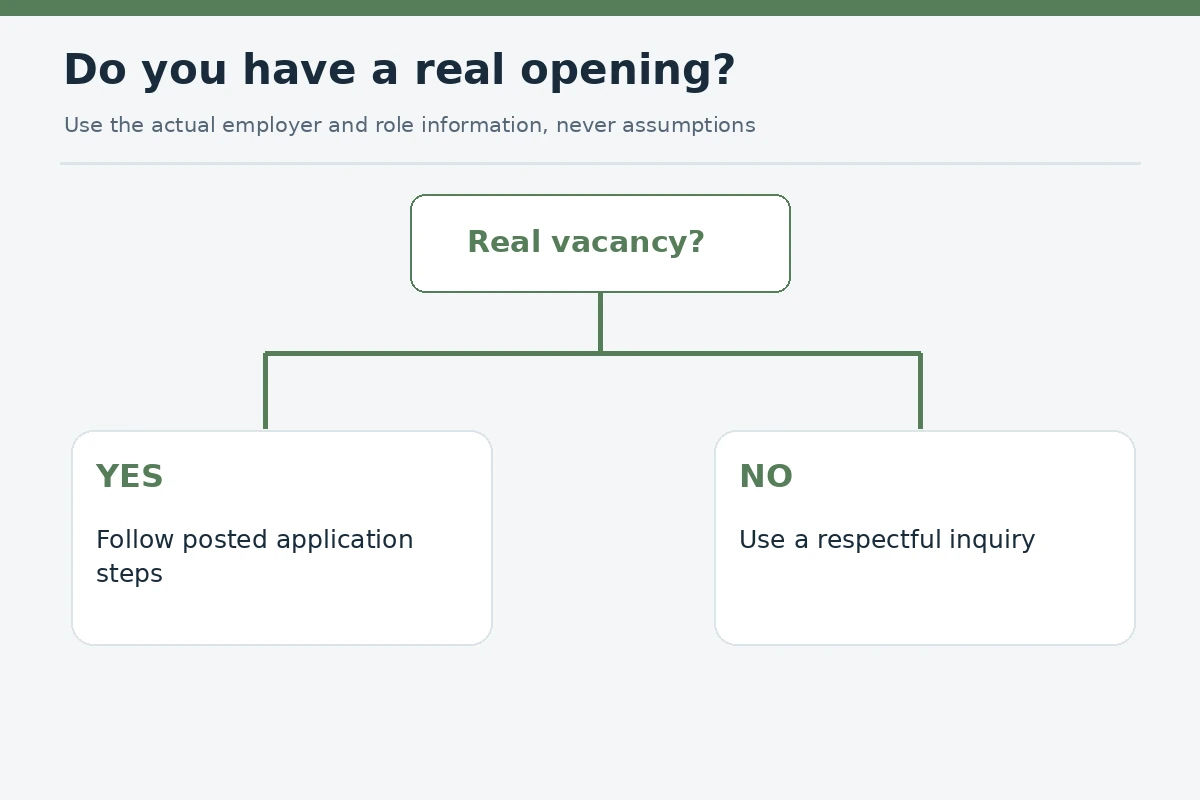
Prioritize verified openings with clear duties and a realistic application route. Then consider exploratory leads where a business explicitly welcomes inquiries. A narrow, honest list is more actionable than hundreds of unspecified “local openings” with no employer contact or role title.
| Situation | Key condition | Evidence to check | Next step |
|---|---|---|---|
| Posted vacancy | Role and employer stated | Official application | Submit materials |
| No opening shown | Employer verified | General inquiry | Ask permission |
| Unknown contact | Cannot confirm | Do not send files | Verify first |
Turn a modest task into an interview-ready story
Choose one example showing dependable follow-through. A school fundraiser, community group or household organization project can sometimes illustrate counting materials, answering questions, taking messages or maintaining a schedule. Say what you did, whether you worked under supervision, and what you learned when details changed.
Avoid turning volunteer work into invented retail sales or claiming management authority you never had. You can be credible without a long paid history when the example matches the employer’s task and the boundaries are explicit. Prepare one question about training and one about daily workload for each actual interview.
How We Research and Verify These Recommendations
This guide separates published occupational guidance from illustrative candidate examples. The named sources were reviewed on 2026-11-05 for the claims described below; employer-specific schedules, conditions, qualifications and openings must still be confirmed individually. Examples and comparisons are hypothetical, not real offers or hiring guarantees. This page is independent educational content; see the affiliate disclosure for the site-wide policy.
Source basis: USAGov — Lists state job banks and public libraries as recognized job search channels.; FTC — Explains recruiter and employer impersonation, fake sites, and job scam warning signs.; O*NET — Provides examples of clerical and customer-contact work that require employer-specific verification.. Publication dates and local employer requirements can change; recheck the original organization before acting on any time-sensitive rule or opening.
Related Job Search Guides
A short inquiry can be reasonable through an appropriate official channel, but clearly state that you are asking whether there is an opening rather than claiming there is one.
No. Follow any posted application method, and do not interrupt service or assume an employee is authorized to hire.
Check the company and contact independently. Investigate unusual payment demands, fake checks or contacts who cannot name a real role.
Yes for relevant tasks when described honestly and labeled as volunteer or project work, not fabricated paid employment.
Thank the contact, update your ledger to “no current opening,” and focus on verified jobs elsewhere instead of repeated pressure.