
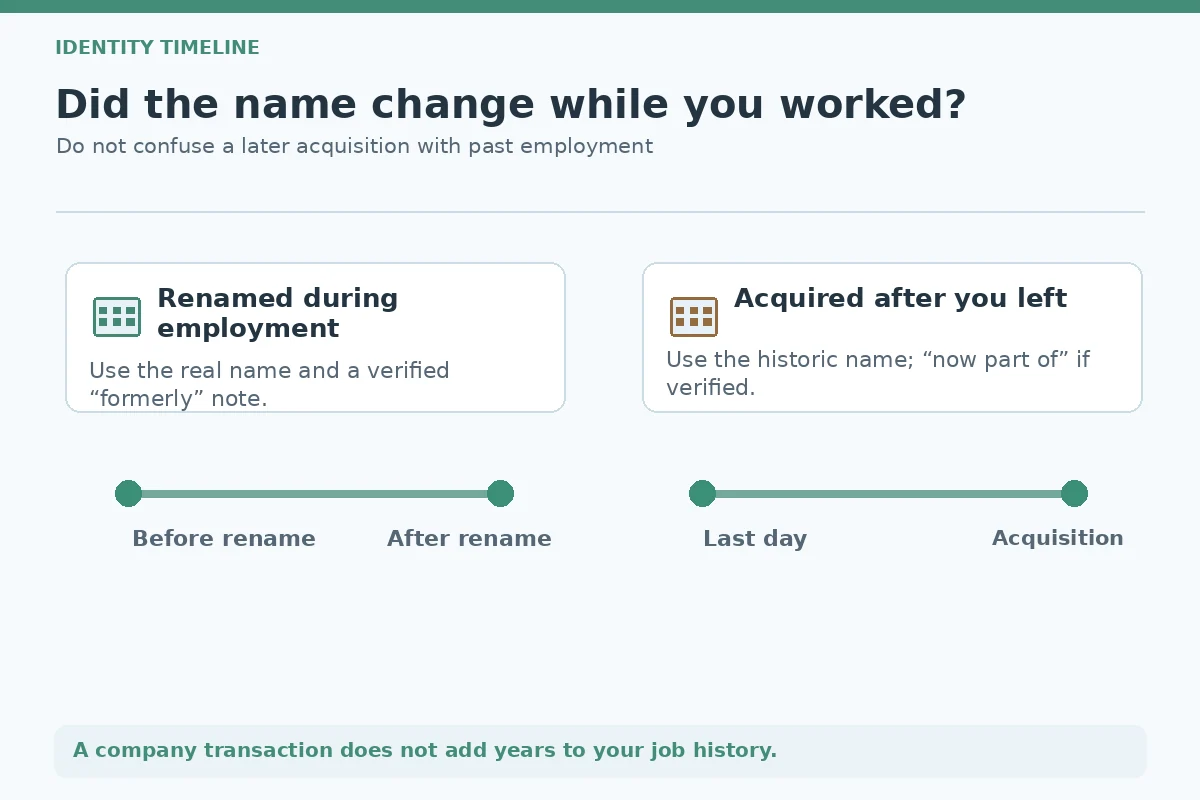
If a former employer changed its name, keep the name you actually worked for and add a short, verifiable identification of the new name when that helps the reader. A line such as “Riverbend Analytics (now part of Harbor Group)” can clarify a genuine acquisition without pretending you worked for the parent company after you left. If you stayed employed through the rebrand, show one continuous period of actual service and use the correct role dates. The goal is employer identification, not implied prestige.
Identify what actually changed at the organization
A company may adopt a new brand, merge into another business, change its legal entity, sell a division, or close entirely. Those situations are different. A brand change does not necessarily mean your employer changed legally; a sale might transfer your employment to a new organization. Consult reliable information such as your employment records, pay statements, a public company announcement, or an HR contact before choosing labels like “formerly,” “acquired by,” or “now part of.” Do not assume that sharing a brand makes two businesses the same employer.
For a hypothetical example, suppose Alder Systems became AlderWorks while you were still employed. You might write: “Alder Systems (renamed AlderWorks in 2024) — Support Coordinator | May 2022–September 2025.” This names the former employer and makes the current name findable. But if you left in 2023 and the acquisition happened in 2025, it would be misleading to imply that you worked at the acquirer. A careful alternative: “Alder Systems (now part of AlderWorks) — Support Coordinator | May 2022–August 2023.”
Choose between the old name and the current name
Use the name that best represents the identity in your employment records, and supplement it with the other name for recognition. If your pay record and employment verification identify the old company, leading with the old name may avoid confusion. If all current public records display a rebranded company and you stayed through the transition, leading with the current name plus “formerly” can be clearer. Indeed’s updated company-name guidance describes both approaches; there is no universally required resume formula.
Avoid dramatic language such as “merged into a world-leading enterprise” unless the statement is relevant and verifiable. The parent brand’s reputation is not an accomplishment of the employee. Likewise, avoid placing a trademarked logo or legal suffix you are uncertain about. Use ordinary words, one simple parenthetical, and the same professional formatting as the rest of your resume.
Keep your dates tied to real employment
One continuous job does not become two years longer just because a buyer acquired the business. Preserve the dates of your actual employment and show meaningful role changes separately when necessary. If the reorganization produced a genuine new contract or employer, your record may need two entries instead; make that choice from evidence, not convenience. If your title changed during the acquisition, note the old and new titles with the correct periods rather than attributing the current title to an earlier year.
Consider another invented timeline: “Moss Creek Services — Scheduling Assistant | January 2021–June 2023” followed by “Harbor Operations (acquired Moss Creek Services) — Scheduling Coordinator | July 2023–December 2025.” This would be appropriate only if it truly reflects two employer or job records. If your work was uninterrupted at a renamed entity, a single listing may be simpler. The visual layout should explain the transition, not conceal it.
Describe what you did during a transition
An acquisition alone is not a resume achievement. You can describe a task you personally carried out: reconciling two customer-information lists, updating approved procedures, transferring tickets under guidance, or helping train staff on a new system. Make the limits visible. A hypothetical bullet might say: “Mapped existing appointment categories to the replacement scheduling system and flagged unmatched records for administrator review.” It is more credible than “Led enterprise merger integration” when the applicant was one of several support staff.
Only add numbers that your employer permits you to disclose and that your records support. An unverified headcount, transaction volume, integration budget, or supposed efficiency gain weakens trust. If your contribution was routine and still useful, describe it accurately: “Updated customer-facing templates following the company name change.” This is legitimate evidence of careful documentation, even without a revenue claim.

Prepare for resume-to-application differences
An online application may demand a legal employer name, reference contact, or payroll entity. Answer that form’s questions as directed. Your resume may use a brand descriptor for readability, while the application form may require the exact entity from a W-2 or employment history. Do not guess what an investigator or recruiter can see; simply keep your own records consistent and be ready to explain the relationship in one sentence.
If the former employer closed and no longer has a website, don’t erase it from history. The company still existed when you worked there. Use the historic name, real dates, title, and verifiable duties. A reference may be a former supervisor who agrees to be contacted, but do not attach private contact details without permission. And do not add a current web address if the site now belongs to an unrelated organization.
Review the name line before saving the final resume
Apply a four-point check. First, did the organization truly change names or ownership? Second, is the parenthetical relationship phrased precisely? Third, do the dates show when you worked there rather than when the new brand existed? Fourth, could a recruiter reasonably locate or verify the old employer from the wording? If a company is very small, one clarifying phrase can help. If the current name is familiar, you can keep the parenthetical shorter.
Keep the same naming convention on your profile and across applications where possible, but do not alter a legally required field just to match a shorthand profile. CareerOneStop recommends employer and date clarity; Harvard emphasizes consistency and specific experience descriptions. Neither recommends inventing company pedigree. The best entry lets the reader recognize the business and evaluate your actual work.

How We Research Employer Name Changes
We used CareerOneStop’s U.S. resume work-history guidance, Harvard’s advice about consistent formatting and truthful content, and the updated Indeed explanation of how employers can be named after a merger or rebrand. These sources are editorial guidance rather than a legal determination of which entity employed you. See CareerOneStop work experience, Harvard resume guidance, and company name changes. Names and date examples above are fictional. See the site’s affiliate disclosure.
More Resume and Cover Letter Guides
Use the name that matches your history, and add the other name in a short parenthetical when it clarifies identity. Make sure the relationship is verifiable.
You may add “now part of” when that fact is verified, but do not imply you were personally employed by the buyer after your departure.
Not necessarily. A rebrand can occur during continuous employment; keep the actual service dates and separately show role changes when they truly occurred.
Use its real historical name and dates. You can still describe work done at an organization that no longer operates.
Only when verified and helpful. It is usually more important to show the dates you worked there than an unnecessary exact corporate transaction date.