
The first STAR answer tells the story; the follow-up question checks what is behind it. Be prepared to explain why you chose an action, which information you used, who had authority, what happened next and what you would change. A good follow-up should sharpen a real example, not create details you never observed. “I do not know the later result” is more credible than a confident invented metric.
This guide focuses on the second layer of a behavioral interview. OPM describes structured questions that seek concrete Situation or Task, Action and Result information, and USC advises candidates to know the details of the projects they discuss. Not every interviewer asks identical probes. Use these practice questions to check the accuracy and limits of your own experience rather than memorizing unsupported answers.
Prepare the Timeline Probe: What Happened First?
A follow-up may ask, “What happened before you stepped in?” or “When did you discover the problem?” Reconstruct the sequence from what you actually remember: the warning, the request, the check, the handoff and the result. Distinguish an approximate time from a known timestamp. A clear timeline can show when your action was possible without making the story sound more urgent than it was.
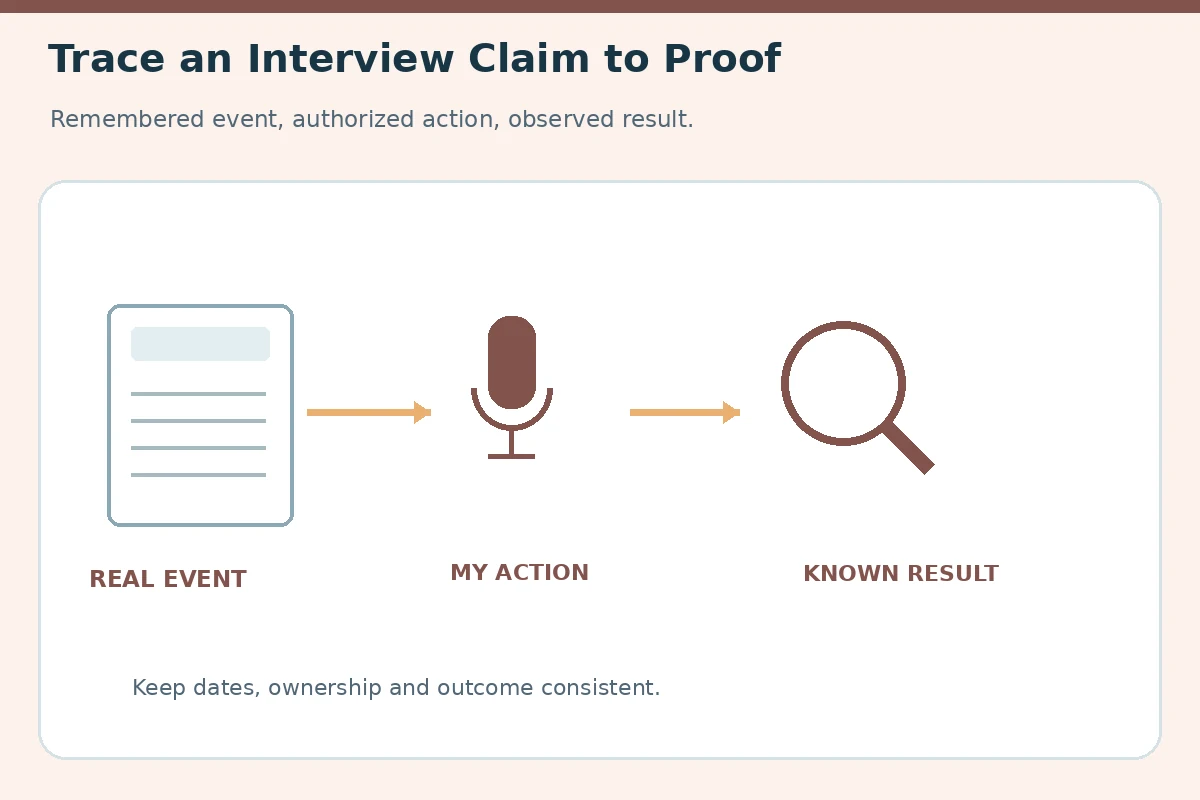
For a fictional service-desk case, a candidate might say, “I saw a repeated error report during my assigned shift. I checked the approved troubleshooting guide, logged the issue and passed it to the system administrator.” That sequence indicates authorization and escalation. Do not claim the incident began when you first saw it if it may have started earlier. If you cannot remember a specific minute or day, do not invent one.
Prepare the Decision Probe: Why That Action?
Interviewers may ask what alternatives you considered and what tradeoff mattered. Your answer should reveal information you actually had at the time, not perfect hindsight. Perhaps you could either proceed with an ambiguous record or ask for clarification. Explain the risk of guessing and the reason you requested review. The action itself is important, but the choice can reveal judgment, prioritization and awareness of limits.
In the fictional service-desk episode, the candidate could say, “I did not reset an account because the guide required identity verification I was not authorized to perform. I recorded the symptoms and escalated.” That gives a constraint and a defensible reason without claiming an unearned certification or security role. If you made a less effective choice, acknowledge it and describe what you learned instead of rewriting the alternatives.
| Possible probe | Check your evidence | Safe approach |
|---|---|---|
| When did it happen? | Sequence or approximate period | Do not invent a timestamp |
| Why did you do that? | Information and constraint | Explain real tradeoff |
| Who approved it? | Recorded role ownership | Credit reviewer |
| How did it end? | Observed result | State unknowns |
Prepare the Ownership Probe: Who Approved and Delivered?
“What did you do yourself?” and “Who signed off?” are useful reality checks. State your contribution in first person, then name the approver’s role when relevant. You may have drafted a response that a supervisor authorized or gathered data another analyst interpreted. These are real contributions even without final authority. Do not let an interviewer infer you approved work outside your remit.
A concise response might be, “I documented the user’s report and the checks I performed. The administrator determined the fix and confirmed the resolution.” That answer distinguishes preparation from decision-making. If teammates shared responsibility, clarify the handoff points. A truthful scope explanation makes it easier to answer deeper questions about the work without drifting into imaginary experience.
Prepare the Evidence Probe: How Do You Know It Worked?
Some interviewers ask what you observed, whether anyone reviewed the result or how you assessed quality. Use what can be verified: a completed ticket, an approved revision, a recorded review or directly observed behavior. Avoid exposing identifiers or internal logs merely to sound credible. An interview should not require you to break privacy or confidentiality rules to establish that a real task happened.
If the final effect was measured by another department, distinguish their reports from your direct experience. “The administrator closed the incident after review” says something useful; “I eliminated all future problems” is an unsupported leap. USC and Harvard career materials encourage real examples and concrete outcomes, not impressive claims without support. When no outcome is known, state the work you completed and its boundary.
Prepare the Learning Probe: What Would You Change?
Reflection is not a mandatory confession of failure; it is a chance to show how you evaluate decisions. Identify one real improvement and the reason it would help. The fictional service-desk candidate might say, “Next time I would capture the error wording earlier because the administrator needed that information.” If a later shift actually adopted the revised checklist, mention it only if that is true.
Avoid stock phrases such as “I would work harder” or “I learned communication matters.” Choose a concrete change to documentation, timing, consultation or verification. If an interviewer challenges your decision, listen and explain the information available at that moment. Do not become defensive or pretend there was never uncertainty. The point is thoughtful ownership, not flawless retrospective certainty.
Rehearse a Probe Set Without Overpreparing a Script
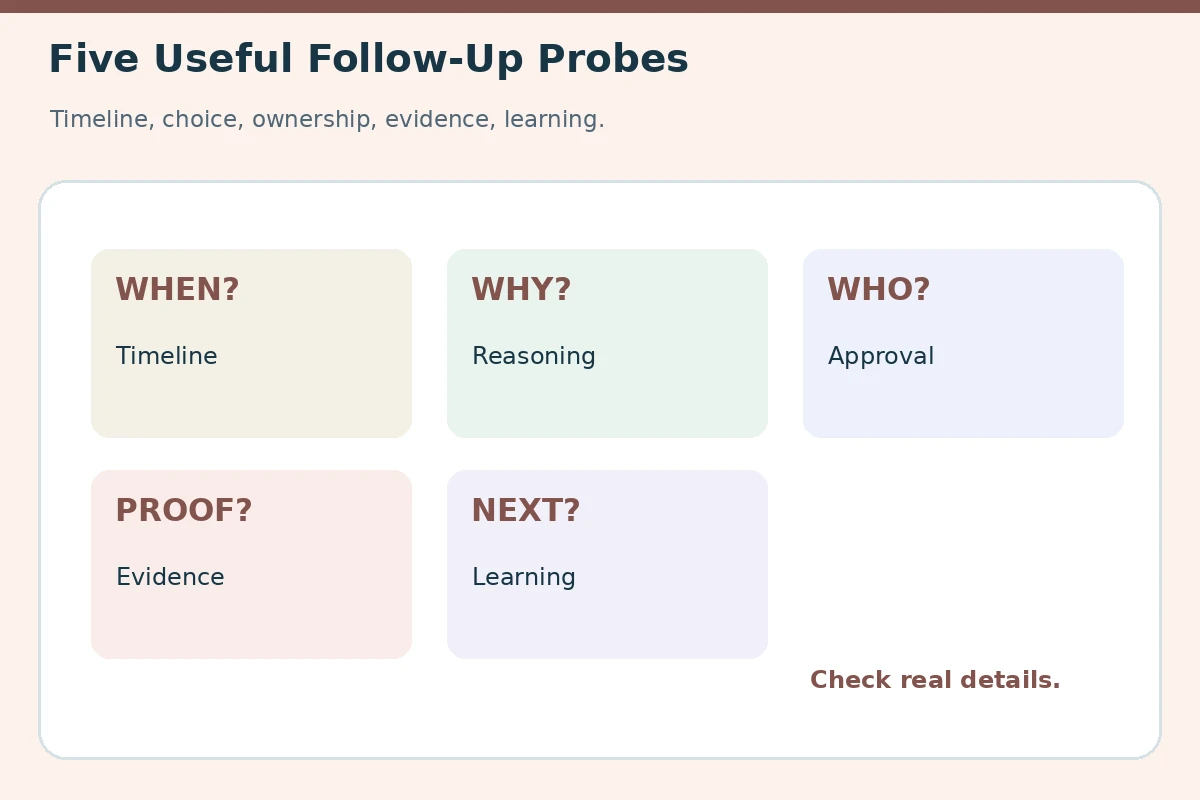
Put five prompt cards beside a verified STAR story: When? Why? Who? How do you know? What changed afterward? Say the story once, then have a partner choose two prompts randomly. A strong answer should fit the same underlying event. If a detail changes under questioning, stop and correct it. This is not an audition for a perfect memory; honesty about an approximate date or unknown outcome is acceptable.
Do not confuse past-behavior questions with hypotheticals. OPM distinguishes descriptions of previous action from questions about what you would do in a future situation. If the interviewer pivots to a hypothetical, label your new reasoning as prospective rather than describing it as another event that happened. Finish by returning to the job-relevant competence demonstrated by the actual experience.

How We Research Interview Story Guidance
We reviewed the cited primary career-center and government sources on 2026-11-14: OPM structured-interview FAQs — OPM describes structured behavioral questions that elicit context, specific action and consequences.; OPM structured interviews — OPM distinguishes behavioral questions about previous conduct from hypothetical situational questions.; USC interview preparation — USC Career Center recommends preparing several real experiences and being ready for clarifying questions, including imperfect outcomes.; Harvard FAS interviewing — Harvard career guidance emphasizes concise specific experience, personal role, relevant results and learning, including examples outside paid work.. We also compared this narrow interview topic with the supplied WordPress post-title export and existing JobAsk STAR and behavioral-answer guides to reduce overlap. All candidate stories and suggested responses are fictional illustrations unless explicitly attributed to a cited source. The frameworks are coaching structures, not employer-wide scoring rules or hiring promises. Read our affiliate disclosure; no partnership or paid recommendation is claimed.
More Interview Preparation Guides
Not necessarily. Interviewers may seek more detail about decisions, ownership or outcome as part of their normal assessment.
Give the accurate approximate period if appropriate and say you do not recall a precise date rather than guessing.
No. Respect privacy and workplace obligations; describe permitted high-level evidence instead.
Explain that person’s responsibility and your own role without claiming authority you did not have.
Name a genuine improvement based on your experience and distinguish a plan from a change you have already implemented.