
When your strongest example comes from a team project, STAR can make your contribution clear without taking credit for everyone’s work. Describe the shared Situation, identify your own Task, explain Actions you personally performed and distinguish the Result you observed from the part teammates delivered. Use “we” for the group’s shared work and “I” when speaking about your own decisions.
This guide is for ownership problems inside teamwork stories, not a generic list of teamwork interview questions. University of Washington and UC Berkeley both stress describing personal action even when the setting is collaborative. A real class project, volunteer event or workplace assignment may qualify when you can name its context accurately. Every example below is fictional and should be replaced with an actual episode.
Start With a Shared Goal and a Clearly Assigned Piece
Suppose a four-person student group needed to prepare a community survey summary. The Situation is that the group had incomplete and inconsistent responses before a presentation. Your Task might be to clean the spreadsheet and identify missing answers, while another student designed slides and a third reviewed the discussion. State this division plainly; being on the team did not make you the project leader or the author of every deliverable.
A useful first-person opening is, “Our group prepared a survey summary, and I was responsible for checking the response sheet for missing entries.” The listener now knows the group context and what to credit to you. Do not spend half the answer listing everyone’s job. Only mention collaborators when their role explains a handoff, a needed approval or a decision you did not control.
Distinguish Your Action From a Colleague’s Approval
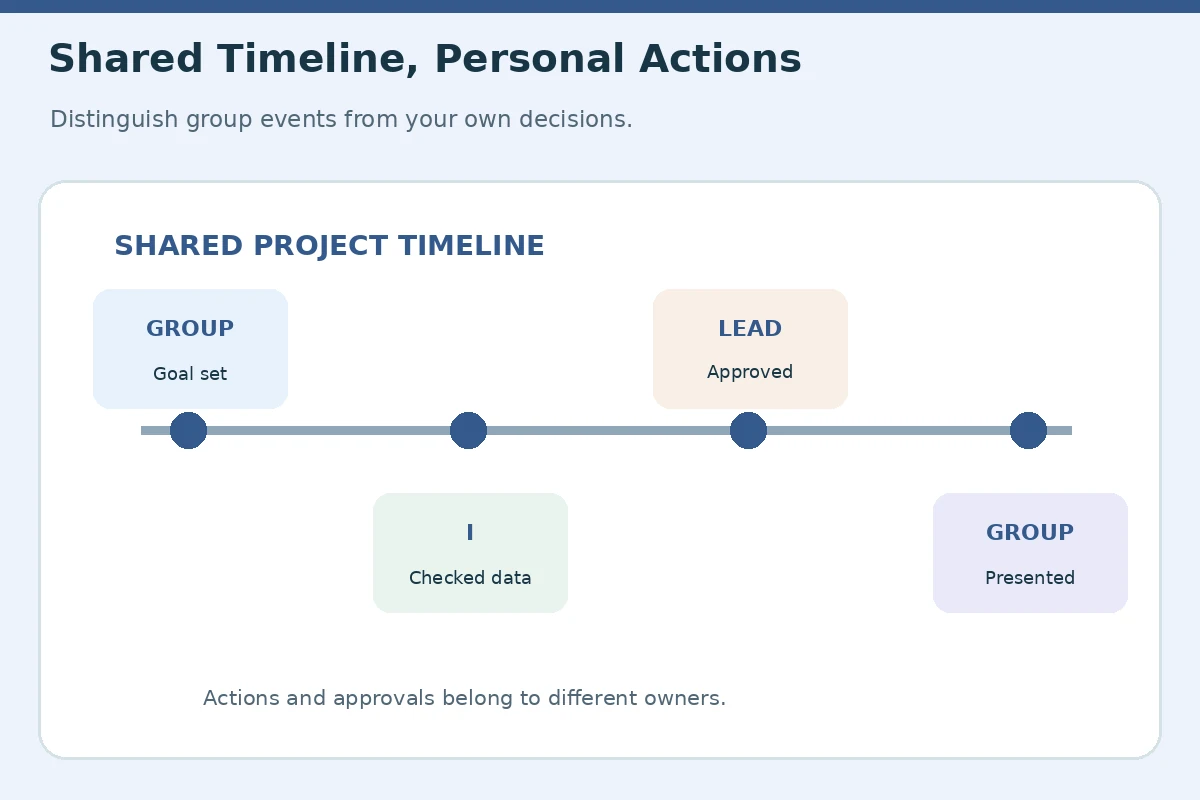
A candidate may have collected information, proposed a change or completed an assigned test without approving the final version. That boundary matters. In the fictional survey, perhaps you highlighted inconsistent responses and wrote a short issue note; the instructor or group lead decided which cases to exclude. Your Actions were checking, flagging and communicating. Claiming “I approved the research data” would go beyond the role you held.
Look for verbs that identify your scope: requested, drafted, compared, reviewed, presented, documented or escalated. Pair them with a named object and reason. “I compared duplicate rows against the assignment instructions and asked the team lead to review uncertain entries” gives much more evidence than “We handled the data.” Honor privacy rules; interview stories should not contain real respondents’ private answers.
| Story element | Who owns it | Useful wording |
|---|---|---|
| Goal | Whole group | We prepared the presentation |
| Task | You | I checked the response sheet |
| Approval | Lead or instructor | The lead approved exclusions |
| Result | Shared, with limits | The team presented the revised summary |
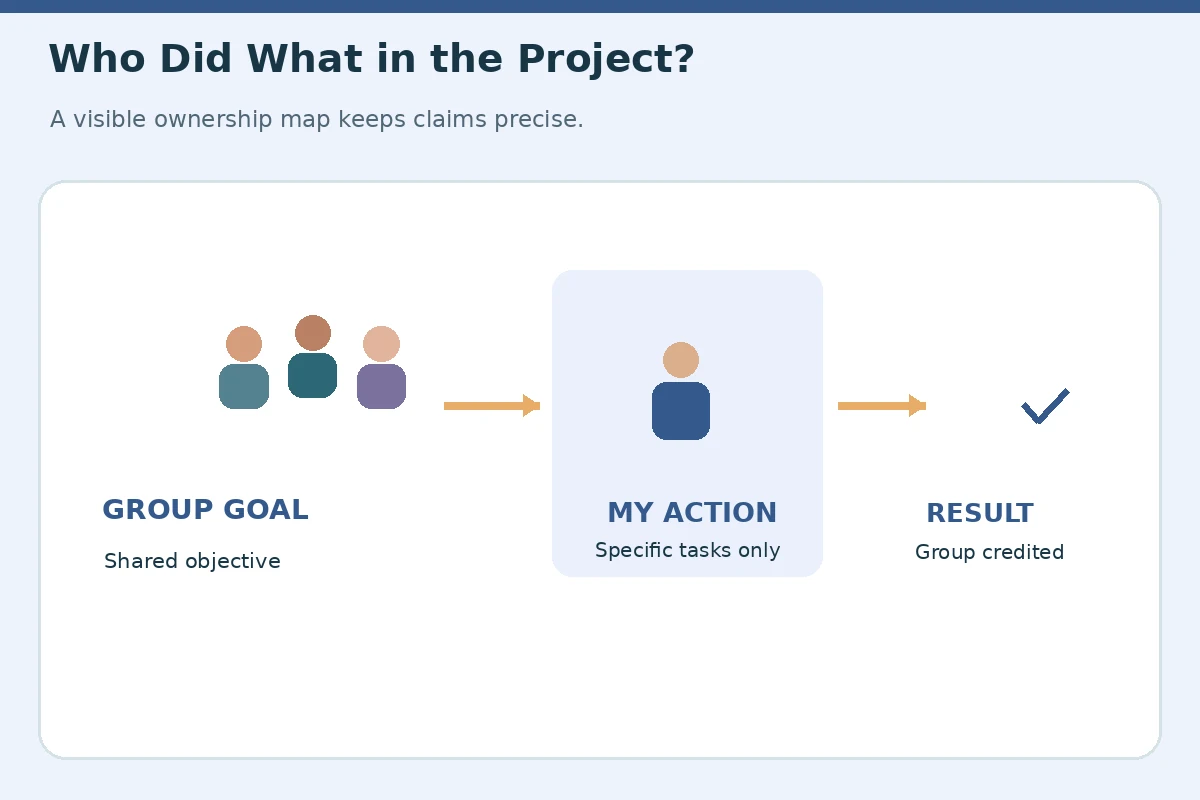
Use I and We Without Hiding Collaboration
There is no need to avoid “we” completely. “We finished the presentation” can accurately describe a group result. But your Action should make your part audible: “I prepared the accuracy note and explained which rows needed review.” Then credit the presenter, editor or supervisor where relevant. USC encourages explaining the exact role you had; a team is not a single person with a shared resume.
If leadership truly was your assignment, describe concrete leadership behaviors such as setting a review agenda or checking that contributors knew their deadlines. Do not infer “leadership” simply because you spoke at the final meeting. A small, reliable task can show attention to detail, communication and judgment. Inflating the title or claiming that teammates followed your direction can make follow-up questions difficult to answer accurately.
Report the Team Result With Attribution
In the fictional survey case, the shared Result might be that the group delivered its presentation with clearly marked limitations. Your personal output was the issue note that informed the summary. You can say both: “I supplied a checked response list; the group used it when completing the presentation.” Do not say you raised attendance, improved community policy or produced a validated research finding unless those events actually happened and you had evidence.
When the final outcome comes after you left a project, identify the stopping point of your knowledge. You may have delivered a test report to the engineer who deployed a fix; you should not claim to have deployed it. Crediting later colleagues does not weaken your story. It reveals how you understand handoffs, approval ownership and shared responsibility—valuable behaviors that may be central to the interviewer’s question.
Explain Disagreement Without Inventing a Hero Narrative
Team projects can involve disagreement about deadlines, roles or quality. Pick an event where you can show what you said, how you listened and what you changed. A hypothetical example is noticing two inconsistent survey definitions and bringing them to a group discussion, then following an agreed rule. Avoid portraying teammates as careless or claiming you resolved every conflict single-handedly.
If your suggestion was not adopted, state the decision and your subsequent action. “The group chose the original categories after discussion; I documented the limitation in our notes” can show professionalism. The Result is not necessarily your preferred outcome. Interviewers may ask what you would do differently; give a measured response grounded in the facts rather than rewriting the episode to make you appear flawless.
Prepare an Ownership Map for Follow-Up Questions
Draw six boxes before practicing: group goal, my assigned responsibility, my actions, other people’s actions, final approval owner and known result. This exercise exposes vague phrases. If you cannot identify who approved the deliverable, do not imply that you did. If two people worked on the same section, explain your portion honestly rather than presenting the whole section as your individual creation.
Practice follow-ups such as “What did you do when the group disagreed?” and “Which part did you complete personally?” Answer directly and briefly, with enough detail to support the story. Some details may be confidential, so use non-sensitive descriptions. Avoid showing unpublished slides, private datasets or internal documents without permission. A credible teamwork story makes both cooperation and accountability visible.

How We Research Interview Story Guidance
We reviewed the cited primary career-center and government sources on 2026-11-14: UW STAR career guide — University of Washington defines the four-part STAR framework and recommends putting the greatest emphasis on personal actions.; USC interview preparation — USC Career Center recommends preparing several real experiences and being ready for clarifying questions, including imperfect outcomes.; UC Berkeley CAR interview tips — UC Berkeley describes CAR as Context, Action and Results and recommends separating one’s own actions from team activity.; Harvard FAS interviewing — Harvard career guidance emphasizes concise specific experience, personal role, relevant results and learning, including examples outside paid work.. We also compared this narrow interview topic with the supplied WordPress post-title export and existing JobAsk STAR and behavioral-answer guides to reduce overlap. All candidate stories and suggested responses are fictional illustrations unless explicitly attributed to a cited source. The frameworks are coaching structures, not employer-wide scoring rules or hiring promises. Read our affiliate disclosure; no partnership or paid recommendation is claimed.
More Interview Preparation Guides
No. Use we for shared context and results, and I for the actions and decisions you personally made.
Describe it accurately, including why it mattered, instead of claiming a larger role you did not have.
Yes. State that it was coursework and distinguish it from employment or an employer project.
Report the deliverable or confirmed shared result and be clear about any downstream impact you did not track.
Usually roles are enough. Do not reveal confidential or identifying information that is unnecessary to your answer.