
If you stepped away from paid work to care for a child or another family member, keep your actual employment dates accurate. You generally do not need to invent an employer, convert household responsibilities into a paid job, or disclose personal medical or family details on your resume. CareerOneStop recognizes caring for children or relatives as a common reason for an employment gap and recommends truthful dates with an emphasis on relevant skills.
You have more than one reasonable presentation choice. You can leave the interval unexplained on the resume and address it briefly if asked. You can add a short “Family Caregiving Career Break” line if clarity would help. Or you can use a genuine volunteer, part-time, training, or personal project entry from that interval when it is relevant. None of these options requires creating an imaginary organization or employment record.
Keep two timelines separate in your draft
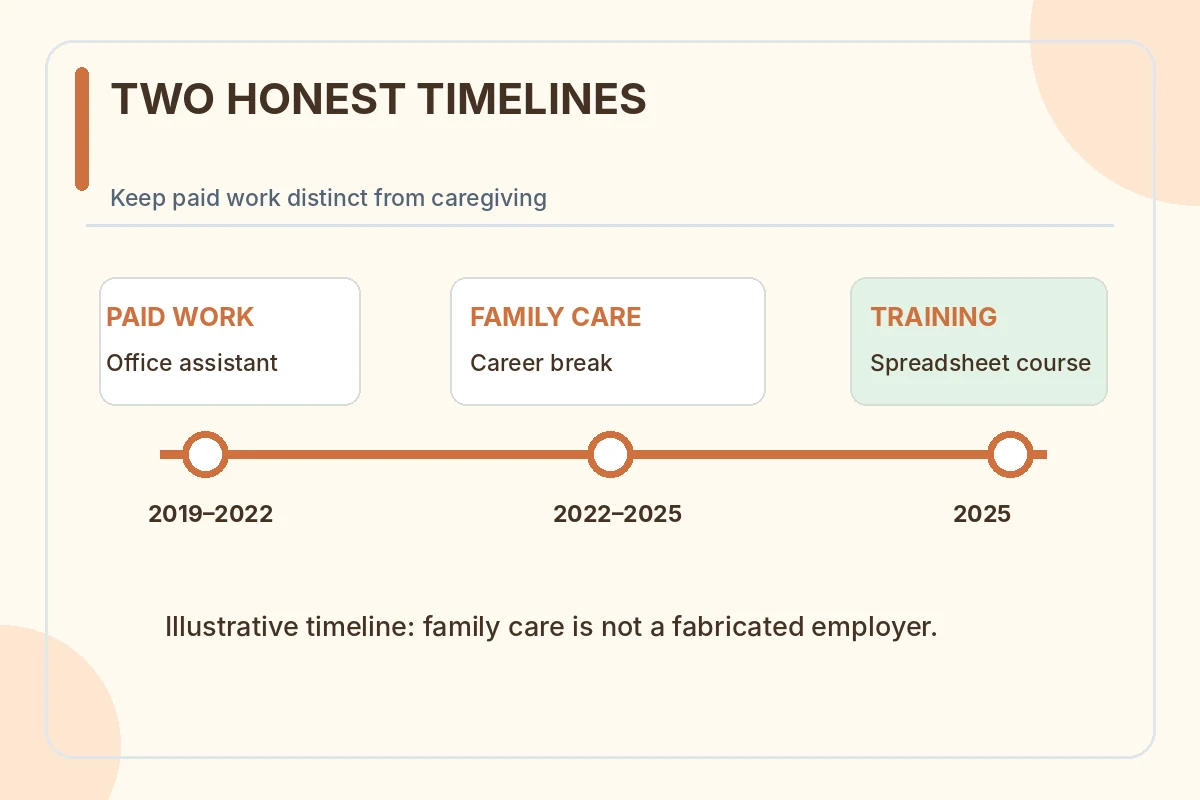
Draw one timeline for verified employment: each employer, title, start and end date, and actual work. On a second timeline, note any relevant learning, community contribution, authorized volunteer role, or personal project completed during the break. The two timelines can overlap in time, but they must not imply that unpaid family care was a formal job unless you truly had such employment.
For example, a hypothetical applicant worked as an office assistant until 2022, spent 2022–2025 providing family care, and completed an introductory spreadsheet course in 2025. The resume can list the actual office assistant position under Work Experience and the course under Training. It should not claim the person served as “Household Operations Director” for an invented company.
If you need to explain the gap directly, a one-line statement may be enough: “Career break for family caregiving; returned to professional development through [real course or activity].” You can leave out the reason entirely if it is not useful in the resume. The point is to make the record truthful, not to satisfy a fictitious universal requirement to account for every month.
Find transferable evidence you can actually describe
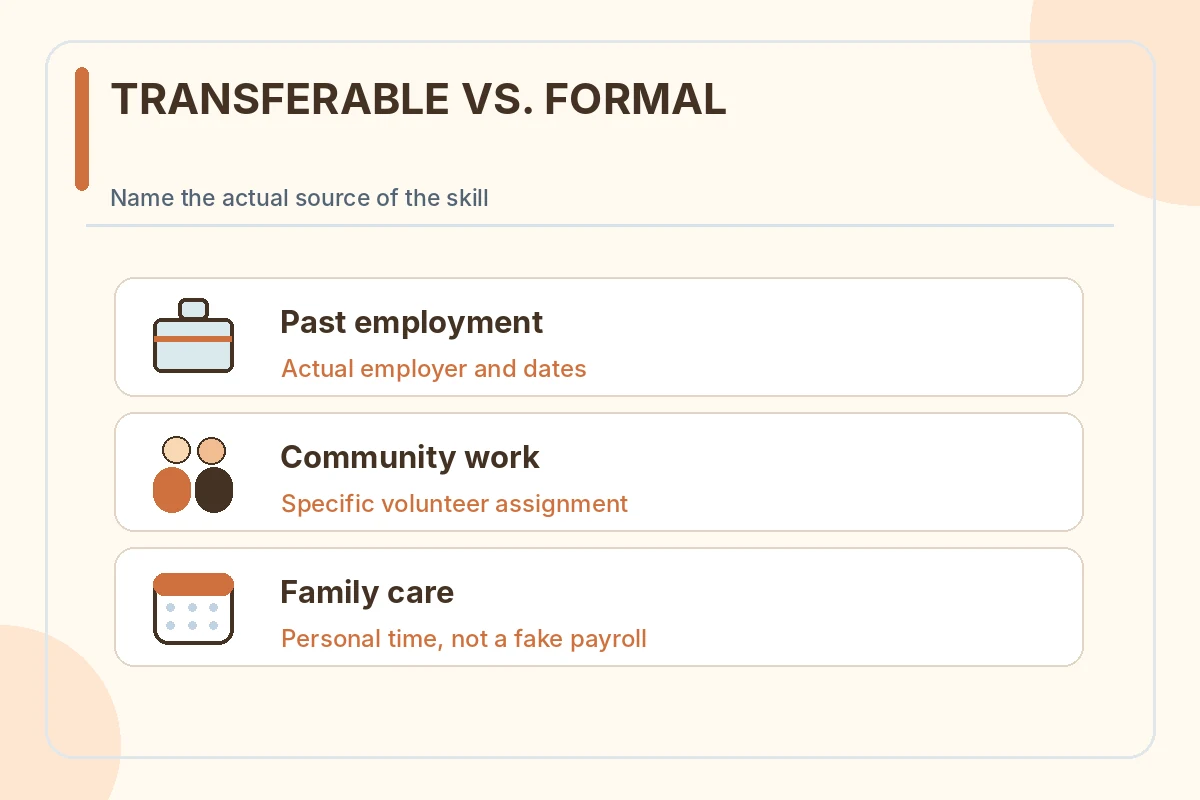
Think beyond job titles, but be precise. Did you organize a registered community event, reconcile funds as an authorized volunteer treasurer, or maintain schedules for an established group? Those may be credible examples if you can identify your role and responsibilities. Routine household budgeting or arranging family appointments may show personal practice, but it is not automatically professional financial management or formal scheduling experience.
Start by writing a factual inventory: task, setting, tools used, who relied on the work, and what was produced. Then compare those facts with the vacancy. For an administrative role, a volunteer sign-up spreadsheet maintained with permission may matter more than broad statements about “multitasking as a parent.” If no outside evidence exists yet, it is acceptable to emphasize your previous paid work and current training instead.
Avoid using children’s names, school details, medical information, or other family records as proof. You do not owe a recruiter access to private family information. Any portfolio sample should be public, fictionalized from scratch, or properly anonymized with permission.
Update older paid work without changing its dates
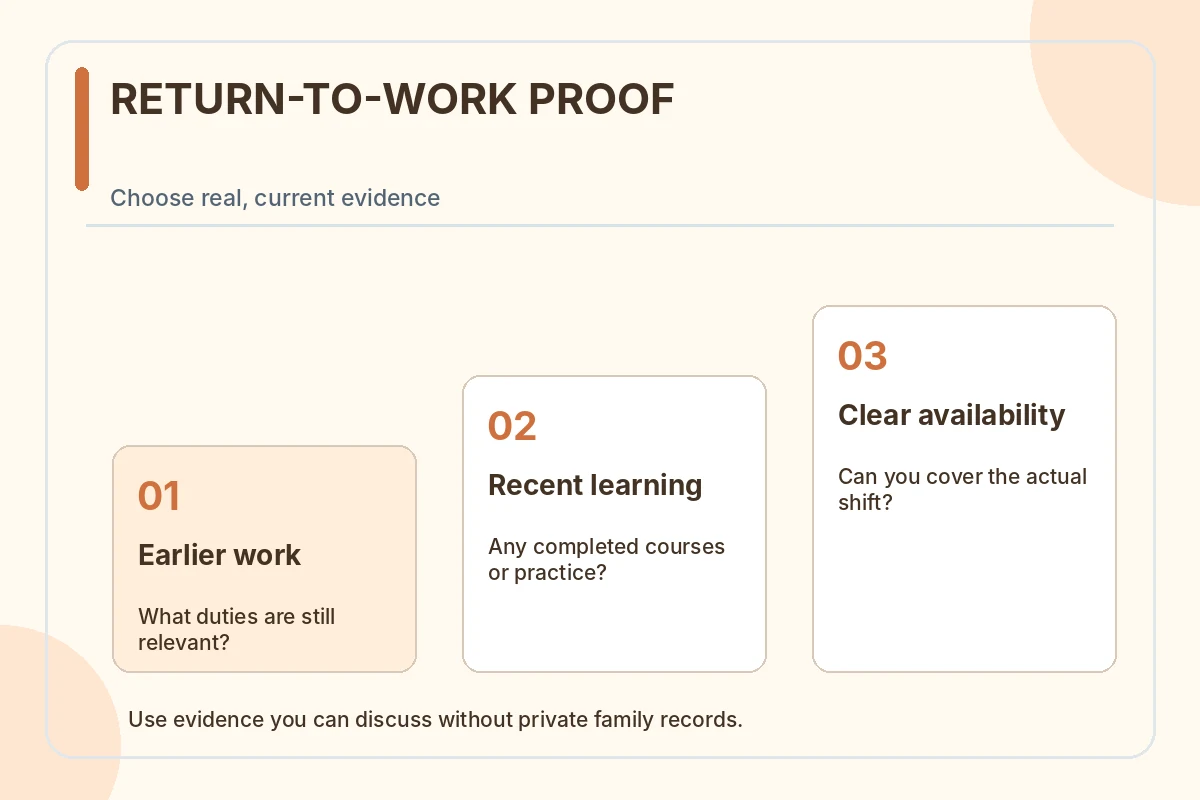
The best evidence may still come from before the break. Review your past responsibilities and identify what remains relevant to the target role: handled customer records, scheduled appointments, prepared documents, or reviewed invoices within the permissions you had. Rewrite vague duty phrases into specific actions, but do not introduce tools you never used or newer results that you cannot substantiate.
If you had several paid roles, prioritize those that demonstrate current job fit rather than devoting equal space to every historical task. Put actual dates in a consistent format. An old job does not become current merely because you maintain a related skill at home; present-tense claims should describe present activity, and past-tense claims should describe completed employment.
You can also list recent coursework or professional development near the top if it supports reentry. CareerOneStop notes that education and training can include relevant classes and continuing development. Treat a class as training, not as a professional license or an employer reference unless it genuinely is one.
Prepare a short gap explanation for interviews
A useful answer is factual, brief, and future-oriented. An illustrative version: “I took time away from paid employment for family caregiving. During that period I refreshed my spreadsheet skills through a course, and I am now looking for an administrative role where I can use my scheduling and records experience.” Tailor it to what you actually did. Do not say you completed training, gained a credential, or maintained a professional client base if that did not happen.
You may prefer not to explain personal circumstances in detail. Keep boundaries around family members and health information, and redirect to your readiness and job evidence. The interviewer needs to evaluate your fit for the role, not receive a family history. There is no need to apologize for the break or invent a dramatic narrative about it.
If your work availability has changed, verify the shifts or schedule you can genuinely cover before you apply. A claim of 24/7 flexibility is not helpful when the role has fixed hours and you cannot meet them. Discuss workable availability where required, without disclosing unnecessary private details.
Use a truthful reentry review checklist
Before sending the resume, ask whether every paid role really was paid employment, every training credential was awarded, and every volunteer responsibility was assigned to you. Remove senior-sounding household job titles that do not correspond to a real organization. Check that any course dates, public samples, and contact links are correct.
Then ask whether the opening half of the resume gives a hiring manager a reason to keep reading. A recent project, a relevant earlier job, or honest technical skills may be stronger than a long personal explanation. A caregiving interval is one fact about the timeline; it need not become the sole theme of the application. Put the evidence of your ability to do the target job where it can be found quickly.
How We Research and Verify This Guidance
This guide is based on documented career-service guidance and the actual limitations of the example scenarios, not promises about hiring outcomes. We checked the linked primary or specialist sources on November 2, 2026, and distinguish general resume recommendations from decisions that depend on a specific employer. We do not have confirmed affiliate relationships for these articles. Read our affiliate disclosure for the site policy.
CareerOneStop source reference: CareerOneStop advice on employment gaps, including family caregiving. The linked material informs the stated advice; it does not certify an individual applicant or guarantee employer acceptance.
CareerOneStop source reference: CareerOneStop advice on honest work history, responsibilities and accomplishments. The linked material informs the stated advice; it does not certify an individual applicant or guarantee employer acceptance.
CareerOneStop source reference: CareerOneStop guidance about completed credentials, current education and project evidence. The linked material informs the stated advice; it does not certify an individual applicant or guarantee employer acceptance.
FTC source reference: FTC warning about sensitive personal information in fake job recruitment. The linked material informs the stated advice; it does not certify an individual applicant or guarantee employer acceptance.
More Resume and Cover Letter Guides
Not as paid employment unless it truly describes paid work. You may identify a family-care career break if useful, or leave it off and explain the gap briefly later.
No. CareerOneStop notes that a gap does not necessarily require explanation on the resume. Emphasize truthful job dates and qualifications relevant to the new role.
It can be discussed as personal or transferable practice, but do not imply formal employment, credentials, or outside clients. Verified volunteer work and training may be easier to substantiate.
Use your true prior employment and any current skills you can demonstrate. You do not need to invent activities to fill a date range; consider building one relevant project if it would help.
As little as needed to explain your work timeline and availability. Avoid sharing children’s identifying details, medical information, or private records as resume evidence.