
An accounting background can be useful in technology because it often involves reconciliations, audit trails, controls, and communication about exceptions. But “IT” is too broad to plan around. User support, application support, data reporting, information systems controls, and software development require different evidence. The first decision is what kind of problem you want to solve. Do you enjoy helping a person use software, tracing why records disagree, or documenting whether a system change was approved?
List three actual vacancies from each plausible route and compare daily work rather than salaries or job titles alone. BLS describes computer support specialists as helping users or maintaining systems, with entry requirements that vary by employer and technical level. The same fact that makes some user-support jobs accessible does not make network engineering or security administration entry level. Keep the scope of each role separate.
Map accounting strengths to target activities carefully
Reconciliation can transfer to checking data consistency, and documentation can support issue records or test evidence. A monthly close checklist is not the same as troubleshooting a failed network connection, however. Write two columns: accounting actions you have actually performed and IT actions a posting requests. Mark each proposed transfer as direct, adjacent, or new. If you have used a particular accounting platform, describe your user-level experience rather than claiming to have configured its infrastructure.
A hypothetical accounts-payable specialist might have investigated duplicate invoice entries, documented root causes with a supervisor, and communicated corrections to approved staff. Those actions can help explain careful issue triage. They do not prove database administration, penetration testing, or production access rights. Your objective is to make the boundary explicit so a hiring manager knows what training you will need.

Compare user support, reporting, and technology controls
User support focuses on describing and narrowing a problem, reproducing symptoms, documenting attempted steps, protecting credentials, and escalating when access exceeds authority. Reporting or data operations may emphasize queries, source definitions, validation, and clear explanations of exceptions. IT controls support may involve documenting who approved changes, reviewing access evidence, and tracking exceptions under a defined procedure. “IT auditor” may involve additional qualifications and accounting or audit experience rather than being a simple first support role.
Read role descriptions for the tools and permissions expected. If the job asks you to reset employee accounts, request credentials, or work with financial records, do not practice on real employer systems without authorization. Skills that transfer across these paths include attention to records and controlled handoffs; the technical workflow still has to be learned and independently demonstrated.
Make one small practice artifact for the chosen route
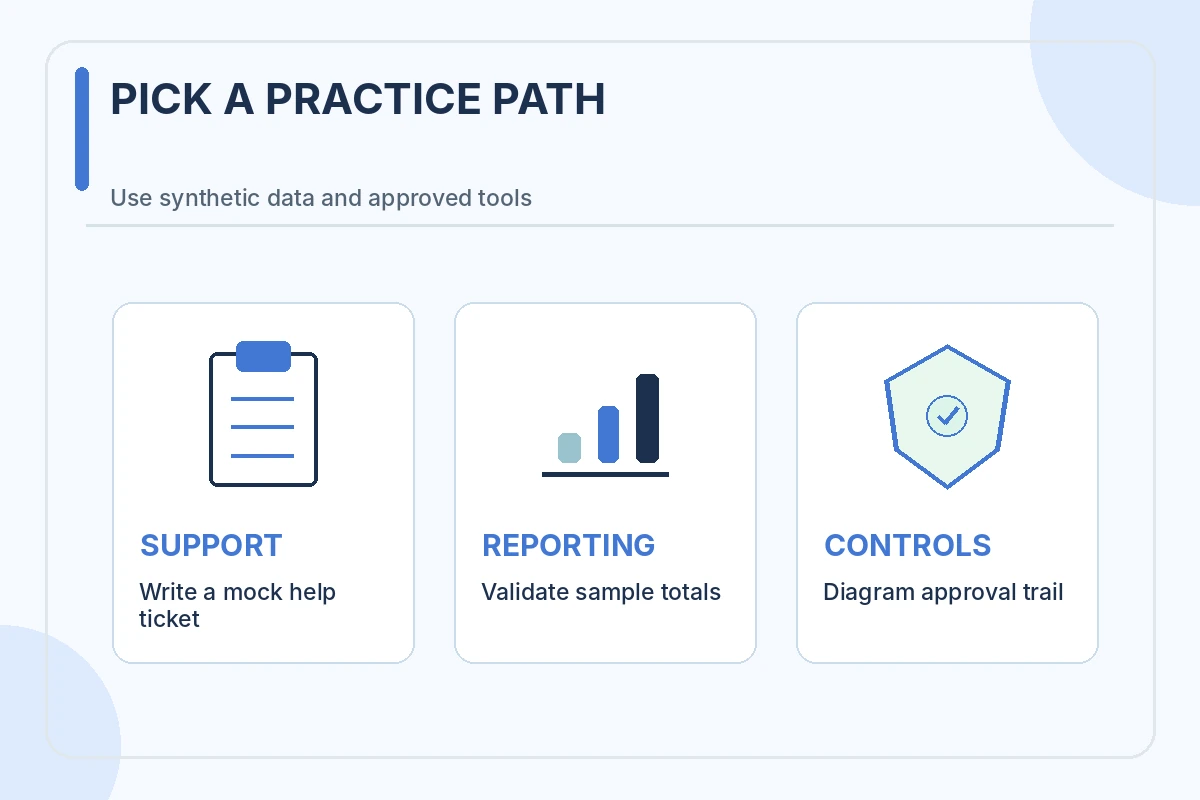
For support, draft a hypothetical ticket with issue description, reproduction steps, basic checks, and an escalation point. For data, create a synthetic invoice dataset and show how you identify duplicated records, explain null values, and verify totals; never include actual customer invoices. For controls, draw a mock approval trail identifying requester, approver, timestamp, and exception review. These exercises prove different things, so resist combining them into one vague “technology portfolio.”
Label the sample as self-directed practice, note what you learned, and describe what remains untested. If a SQL project ran only on local sample data, do not say it deployed in production. If you documented an access-control process, do not claim you held administrator privileges. A short, reproducible artifact with a clear limitation is better than a complicated screenshot copied from a tutorial.

Choose training from posted requirements, not advertisements
The BLS notes that some computer user-support jobs can be entered with relevant coursework, experience, or certifications, while more technical roles may expect additional education. That is occupational guidance, not an employer promise. Count which credentials recur across genuine postings for your preferred path and which are only optional. Contact a program to ask about hands-on assignments, assessment, total price, and refund policy before paying.
A person with an accounting degree may already meet a broad education requirement for some roles but still lack troubleshooting experience. Another person may have strong technical practice without the specific credential an employer requires. Do not use generic advice about “breaking into tech in weeks” as a substitute for comparing individual vacancy requirements and testing whether you enjoy the actual work.
Show evidence without renaming accounting experience
Keep the real accounting title and dates on your resume. Under it, highlight relevant work: checking exceptions, documenting control steps, coordinating with software support, or improving an approved reporting process. If you built a separate practice project, place it under Projects with the actual tools and dataset type. Example: “Built a local sample invoice-check workflow and documented duplicate-record tests.” That sentence must be adjusted to match the work you truly did.
In an interview, explain your route: “I am transitioning from transaction reconciliation toward application support because I enjoy investigating how systems and records disagree.” Then give a real accounting example and one technical sample. Avoid claiming that financial reporting automatically qualifies you to design a production database. Clear evidence helps the employer judge your starting point and the support you will require.
Run a low-risk test of the transition
Before leaving your current job, speak with an internal application support analyst or a professional in the chosen field if access is appropriate. Ask what tasks new hires handle first, what permissions are restricted, and which errors require escalation. Try a structured, authorized learning project and compare how much time you spend debugging rather than just reading about tools. If you dislike repeated troubleshooting, another pathway may fit better.
Build a small tracking sheet with target role, required skills, sample completed, training cost, and posting source. Review job ads for geographic restrictions and schedules. Protect confidential financial data at every stage. A strong transition preserves your accounting credentials and reputation while gathering enough evidence to justify the change rather than betting on a single certificate.
How We Research and Verify This Guide
This article uses occupational guidance and work-role descriptions from primary public sources, checked on November 2, 2026. Examples are hypothetical and illustrate how to assess responsibilities; they do not predict hiring results, eligibility, salary or legal rights. Check a specific employer and applicable licensing body before acting. The site policy is described in our affiliate disclosure. We do not claim a verified affiliate relationship in this guide.
BLS source: BLS accounting work, financial controls, records, and risk analysis. Consult the official source and the individual job posting for any role-specific requirement.
BLS source: BLS technical support tasks and varied educational entry requirements. Consult the official source and the individual job posting for any role-specific requirement.
CareerOneStop source: CareerOneStop Skills Matcher for comparing existing skills with occupations. Consult the official source and the individual job posting for any role-specific requirement.
CareerOneStop source: CareerOneStop career-change path: assessments, informational interviews, and targeted resumes. Consult the official source and the individual job posting for any role-specific requirement.
Explore Related Career Guides
Not every IT role requires programming. User support, systems support, and data reporting differ, so check the target role before choosing a coding course.
It can show general professional preparation, but support roles still require relevant technical knowledge and some employers specify credentials or experience.
No, not without explicit permission and appropriate removal of restricted information. Synthetic data are safer for demonstrating queries or reconciliation logic.
Requirements vary. IT audit work may expect controls knowledge, technical familiarity, and experience; evaluate real openings rather than assuming a direct switch.
Choose one aligned with the target: a support ticket, a validated sample-data report, or an authorization-trail example. State what was simulated.