
Student resume achievements can come from class projects, campus activities, research exercises and documented awards—not only paid jobs. Put the experience in the right section, state what you personally produced, and use the official title for any award. For example, “Compared survey responses for a course research project and presented a written summary to the class” can be a truthful project bullet if you did those activities.
A campus award is not the same thing as a project accomplishment, and a group grade is not an individual achievement. Boston College, UCLA and University of Minnesota Duluth career guides describe ways to present coursework, projects and honors. The examples below help separate those evidence types before you decide which ones best support a particular internship or entry-level application.
Choose the Right Evidence Source Before Writing a Bullet
Begin by listing four kinds of material: coursework, projects, responsibilities and formal honors. Coursework can show subject exposure; a project can demonstrate what you produced; a student club role can demonstrate tasks you completed; an award shows documented recognition under its official title. Do not blend them into one inflated statement such as “Won leadership award for managing major client accounts” if you simply earned credit for a simulated case study.
For each item, save your class or organization, date, your specific role and an artifact you are allowed to discuss. If the work was hypothetical, retain that label. A resume might include “Course Project” and name the course rather than present it as a job at a real business. This makes the achievement credible even if no employer has paid you yet.
Write Project Bullets Around Your Own Deliverables
Useful project bullets name an action, method and tangible output. A hypothetical example is, “Cleaned a class survey spreadsheet, documented missing values and drafted a comparison chart for the team presentation.” This describes a reproducible task. The same project may have included a public presentation, but do not claim that you led the presentation if another student delivered it.
University of Minnesota Duluth recommends giving projects a title, course and dates with bullet statements describing the work. If you used a coding notebook, created a poster or conducted an interview under an instructor’s supervision, describe what happened accurately. An assignment grade, by itself, does not establish that a solution performed in a real client environment.
| Evidence source | Safe placement | What to verify |
|---|---|---|
| Coursework | Education | Official course taken |
| Team project | Projects | Your own deliverable |
| Campus role | Leadership or Activities | Tasks and dates |
| Academic honor | Education or Awards | Official name and term |

Separate Team Results From Your Individual Work
Group projects can be valuable because teamwork matters, but group ownership can be misrepresented easily. A sentence such as “Developed the complete project website” is misleading if you wrote the FAQ page while teammates built other sections. Use, “Wrote and tested the FAQ page for a team website prototype, then incorporated peer review notes,” if that matches your contribution.
When explaining the result, distinguish “our team delivered a prototype” from “I built the whole platform.” A completed presentation or shared report can be named as team output, while your role is specified separately. Avoid claiming funding, outside adoption or client approval for classroom models that were never deployed. A precise contribution lets a reviewer ask meaningful follow-up questions.
List Honors Using the Official Award and Dates
Honors should be supported by the institution or sponsoring organization. If you received Dean’s List recognition, use the school’s official designation and the correct term; do not relabel a high course grade as an institution-wide award. Boston College and UCLA both identify academic honors as possible resume entries, but their mere mention is not proof that a particular student received one.
An award may fit beneath Education or in an Honors section depending on how many relevant awards you have. For scholarships, use the official name and date rather than inventing how many people applied or implying a competitive selection criterion you cannot substantiate. If an award is pending or nominated rather than received, label the status clearly instead of treating it as final.

Turn Course Skills Into Evidence Without Overclaiming
Listing “Data analytics” or “Project management” as a skill may be too broad if your experience consists of a short class assignment. Instead say exactly what you used: organized survey responses, prepared a basic schedule or compared sample data. A hypothetical bullet is, “Mapped milestone dates for a simulated event-planning assignment and noted conflicts for instructor review.” It does not claim professional event management.
Coursework helps most when the role seeks exposure to a method you can explain. Relevant course names may be listed directly; a project with a meaningful deliverable can have its own bullets. Avoid piling every course and certificate onto the page. Select the evidence that matches the advertised internship or entry-level position, then describe the learning context honestly.
Choose Where Achievements Belong on a Student Resume
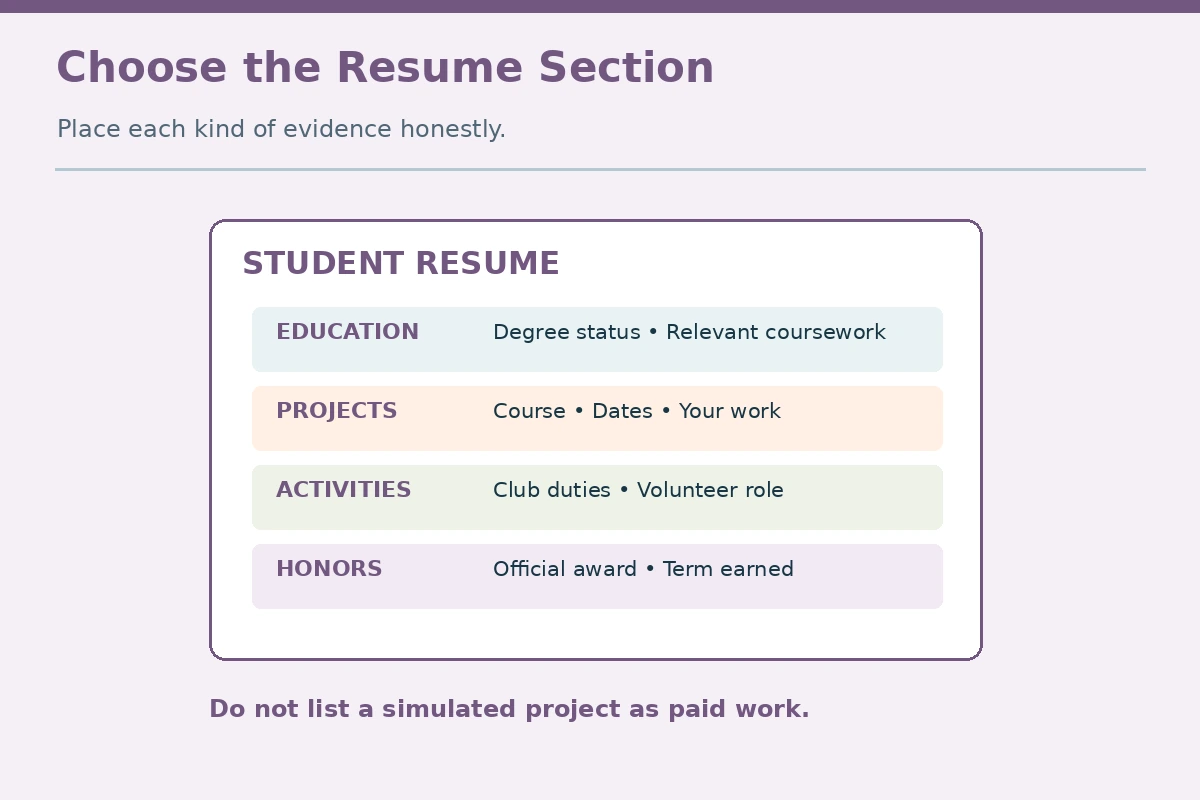
Place an earned degree or in-progress program beneath Education with the accurate expected date when known. Coursework can sit within Education; substantial projects may deserve a separate Projects section; club responsibilities can go under Activities or Leadership; formal honors can be grouped with Education or Awards. The career-center materials describe these options, but no single layout fits every student.
If you have paid or volunteer work closely related to the target position, do not bury it merely because it occurred during school. Conversely, do not rename a class project as an internship. Dates and labels should let the reader see whether the evidence came from work, training, coursework or independent activity. That context is part of honest resume writing, not an apology for being a student.
Audit Three Achievement Bullets Before Exporting
Choose one project outcome you personally produced, one demonstrated team responsibility and one relevant honor or course activity if you have them. Remove passive claims such as “Highly motivated scholar” unless they are supported by action. A credible project bullet may include the tool, the document created and the audience it was presented to, without needing a fabricated grade or impressive numerical impact.
Read the final statements aloud: could you show a permitted artifact, identify your own contribution and distinguish completed work from an in-progress plan? Check whether the official award name and date are correct. Finally, make sure links to projects do not expose classmate data, school accounts or unpublished research. Your resume is a short map to discuss evidence, not an unrestricted archive of course files.
How We Research Resume Achievement Examples
Checked on 2026-11-14: Boston College: Resume Sections — Boston College Career Center discusses when students can feature coursework, projects and honors.; UMD: Write a Resume — University of Minnesota Duluth explains dated project entries, responsibilities, and evidence-based project bullets.; UCLA Career Center: Resume Guide — UCLA Career Center advises accurately naming projects, honors, leadership and participation.; Miami University: Accomplishment Statements — Miami University Career Center describes accomplishment statements built from an action verb, task context and supportable contribution.. We compared the intent with the supplied WordPress title exports and the previous JobAsk draft topics, and reviewed public search results for the specific subject. Every example bullet and illustrated worksheet in this article is hypothetical; adapt only confirmed tasks, dates and results. These are writing guidelines, not guaranteed applicant-tracking outcomes or proof that an employer will hire a candidate. We do not imply an affiliate or recruitment relationship with any cited institution. See the JobAsk affiliate disclosure.
More Resume and Cover Letter Guides
Yes. Label them as coursework or projects and identify your contribution, dates, methods and results truthfully.
You can describe your individual tasks and the shared deliverable, but do not claim teammates’ work as your own.
It can appear under Education or Honors if officially awarded; use the institution’s exact name and term.
Prioritize a few relevant courses and projects that help explain your ability to perform the target role.
A grade can be shown when relevant and accurate, but do not present it as a real employer or customer outcome.