
If a staffing agency paid you while you worked at different client sites, a resume can usually show the staffing agency as the employer and identify relevant assignments underneath. If you were hired directly by each company, list those employers instead. Preserve true dates, titles, breaks and duties. The central problem is not that work was temporary; it is avoiding confusion between the company that employed you, the site where you worked, and the person who supervised a task. This guide gives two usable layouts.
Separate the payroll employer from the assignment site
Before writing anything, inspect your contract, pay stub and assignment confirmation. A staffing agency may be the employer of record while a host company directs daily tasks. OSHA describes temporary workers as employees supplied by staffing agencies to host employers and notes that both entities have workplace safety responsibilities. That arrangement does not automatically make the host company your payroll employer. Use precise language so a hiring manager can understand the relationship.
An illustrative line might read “Administrative Support Associate — Northfield Staffing (assignment at a regional warehouse), April–June 2025.” Both organization names in this sentence are fictional. If the client must remain confidential, use the industry or type of worksite instead of the real name. Do not invent a long-term employee title at the client or write “permanent employee” to avoid explaining a temporary assignment. Accurate labeling is more useful than disguising the arrangement.
Choose between a grouped agency entry and separate placements
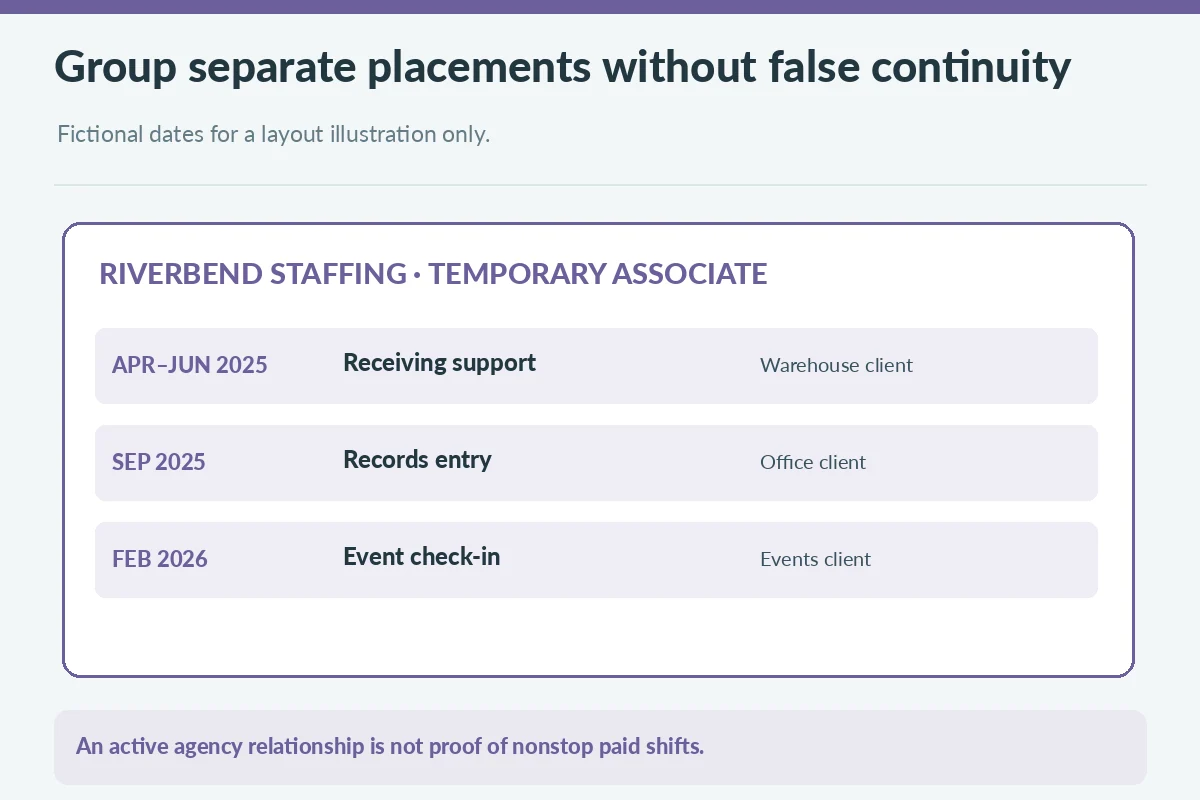
For several similar placements through one agency, group them under that agency and use indented assignment lines for dates, location and duties. This is useful when ten short placements would fragment an otherwise clear work history. For a substantial assignment with distinct responsibilities, a separate entry may be easier to read. The critical check is whether the format still makes the agency relationship visible and preserves the real timeframe.
If the agency supplied work in distinct years with a long break, show the actual periods or a note such as “assignments during 2024 and 2026.” Do not write “2024–Present” if you have not accepted assignments during the interval and the wording would falsely suggest continuous paid employment. Follow the employment dates requested on a formal application, which may need each placement separately even when a concise resume groups them.
Build a mini log of assignments and transferable tasks
Make a private table with agency, client type, job title, first and last day, supervisor contact where permitted, tools used and actual duties. Separate clerical data entry, inventory counts, quality checks and customer contact instead of claiming generic operational leadership. An accurate entry might say “Recorded inbound package exceptions in a host-approved system and routed discrepancies to a shift lead,” if that work was performed.
Keep personal customer data, invoice details and proprietary system screenshots out of the resume. A fictional process diagram can demonstrate your ability to explain an exception workflow, but it is not proof that an employer delegated approval authority. Ask what is safe to describe when a client had nondisclosure rules. The most transferable evidence is often accurate records, fast onboarding and dependable handoffs rather than an invented productivity percentage.

Describe short placements without overstating their duration
A two-day assignment can still be relevant when it demonstrates event registration, stock counting or a tool you used correctly. It should not be described as “managed year-round operations.” If the work was a one-time project, label it as such, especially when the employer would verify only limited hours. On resumes that require brief bullets, compress related assignments but avoid hiding unusually important breaks or distinct clients.
Use month-and-year dates consistently in your resume, with more exact information ready for applications and checks. A heading such as “Temporary Assignments — Various Client Sites” works only if the employer relationship is spelled out nearby. If you were converted to a direct employee by the host, create a second employer entry showing the genuine change in status, rather than extending the agency date into the later direct-hire period.
Write task-to-evidence bullets for each meaningful placement
Start with the task, then the record or service you handled, then the handoff or result that you can explain. “Updated order exception logs and notified the designated coordinator of mismatches” has identifiable scope. “Optimized company operations” does not establish what you did. Where numbers are accurate and safe to share, a supported count or shift volume can add context, but do not fabricate cost savings or a completion-rate improvement.
Match bullets to the next role. A records coordinator application might lead with accurate data entry, document routing and follow-up. A logistics role might lead with receiving checks, safe material movement within training, and exception reporting. Do not infer equipment certifications, forklift authorization, hiring authority or accounting sign-off from having assisted at a client site. Those rights depend on actual training and assignment scope.
Address training and workplace safety realistically
OSHA explains that staffing agencies and host employers share responsibilities for protecting temporary workers. Training and hazard control may involve both parties, and workers should receive protection appropriate to the assigned job. On a resume, list training only when you completed it and keep employer-specific site orientations distinct from broadly recognized qualifications. Do not describe a brief equipment demonstration as a professional license.
If an assignment required you to identify and report a hazard, you may describe following an approved reporting process; do not claim you engineered or certified safety controls. Similarly, a supervisor may have authorized access to tools or systems at one worksite but not another. Strong bullets specify the environment and the limits of your task. This keeps the skills section consistent with what references are likely to confirm.
Prepare a simple explanation for interview questions
When asked why you held multiple short jobs, explain the staffing arrangement without apologizing or inventing a permanent promotion. For example: “I accepted short placements through one agency, mainly in inventory and administrative support, and each placement had a defined end date.” Then explain a relevant skill or a verified contribution. Do not disclose a confidential client name just to sound impressive.
If you joined one host directly afterward, explain the transition with the separate dates. If you left an assignment early, keep the factual description concise; do not publicly blame a company or promise references you cannot provide. A clean paper trail—contracts, dates, and a neutral description of each placement—makes the unusual-looking schedule easier to interpret.

Audit both the resume and the online application
A resume is a short marketing document, while an application may request every employer, assignment, start date, supervisor and reason for leaving. Do not copy a grouped resume heading into a form that asks for individual placements if that would omit required information. Use the agency payroll information where the form asks who actually employed you, and use the host site where the form specifically requests work location.
Read the document in PDF form to verify that the indentation clearly connects agency and assignments. Recheck titles for inflation: “project lead” should not replace “temporary records clerk” unless it was truly your role. Keep actual confidential details out of public materials and answer reference questions through the agency’s permitted verification channel. A transparent work history can demonstrate adaptability without claiming continuity or authority you never had.
| Experience type | What to show | What not to imply |
|---|---|---|
| Agency payroll + multiple sites | Group under agency with site lines | Do not call host the payroll employer |
| Direct hire after placement | Add separate host-employer entry | Do not merge employment statuses |
| Client confidentiality | Describe industry and tasks | Do not reveal protected client information |
How We Research Resume Work Experience
We compared the supplied JobAsk WordPress post inventory and recent draft packages with the role-specific duties in primary public sources. We reviewed source guidance on 2026-11-05, while job duties, state requirements, organizational roles, and school policies can vary. All named workplace examples, invented labels, practice records and sample bullets here are illustrative, not actual candidate outcomes. We do not claim a particular resume format guarantees an ATS or job result. Read the JobAsk affiliate disclosure for information on commercial relationships.
Primary sources checked on 2026-11-05: CareerOneStop / U.S. Department of Labor — CareerOneStop advises including employers, job titles, duties and dates.; OSHA — OSHA describes the staffing-agency and host-employer relationship and shared safety responsibilities.; OSHA — OSHA explains communication and training coordination among staffing agencies and host employers.. Sources describe general professional practices or specific institutions; verify the actual employer and its policies before applying.
More Resume and Cover Letter Guides
List the actual employer relationship accurately. For agency-paid placements, the agency can be the heading and the client site described as an assignment.
Yes, when the agency relationship and individual assignments remain understandable and their dates are not misleading.
Use a permitted neutral description such as “regional distribution client” and focus on non-confidential duties.
Not necessarily. Make the nature and dates of intermittent paid assignments clear instead of suggesting full-time work during inactive periods.
Record the direct employer and actual start date as a new employment relationship, with the agency placement shown separately or beneath it as context.