
For an in-person job interview, a practical default is to check in about 10–15 minutes before the scheduled start, unless the invitation gives another time. Arrive in the surrounding area earlier if travel, parking or visitor security is unpredictable, but do not force a receptionist to host you far ahead of your appointment. Treat the time in the employer’s message as the controlling instruction. If a real delay makes punctuality unlikely, notify the recruiting contact promptly with a factual update instead of arriving silently and hoping nobody noticed.
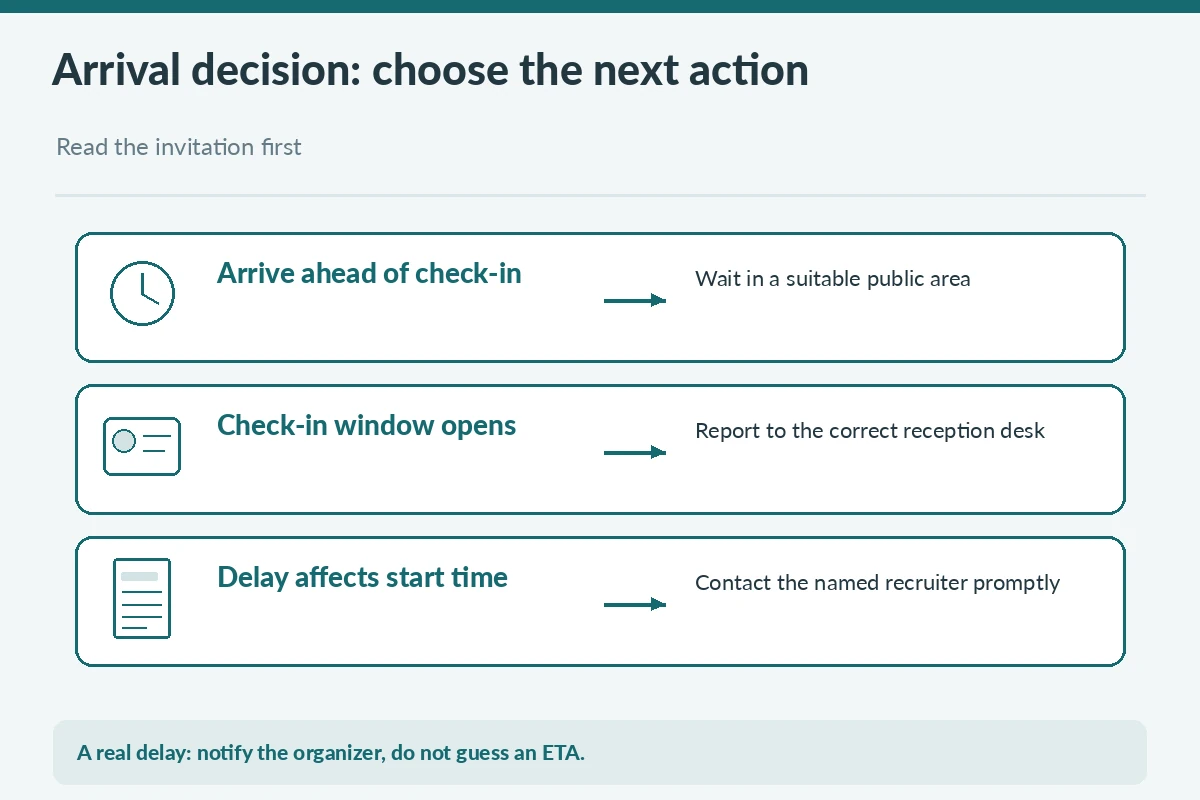
Separate arriving nearby from checking in at reception
A 9:00 a.m. interview can involve three different clocks: when your train or car reaches the area, when the building lets visitors inside, and when the interviewer expects the conversation to begin. Plan each separately. CareerOneStop and Harvard career guidance use roughly 10–15 minutes early as an in-person arrival target, not a guarantee that every lobby opens on that schedule. A large campus with a visitor gate may ask you to report to security at a different time than the hiring manager’s calendar invitation.
Choose a nearby public waiting place or approved visitor area if you are much earlier than requested. Use that buffer to silence your phone, check the interviewer’s name and review one or two examples. Do not pace outside an employee-only door or repeatedly interrupt reception to ask whether the manager is ready. A professional arrival means you respect both your appointment and the team’s current work.
Read the invitation for access instructions before traveling
Find the exact street address, building name, floor, suite, parking location and sign-in instruction. A company may operate several buildings or use a lobby with restricted elevator access. Verify whether you need a government-issued photo ID for security; do not send a copy of your ID to an unverified contact in advance. If the invitation lists a phone number for visitor assistance, save it separately from your email in case the building has weak reception.
If you need an accessible entrance or other interview accommodation, contact the hiring team in advance with the practical request. The EEOC describes reasonable accommodation during hiring; there is no need to convert an ordinary access question into a public account of your medical history. When the organizer supplies a special arrival time for a test, facility tour or escort, follow that instruction instead of applying a generic fifteen-minute rule.
Build a time budget for transport and check-in
Work backward from the scheduled start: interview-room start, security screening, visitor badge, entrance walk, parking and a possible transport disruption. A bus arrival at 8:48 does not create an adequate buffer if the building is a ten-minute walk away and the elevator queue takes five more minutes. For unfamiliar locations, check a map and a backup route ahead of time; let an unexpected detour use your private buffer rather than your interviewer’s time.
A workable hypothetical plan for a 10:00 interview might be to reach a nearby café at 9:20, approach the correct building at 9:40, and check in at 9:45–9:50 if security allows it. These times illustrate planning, not a universal rule. If the employer requires a 9:30 security briefing, its specific instruction replaces this example. Keep important travel details accessible without an internet connection.

Handle being excessively early without creating pressure
An unusually early arrival can feel awkward for the receptionist and the interviewer. If you are forty minutes ahead, do not insist on being taken upstairs or ask whether the meeting can be moved forward. Reception staff may be managing other visitors, safety checks or confidential conversations. Use a public waiting space instead of treating the employer’s lobby as a personal preparation room.
When you reach the desk at the approved time, say your name, the person you are meeting, and the scheduled appointment. You can give a brief, calm greeting such as, ‘Good morning, I’m here for the 10:00 interview with the operations team.’ You do not need a rehearsed monologue or a sales pitch. Follow instructions about badges, elevators, phones and visitor seating.
Notify the right person if you will be late
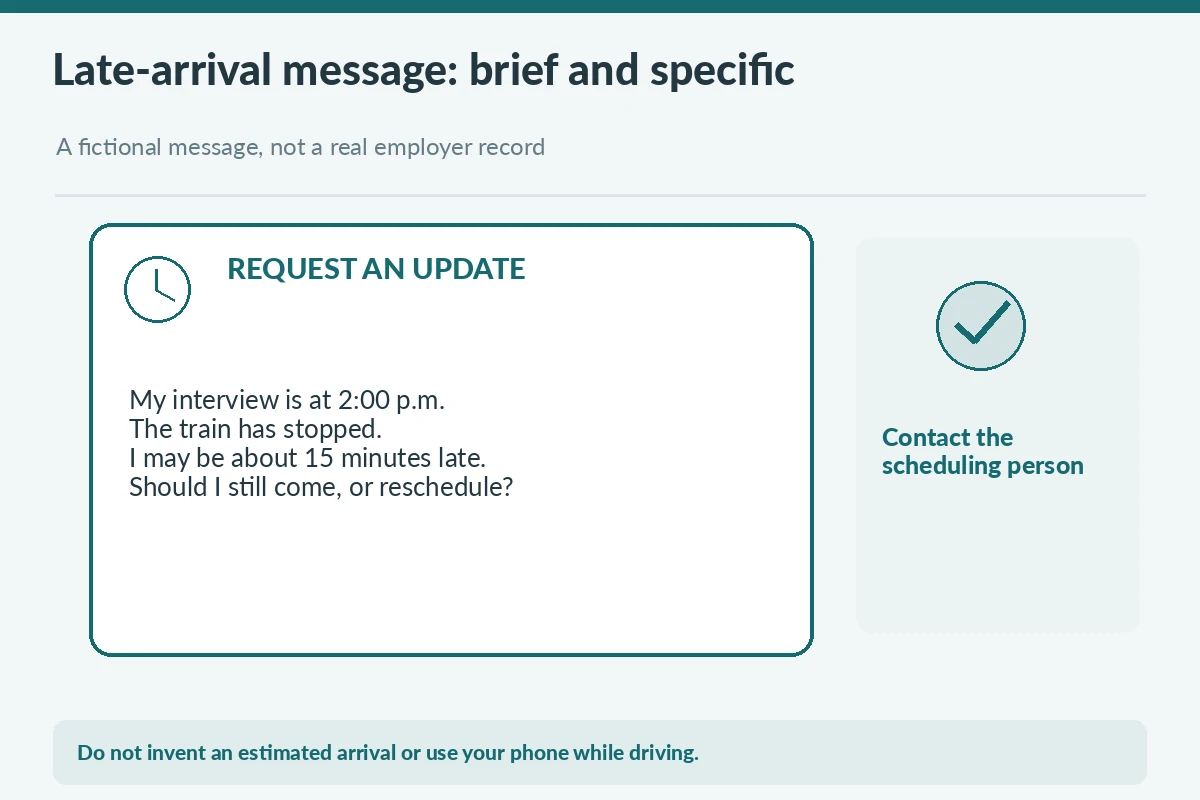
If a train has stopped or you cannot find the authorized entrance, contact the scheduling recruiter or the person named in the invitation as soon as you can safely do so. State that you are delayed, offer a realistic update if you have one, and ask whether they prefer that you still come or reschedule. Avoid dramatic excuses, false traffic details or repeated messages to several employees. Do not use your phone while driving or cross unsafe areas to rescue the appointment.
Illustrative message: ‘Hello, this is Jordan Lee. My 2:00 p.m. interview is scheduled with your hiring team. The train line has stopped, and I may be about 15 minutes late. I apologize for the disruption. Would you prefer I still come in, or should we reschedule?’ If you cannot estimate the delay, say that rather than promising a time you cannot meet. Confirm any new time in writing.
Respond appropriately when reception or the interviewer is delayed
Sometimes the interviewer is running behind even when you arrive on time. Remain courteous to reception, but do not assume the absence means you have been rejected or that you should leave immediately. After a reasonable interval, ask the designated contact whether the meeting is still proceeding. If you have a nonmovable obligation, state the latest time you can remain and offer to reschedule; this is more useful than silently waiting indefinitely.
Do not photograph visitor logs, open doors marked for staff or ask another employee for private hiring information. If the lobby has no one at the desk, use the posted phone or visitor instruction rather than wandering through offices. The details of a building’s visitor process are particular to that employer and take priority over generic etiquette advice.
Know the distinction for video and phone appointments
Video interviews have a different kind of arrival. Test the meeting link, microphone, camera and lighting before the scheduled start; join at the host’s requested time or a minute or two before if the platform allows it. Logging into a room half an hour early does not improve your answers. Keep a working contact route ready in case the invitation link fails or a waiting-room notification does not reach the host.
For phone interviews, keep the confirmed number, time zone and quiet location nearby. If the employer says they will call you, don’t preemptively call a switchboard several minutes early. If the call does not come, wait briefly and contact the scheduling person through the agreed channel. Keep all communication factual and concise; there is no need to invent a technical story.
Use a final five-minute check before the greeting
Check that your phone is silent, your materials are in one folder, and you can pronounce the interviewer’s name as written. Take a moment to recall what the role actually involves and prepare one question about its priorities. You can be confident without being overly familiar with staff you have just met. If a handshake is not offered, a greeting and a smile are sufficient; avoid pressuring someone into physical contact.
After the meeting, leave through the visitor route and return any badge. Save concise notes after you are outside the building, not while photographing internal displays. Arrival etiquette is one supporting detail in an interview, not a substitute for relevant examples, accurate answers and professional judgment during the conversation.
| Situation | Useful action | Avoid |
|---|---|---|
| Arrive well before time | Wait nearby until check-in window | Do not demand early access |
| Security line or badge | Use the stated visitor process | Do not enter staff-only areas |
| Possible transport delay | Update recruiter with facts | Do not invent an ETA |
How We Research Interview Etiquette
We checked the latest JobAsk WordPress topic inventory supplied for this project, reviewed recent draft titles for overlap, and compared the specific recommendations with the primary guidance below on 2026-11-05. Interview practices and dress codes vary by employer, profession and location; accessibility, privacy and facility safety requirements may control what is appropriate. Illustrative messages, schedules and interview scenarios are invented teaching examples, not employer rules, real candidate testimonials or promises of selection. See the JobAsk affiliate disclosure for information on commercial relationships.
Sources reviewed on 2026-11-05: CareerOneStop (U.S. Department of Labor) — CareerOneStop provides practical interview arrival and preparation guidance.; Harvard FAS Career Services — Harvard FAS advises advance planning for interview timing, clothing, preparation, and respectful conversation.; U.S. Equal Employment Opportunity Commission — EEOC explains that interview accommodations may be requested for hiring-process access.. Guidance is general; always confirm the actual interview invitation and local workplace procedures.
More Interview Preparation Guides
Often it is earlier than necessary. Arriving in the area is fine; follow the invitation or check in about 10–15 minutes before the start unless instructed otherwise.
Follow the organizer’s visitor instructions and allocate enough time for the checkpoint. Ask the contact when to report if the process is unclear.
If you know the delay may affect the scheduled start, notify the designated contact quickly and safely rather than remaining silent.
Wait a reasonable period and politely ask the scheduling contact for an update. If necessary, explain your availability and propose another time.
Test equipment early, but join the meeting at the requested time or shortly before. Some systems keep guests in a waiting room until admitted.