
Two earned degrees should usually be visible as two separate credentials, each with its own official title, awarding institution, and graduation date. The key question is not whether you studied two subjects: it is whether the school conferred two awards. A double major can be one degree with two fields of study, while a dual-degree program or two unrelated periods of study can result in two degrees. Verify the award count first, then format the entries so a recruiter never has to guess.
Count awarded credentials before formatting anything
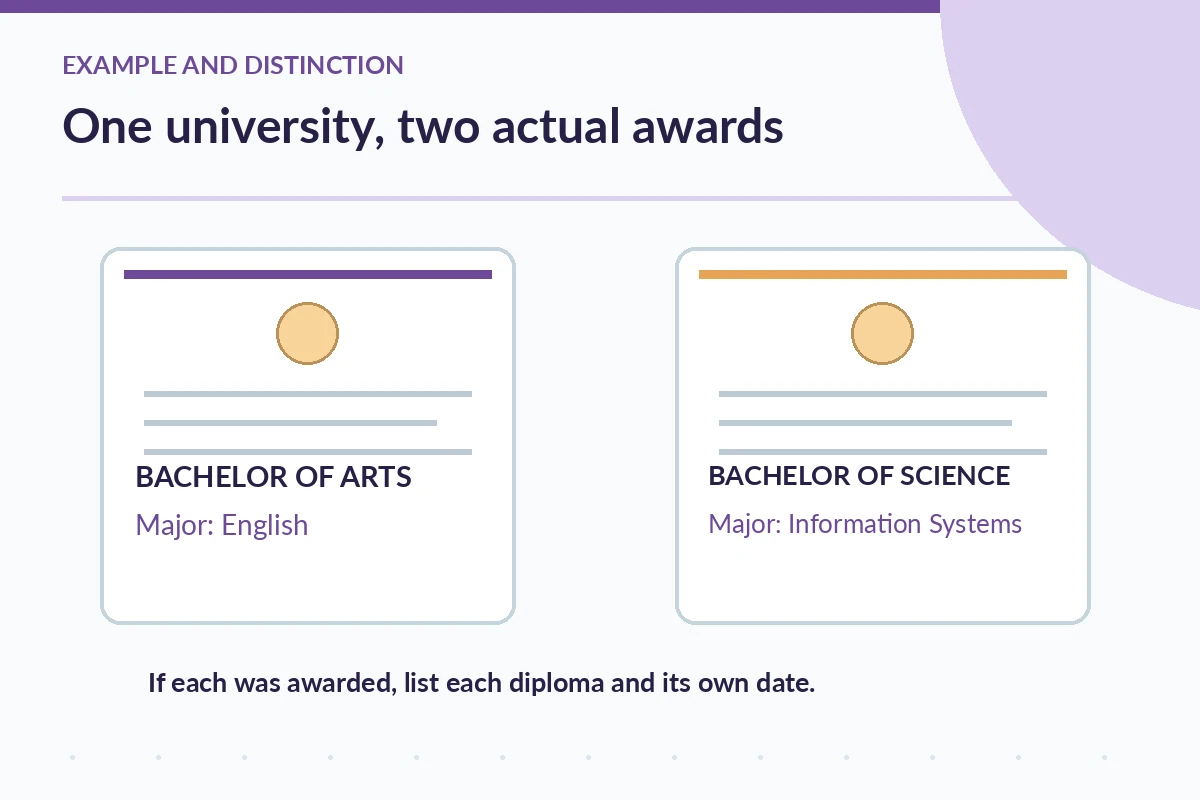
Open the graduation records or diplomas and count distinct awards. If one Bachelor of Arts was issued with majors in history and economics, describe one Bachelor of Arts and both majors; this is not automatically two separate degrees. If you received a Bachelor of Arts and a Bachelor of Science, show each credential as recorded even if both were earned at the same school. Academic terminology varies by institution, so official records control over casual expressions such as “dual program.”
An online application may offer only one field for each degree. Enter two records when two credentials were actually conferred; do not split a double major into invented separate degrees. If the school shows a combined or joint award, use its exact language rather than guessing. This is the core difference from general advice on listing a major: the number of completed awards must remain consistent across resume, application, and verification.
Format separate schools in a readable order
When the two degrees were earned at different schools, list each school with its own credential and graduation date. Reverse chronological ordering is a practical default for education: the most recently awarded degree appears first. You can emphasize the degree most relevant to the vacancy with a short coursework or project detail, but do not invert the facts or hide an earlier award that the application specifically requests.
For example, a fictional candidate might show “Master of Public Administration — Example State University, May 20XX” above “Bachelor of Arts in Sociology — Example College, May 20XY.” The two dates are different on purpose. The LSU career center explains reverse chronological ordering for degrees from different institutions. Keep locations and degree punctuation consistent with the rest of the resume.

Stack two genuine degrees from one institution
If one university conferred both awards, you may write the institution once and stack two degree lines underneath, each with its own major and date. This saves space while leaving the award count visible. The UMGC guidance explicitly suggests stacking multiple awards from the same school. Do not force both into a single “BA/BS” abbreviation if that could obscure the exact awards.
A second fictional example reads: “Example University | Bachelor of Science in Information Systems, May 20XX | Bachelor of Arts in English, May 20XX.” If the dates differ, list them individually. Avoid attaching one GPA to both degrees unless your institution provides a combined figure and you label it accurately; separate GPAs should not be silently merged.
Show a double major without duplicating the degree
Double majors are common sources of accidental overstatement. A candidate with one Bachelor of Science in two recognized majors should write one credential line and name both majors or concentrations as the school records them. The same logic applies to a minor: a minor alone is not a separately awarded bachelor’s degree. Compare the school’s degree verification terminology against the resume instead of following a generic downloadable template.
A simple illustrative correction is “Two bachelor’s degrees in Economics and Mathematics” changed to “Bachelor of Science, double major in Economics and Mathematics,” if that is what the transcript actually shows. The correction does not diminish the academic work; it makes the credential verifiable. If unsure whether your degree program conferred two awards, request the exact official description from the registrar.
Choose supporting detail for the target role
A resume should not become two full course catalogs because two diplomas appear. For a job requiring quantitative analysis, a relevant project from the mathematics degree may deserve a bullet; for a writing role, a researched publication or writing course may matter more. Place the supporting evidence under the matching degree or in a Projects section, label academic practice as academic, and make the candidate’s personal contribution clear.
If the degrees are from different periods in your career, you can show the newer training as a deliberate transition without implying the earlier professional experience changed. Use one small sentence to connect the completed study with the role. Claims such as “certified accountant” or “licensed engineer” require actual credentials and cannot be inferred from a degree title.
Handle current study separately from earned awards
A third academic program that has not yet ended should not be counted as one of your two earned degrees. Add a clear in-progress line, such as “Master of Science in Data Analytics, expected May 20XX,” only when the school confirms the program and the timeline is reasonable. Separating awarded and anticipated credentials matters if the employer requires the completed degree at the application deadline.
If you are returning to study after a long gap, consider whether all credentials need graduation years on the public resume. Requirements vary by application; mandatory fields and formal background checks may need dates even if your resume is concise. Never substitute a completion year for an admission year or change the order to imply a different award sequence.

Audit the PDF and application degree fields
Before submitting, count the awards again. Ensure that every school is the awarding institution, not merely a campus where you attended a summer course. Check degree level, subject, actual completion status, and dates. Distinguish official diploma names from the shorthand an employer might show in a dropdown. If no dropdown option exactly matches, choose a truthful broad category and retain the official wording in any free-text field.
Read the Education section without relying on color or columns; it should still show two unambiguous credentials. Save the final version and prepare to explain why both qualifications matter. The strongest resume makes the connection between education and work visible without asking readers to decipher a decorative layout or accept unverifiable credentials.
How We Research These Education Entries
This guide cross-checks education-labeling recommendations against university career-center advice and, where a licensed profession is involved, a relevant professional or public agency. Sources: Source A — UMGC recommends stacking degrees from one institution and listing education in reverse chronological order. Source B — LSU career center describes how to order degrees from multiple institutions. Source C — Shenandoah University recommends reverse chronological order for multiple awarded degrees. Source D — Indeed provides contemporary examples of distinct awarded degrees versus other degree combinations.. Examples and institutions named as Example are fictional illustrations only; verify your own credentials and follow the actual employer instructions.
This article is independently written for job seekers. There is no claim of approval by an employer, university, or credentialing body and no paid link in this article. See our affiliate disclosure for the site-wide policy. Readers should check issuing-school and licensing-agency records before making a credential claim.
More Resume and Cover Letter Guides
No. A double major can be one degree covering two fields. Check the official award records before representing the number of degrees.
Name the institution once and stack two officially awarded degrees beneath it, with separate dates where necessary.
Reverse chronological order is a useful default. If a job has special application instructions, follow those while preserving the accurate credentials.
Only when the school actually provides that combined GPA and you label it accurately. Otherwise do not merge distinct GPA records.
No. Show an in-progress degree with its actual stage or expected completion date separately from awards already granted.