
Work consistency performance review comments should describe a repeatable pattern in actual work, not call a person “reliable” or “unreliable” without evidence. Compare assignments that were genuinely comparable, review what the employee could control, and identify one action that would make future performance easier to evaluate. A fair comment can praise steady completion while recognizing an unusually busy shift, missing information, equipment downtime, or a change in the work standard.
Consistency is not the same as doing identical work every day. A service coordinator who handles routine inquiries on Monday and a complex incident on Friday has different work conditions. A useful review explains the expected handoff, accuracy, and communication standards in each context. The University of Iowa advises supervisors to request feedback based on observable behavior, while the University of Texas emphasizes a full-period appraisal that reflects previously communicated expectations.
Define the Standard Before Judging Variation
Begin with what the role actually requires: a correctly completed checklist, an agreed delivery window, a documented escalation, or an accurate transfer of information. State the expectation in ordinary language. When an employee is expected to submit a daily status note, consistency can mean that the note identifies completed tasks and outstanding blockers; it need not mean every day produces the same number of completed items. Ask whether the standard was shared, whether training occurred, and whether supervisors applied it to comparable work.
Separate frequency from importance. A single serious documentation problem may matter, but do not quietly treat it as a recurring habit. Likewise, ten routine completions do not cancel an unresolved critical task. Use enough examples across the review period to show the pattern you are describing. If available records capture only part of the workload, say so rather than using the incomplete log as a full performance score.
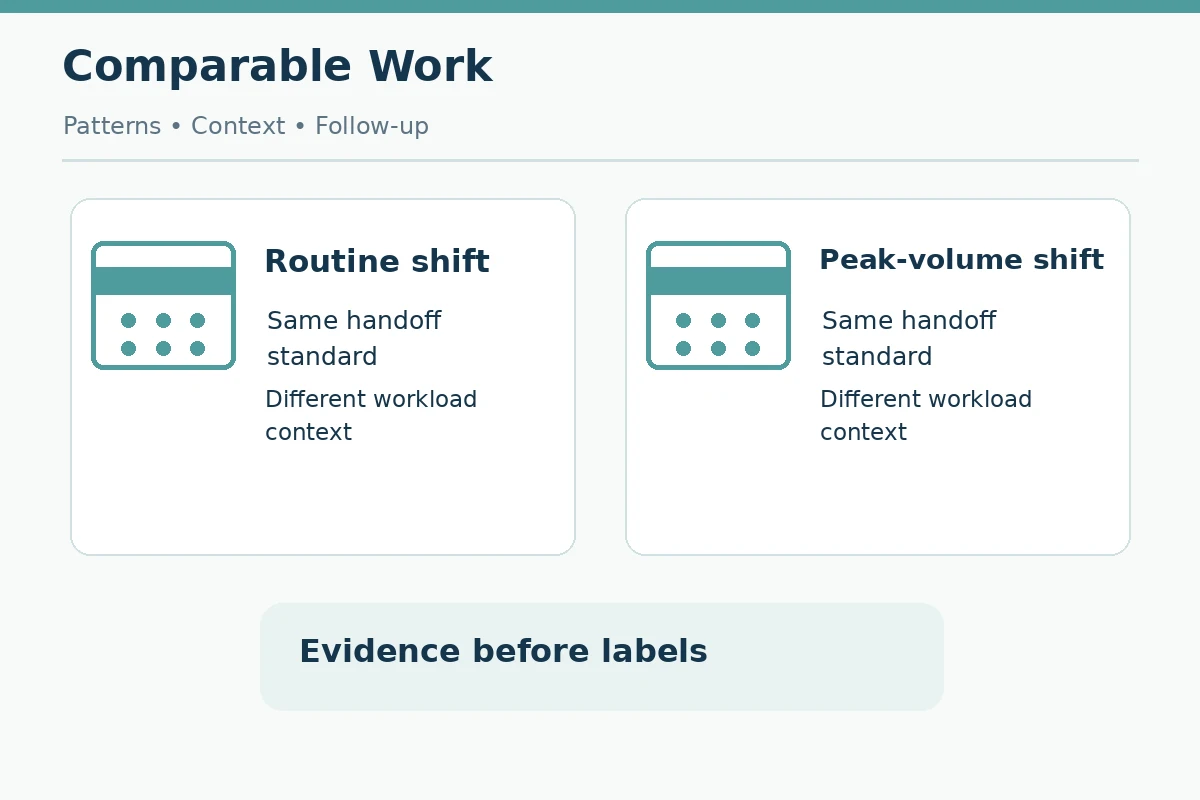
Compare Similar Assignments and Record Context
Use a simple private evidence log with the type of assignment, expected outcome, observed result, available support, and follow-up. For a warehouse administrator, compare similar receiving records with similar deadlines rather than a short routine shift against a peak shipment day. For a remote coordinator, compare handoff notes on tasks with known owners; do not infer productivity from the color of a chat status dot or from the number of messages sent.
Check factors outside the employee’s control. New procedures, late inputs from another team, system outages, and incomplete authority can change what “on time” means. The review can still note a missed handoff, but it should also specify whether the employee raised the blocker at the agreed point. A manager who records both the constraint and the employee’s response gives the employee actionable feedback instead of an unsupported impression.

Use Example Comments That Name the Pattern
Positive example, hypothetical: “Across the reviewed weekly handoffs, you supplied the agreed status fields and flagged open requests before the next shift began. Keep using the same checklist during coverage changes.” This names visible work and an action to repeat without inventing numerical scores. Another example: “When intake volume changed, you confirmed the revised priority order before moving items, helping the receiving team understand what remained open.” It recognizes appropriate adjustment rather than uniform speed.
Development example, hypothetical: “On the two reviewed schedule changes, the assigned owner was missing from the handoff note, which delayed the next team’s decision. Please add the owner and decision date to the shared template and bring three future samples to our next check-in.” Use a count only if actual records support it. If the issue was already discussed midcycle, connect this wording to that conversation and invite the employee to provide context or correct the record.
| What to examine | Evidence to verify | Review action |
|---|---|---|
| Steady completion | Comparable task samples | Keep the checklist and monitor exceptions |
| Uneven handoffs | Missing owner or next step | Agree on a shared handoff format |
| Changing workload | Assignment and staffing context | Set priorities before comparing speed |
Distinguish Output, Follow-Through, and Ownership
Output consistency concerns the quality and completeness of finished work. Follow-through concerns agreed updates, especially when an item cannot be finished on the expected date. Ownership means keeping a commitment visible and involving an authorized decision-maker when needed; it does not require an employee to solve another department’s problem or override an approval requirement. Review comments should name the particular dimension at issue so the next step addresses the real gap.
The same employee may be very accurate but inconsistent about announcing delays. A combined comment such as “Your work is inconsistent” hides that important distinction. Instead, recognize the accurate records and identify the missing update protocol. Similarly, do not label a person slow simply because they escalate a safety concern rather than rushing a high-risk task. Separate protected or approved absences from work behavior, and follow your organization’s policy and HR guidance.

Agree on One Checkable Improvement
A strong close names the future practice, support, review date, and person who can help. For example, the manager can provide an approved handoff template, the employee can record pending items at the transition point, and both can compare samples at the next scheduled conversation. A review comment is a starting point for coaching, not a substitute for a complete employment decision or the organization’s formal rating framework.
Invite the employee to identify missing training, unclear priority decisions, or process changes that would make the standard more realistic. Document the shared conclusion accurately without promising a particular evaluation rating or promotion. If the facts are disputed, verify the underlying records and describe what remains uncertain. The point is to sustain repeatable good work and improve visible handoffs, not to manufacture a personality judgment.
Two Worked Examples With Different Lessons
Imagine a coordinator praised as “always dependable” even though the manager has checked only one busy week. A better review uses the full available period, names how that employee recorded pending issues, and states the next expectation. This fictional example teaches evidence selection; it does not describe a real worker or employer.
Imagine an employee who submitted accurate reports but sometimes omitted handoff owners when schedules changed. The review should acknowledge the accurate reports and address the specific information gap. The manager can request two representative recent records, agree on an owner field, and check whether the new format works under peak staffing conditions.
How We Research and Verify These Examples
We reviewed primary, public occupational and university human-resources guidance on 2026-11-14. The hr.uiowa.edu resource supports supervisor feedback should cite observable work behavior and clear examples. The hr.utexas.edu resource supports staff appraisal advice stresses the full review period, actual expectations, and no surprise criticism. The uhr.umd.edu resource supports specific, timely and solutions-focused feedback provides useful development direction. All example comments and worker situations are hypothetical teaching illustrations. Actual performance ratings, approval limits, privacy standards, and personnel decisions depend on the role and employer policy; this guide is not legal or disciplinary advice. Our affiliate disclosure explains commercial relationships and editorial transparency.
Explore Related Career Guides
It means a documented pattern relative to the job’s communicated standards, after considering differences in assignments and circumstances.
Usually not by itself. Describe an isolated event accurately and look for an actual pattern before calling it recurring.
Name a repeated action you observed, such as complete shift notes, accurate checks or timely blocker updates; do not invent a percentage.
Compare similar work when possible and document changes in volume, complexity, staffing and instructions.
A specific work expectation, support or training where needed, and a scheduled opportunity to assess progress.