
A final interview that reviews a completed work sample is not just a second chance to show the finished file. Interviewers may want to know what you understood from the brief, how you prioritized competing goals, where your data came from and what you would change after feedback. A polished artifact without an explainable process can leave important questions unanswered. Prepare to walk through the actual work you did, not a retrospective story in which every choice was inevitable.
Use the final conversation to explain how you worked
Before the meeting, reread the exact assignment instructions and any permission, confidentiality or originality requirements. Keep a copy of your submitted version. Do not quietly replace the submitted file and pretend it is identical. If the employer has requested a revised version, label the revision and explain the differences.
Separate facts in the brief from your assumptions
Make a one-page decision record with three headings: given facts, assumptions and validation. A brief may provide a customer segment, a dataset or a hypothetical operational problem. If it does not specify a budget, data quality standard or implementation owner, you should not invent those facts. State how you handled the uncertainty and what information you would request from the employer in real work.
For instance, an illustrative analytics task might ask you to compare service requests across weeks. You might assume duplicate entries should be flagged rather than discarded automatically. You could explain that choice, show how many entries were checked if the sample genuinely supports that number, and identify who would approve a final data-cleaning rule. Do not claim that an illustrative dataset represents the employer’s actual customers.
Give a short, usable tour of the artifact
Prepare an opening explanation: problem, intended audience, method, major finding, limitation and recommended next step. In a design sample, the intended user and prototype constraints may matter. In an operations sample, the handoff owner and exceptions may matter. In a writing sample, the source, claim and editorial revision process may matter. Tailor the tour to the assignment rather than using a universal slide template.
Point to visible evidence, not decorative formatting. If you ran a test, describe what it assessed. If you did not test an assumption, say so and name a sensible future check. An employer does not need a fabricated conversion rate or imagined customer testimonial to evaluate your reasoning.

Respond to challenge without defending the indefensible
A reviewer may ask why you selected one approach over another or point out an error. Listen for the precise concern, restate it in your own words and answer what you know. You can say, “That is a useful limitation. I used this definition because the prompt did not distinguish these cases. Before using the result, I would test the alternative definition with the data owner.” That response demonstrates revisability without surrendering every valid choice.
If the sample contains a real mistake, acknowledge it. Identify which conclusion it affects and how you would check the corrected version. Do not present a guess as a confirmed correction. An employer may be testing whether you can recognize the boundary between analysis and final approval as much as whether you can produce an attractive deliverable.
Explain what belongs to you and what does not
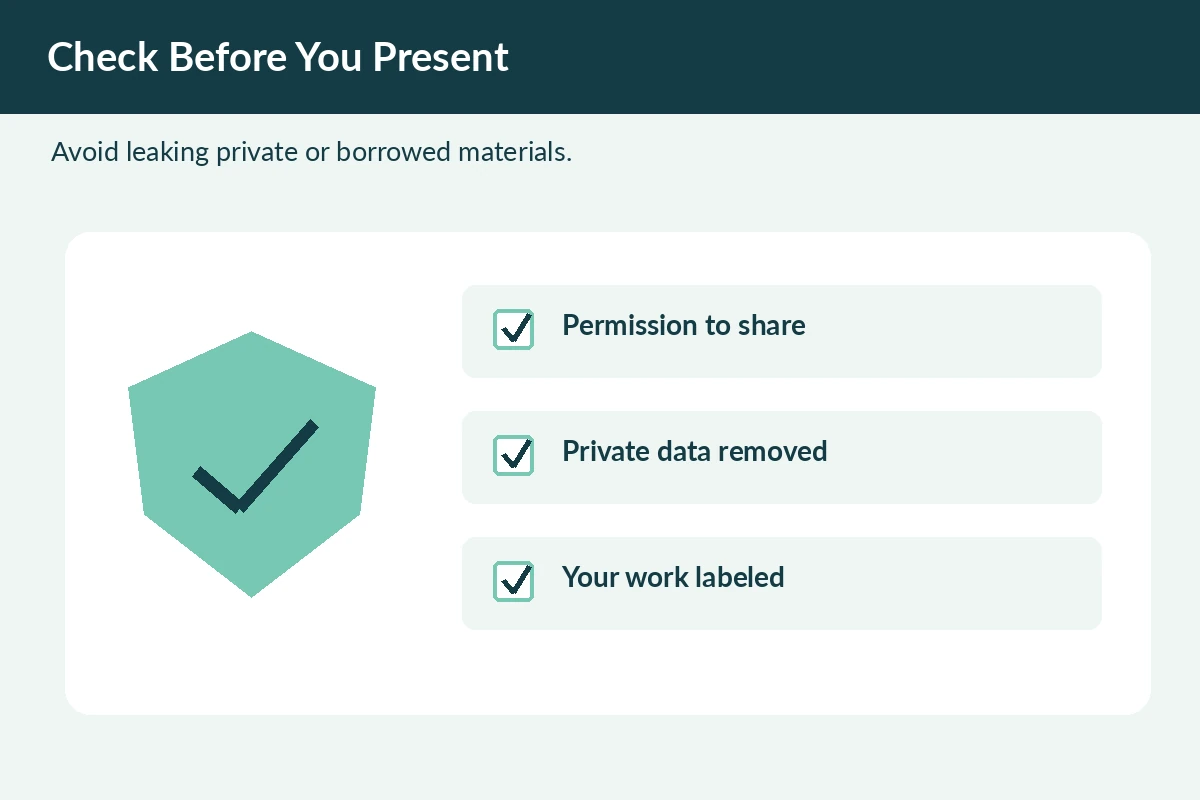
When tools or collaborators contributed, identify them accurately. If the instructions permitted reference material, explain how you used it and what you personally produced. If generative tools were allowed, follow the stated disclosure rules and be prepared to discuss verification. Do not conceal a borrowed template or claim another team member’s research as your own. Assignment rules vary by employer; verify them rather than assuming permission.
You also need to respect third-party rights and confidentiality. A work sample should not contain a previous employer’s proprietary customer data, internal financial reports, private staff information or unlicensed assets. Use permitted, anonymized or newly created materials where appropriate. Refuse requests to disclose protected records and offer to discuss method instead.

Discuss time and scope as trade-offs, not excuses
When the assignment was time-limited, explain which part you prioritized and why. You might say you validated the source data before producing charts, or outlined essential user flows before polishing the interface. Acknowledge what you would do with more time: additional checks, accessibility review, stakeholder validation or a more robust exception process. Priorities are easier to assess when tied to the stated goal.
Avoid claiming that every omission resulted from strategic genius. Acknowledge limitations plainly. If you missed a reasonable requirement, explain how you recognized it and how you would address it in a revised submission. This creates a more trustworthy interview conversation than rehearsed perfection.
Check the employer’s use of your work
If the assignment resembles real business work rather than a hypothetical evaluation, you may reasonably ask how the sample will be used, who can access it and whether the deliverable is only for assessment. Keep the tone curious and practical. Do not make unsupported accusations; also do not assume that every request for a sample is harmless or that a final round guarantees employment.
If asked to pay for software, transfer money or provide banking data before employment is verified, treat that as a warning and independently confirm the opportunity. FTC guidance explains that fraudulent recruiters may imitate legitimate hiring processes. Use independently verified employer contact details for sensitive concerns.
Leave with one question about real decision-making
After your debrief, ask which parts of the sample most resemble the real role and who would review a comparable deliverable on the job. This clarifies whether you would independently execute, recommend or approve decisions. It also gives you a way to test whether the exercise reflects everyday work rather than an artificial challenge.
Write down the feedback and any promised next step. You may use the learning to improve future samples, but do not reuse confidential interview materials without permission. A considered explanation of your process is often more credible than a claim that your first answer was flawless.
How We Research Second and Final Interviews
For this U.S. audience guide we reviewed University of Alabama, University of Michigan, UC Berkeley, Harvard and University at Buffalo career-center interviewing resources on November 10, 2026. These sources describe common interview practices; individual employers may use a different sequence and assessment process. The scenarios, suggested answers and hypothetical examples here are not reports of real candidates or outcomes. We do not predict hiring success and we distinguish the applicant’s real responsibilities from decisions made by a supervisor, employer or hiring committee.
Sources checked November 10, 2026: career.sa.ua.edu (University of Alabama describes deeper later-round interviews with additional staff, practical demonstrations and the need to review first-round notes.) careercenter.umich.edu (University of Michigan recommends role-specific questions, evidence-based answers and different questions for different interviewers.) www.career.berkeley.edu (UC Berkeley describes interview preparation and post-interview evaluation of duties, work environment, and fit.) careerservices.fas.harvard.edu (Harvard career guidance provides behavioral prompts and questions about employer challenges and priorities.) consumer.ftc.gov (The FTC warns that job scammers may impersonate employers and request sensitive information during fake recruiting.) Educational discussion examples require adaptation to the reader’s own facts. No career center or employer has endorsed this article. Review our affiliate disclosure.
More Interview Preparation Guides
No. Explain the high-impact choices and invite questions. Admit where the brief was ambiguous or the available time limited your analysis.
Acknowledge it, check the underlying assumption and explain how you would verify or revise the work. Avoid pretending a flaw is intentional.
Only if you have permission and no restricted information is exposed. A fresh or anonymized sample is often safer.
No. Identify your own steps and any software, templates or collaborators that contributed. Follow the assignment rules on permitted assistance.
Explain how you prioritized within the stated scope and what you would investigate next. Clarify expectations rather than inventing certainty.