
A purchasing assistant resume objective should name the role you are pursuing, point to a concrete skill such as comparing supplier quotes or tracking orders, and avoid claiming you can authorize purchases unless you actually had that responsibility. A useful opening might mention a spreadsheet you maintained or the way you checked item specifications. You do not need an objective on every resume: a direct, well-labeled experience section may already make your fit obvious. Use a short objective when your experience comes from inventory, office support or coursework and the bridge to procurement would otherwise be missed.
Choose the assistant role before choosing the wording
Read the exact posting for purchasing assistant, purchasing clerk, procurement coordinator or buyer. They are not interchangeable titles. A clerk may organize requisitions, compare listed specifications and monitor order status; another employer may expect contract negotiation or purchase approval. Circle the support tasks you can prove and cross out the decision rights you have not held. If you are moving from inventory or accounts payable, describe that transfer directly rather than pretending you already worked in procurement.
Your objective is one or two short sentences below your contact information, not a wish list of career ambitions. A target such as ‘purchasing assistant’ helps a hiring manager understand why your prior spreadsheet, vendor email or stock-record experience matters. Do not say you seek ‘any business opportunity’ or that you will reduce company costs by a percentage you cannot substantiate. Your resume’s later bullets should provide the evidence behind each claim in the objective.
Build a quote comparison from verifiable inputs
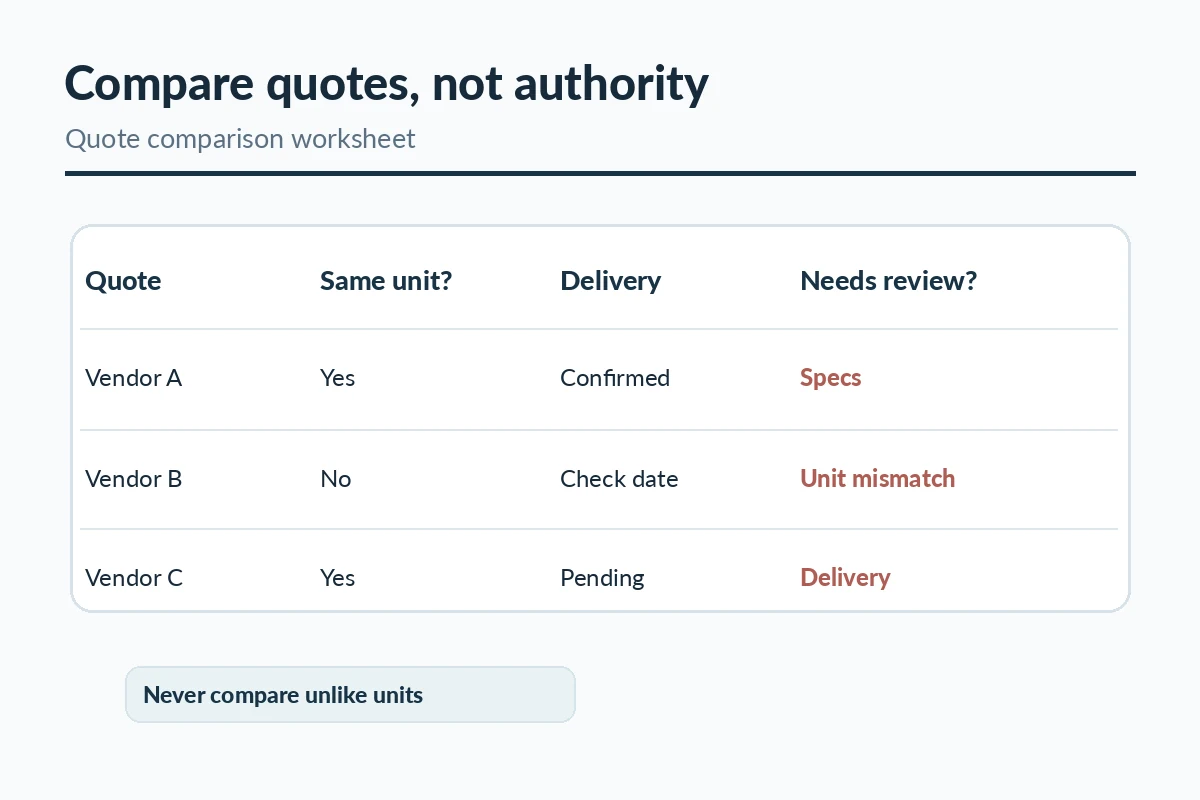
For a class exercise, create a clearly labeled hypothetical table with columns for item name, unit, price, delivery terms, quoted date and source. Check that quantities and units match before you rank any option. For real work, remove confidential prices and supplier names from the portfolio or recreate the method using invented, plainly labeled sample data. Your resume may say that you organized comparisons; it should not claim you selected suppliers unless you made that decision under your actual role.
The important skill is not simply using Excel. It is noticing when a quote covers a different package size, leaves out shipping or changes the delivery window. A truthful objective can refer to documented quote checks and reliable recordkeeping. If you have never contacted a vendor, use a coursework comparison or office filing example instead of inserting ‘vendor management’ as an unsupported phrase.
Trace an order without implying purchasing authority
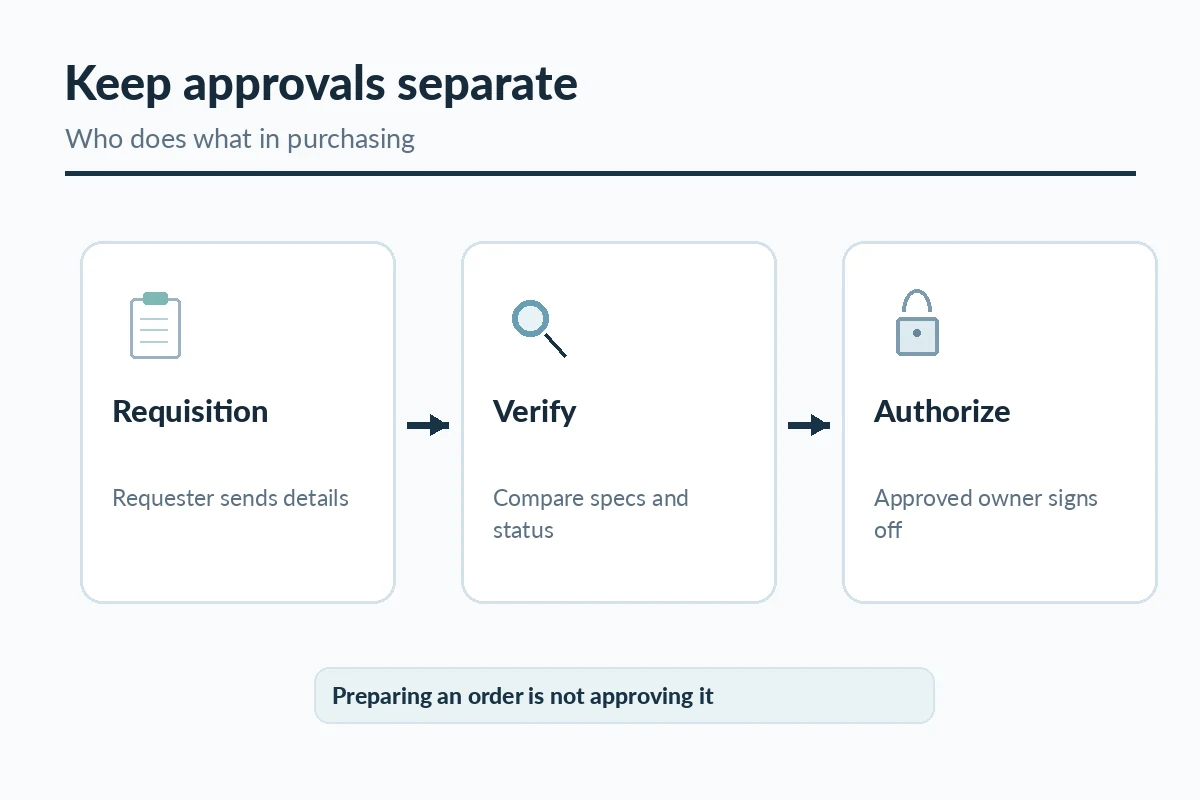
A simple procurement workflow begins with a request, continues through specification checks and required approvals, then produces an order and follow-up record. Your role may cover only some of these steps. Write down which records you created, who reviewed them and what you escalated. ‘Tracked the status of 12 practice requisitions in a classroom simulation’ is an illustration only: substitute your actual figures and label the project. If no counts are available, describe the checks rather than invent a performance result.
Do not blur ‘prepared a purchase-order draft’ with ‘approved a purchase order.’ In many workplaces final authorization depends on budgets and policies; the exact division of duties varies. Say ‘prepared order documentation for supervisor review’ when that matches the record. Ask a former supervisor to verify your job title and scope rather than using an inflated procurement title to seem more senior.
Rewrite a weak objective into a job-specific one
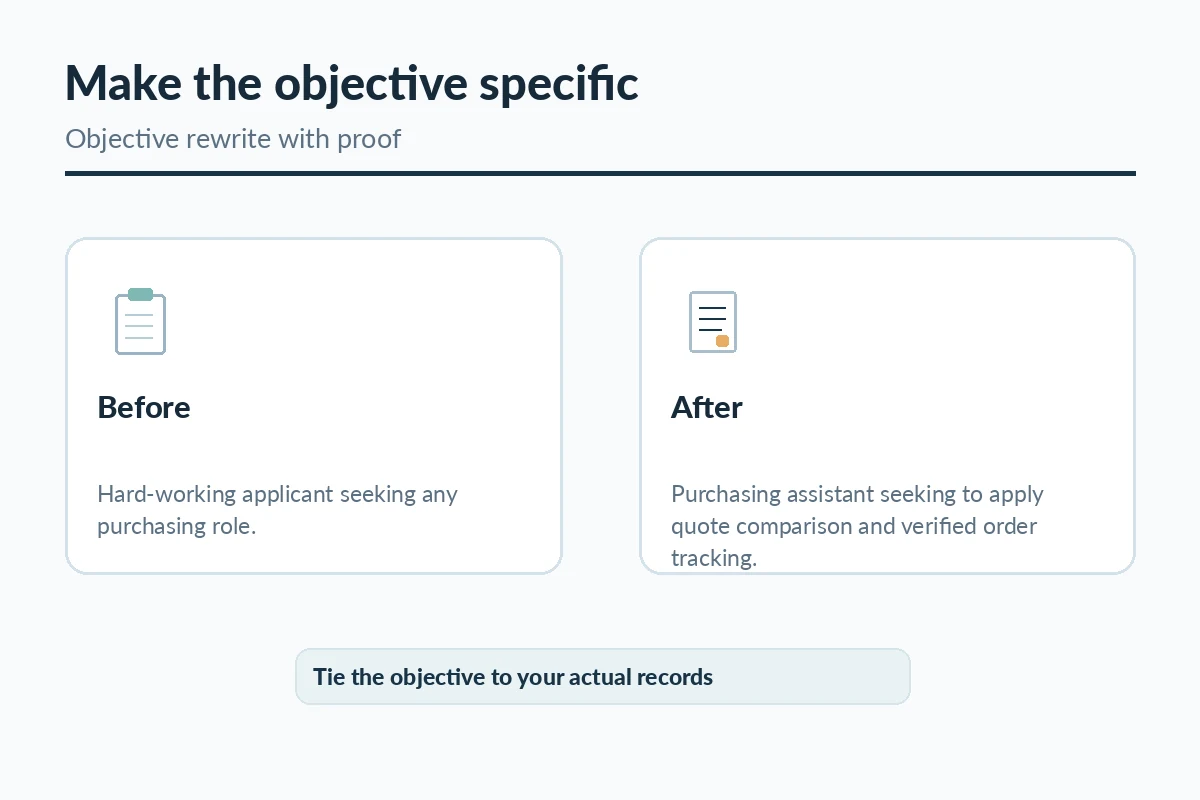
Weak example: ‘Hard-working team player looking for a challenging purchasing job.’ This offers no role evidence. A stronger hypothetical version for a student is: ‘Seeking a purchasing assistant role where I can apply coursework in quote comparison, accurate spreadsheet records and documented review steps.’ It describes a target, an input skill and a limitation without claiming employment that never happened.
For an inventory clerk making a transition, a hypothetical alternative is: ‘Inventory clerk seeking a purchasing assistant position, bringing verified stock reconciliation and order-status follow-up skills to support accurate requisitions.’ If your experience includes genuine supplier communication, add it only after you can identify the task and your specific contribution. The final statement should fit on about two lines in your resume layout.
Show a proof trail immediately below the objective
Under Experience, Projects or Skills, give the reader a place to confirm your opening sentence. A project line can name the table you built, the data you checked and the conditions you tested. A work bullet can explain how you maintained an order log, flagged mismatches or routed missing information. Retain the distinction between a simulated exercise and paid experience in both the heading and the dates.
Avoid a skills section packed with unexplained phrases like ‘strategic sourcing,’ ‘contracting’ and ‘spend optimization.’ Those imply substantial expertise. For an entry-level assistant, accurate data entry, comparison work, version-controlled records and timely escalation may be more persuasive because they correspond to routine support tasks. Use the employer’s vocabulary only where your experience supports it.
Tailor the statement to the real posting
Compare two authentic descriptions of purchasing support. One might prioritize order status and supplier follow-up; another might emphasize invoice matching and specifications. Keep a separate version of your objective for each: never simply replace the company name while leaving a mismatched example. Also check whether the job is based in a warehouse, hospital, school district or office, since its required records and approvals may differ.
If a posting says you will authorize spending, ask what authority is assigned to this position, how limits are documented and who signs off. Do not imply a universal procurement rule or promise legal compliance from a resume statement. A good objective shows you can support a controlled process while respecting the limits of your experience.
Check the final line for accuracy and readability
Read the objective aloud and remove filler adjectives that could be used for any role. Verify that it names the target position, mentions no more than two relevant proven abilities and does not overpromise savings or supplier outcomes. Confirm the wording is consistent with the title and dates in the work-history section. If the objective repeats the first bullet word for word, delete the less useful repetition.
Export a clean PDF only when the employer accepts that format; follow its requested file type and naming convention. Check line wraps at ordinary viewing size and open the file once more after exporting. An optional objective is a navigation aid for the reader, not a substitute for work evidence, a promise of hiring or an automatic screening advantage.
How We Research Resume Objective Examples
We compared U.S. university career-center guidance about optional and role-specific objectives with O*NET occupational duties and role boundaries. Examples are hypothetical and do not describe a real employer, verified hiring outcome, credential, or guaranteed applicant-tracking-system result. Employers can set different requirements, so review the actual job posting and do not claim responsibilities or qualifications you have not held.
Sources checked November 10, 2026: www.umassd.edu; cpd.emory.edu; careercenter.education.wisc.edu; www.onetonline.org. Read our affiliate disclosure for editorial relationship information. This article is educational, not a promise of employment.
More Resume and Cover Letter Guides
Only when it clarifies the target role or connects transferable experience to purchasing. It is optional; remove it if the rest of your resume already communicates that clearly.
Describe the class simulation as a project, including the exercise and limits. Do not present hypothetical negotiation as an actual vendor agreement.
Say you tracked order status or maintained records, and identify who approved orders if relevant. Avoid implying that you independently authorized purchases.
Include a quantified saving only when you can verify your contribution and the calculation. A careful description of comparison checks is better than an invented percentage.
Not necessarily. Employers assign different authority and responsibilities. Match the actual posting and describe your real scope rather than assuming titles are equivalent.