
Quick answer. For “What is your greatest achievement?” select an accomplishment that is relevant to the role, that you personally helped deliver, and that you can describe honestly. In a short answer, name the result, explain the challenge and your own decisions, then connect the learning to the new job. “Greatest” does not mean the biggest number; clear evidence matters more than spectacle. This guide is for US job seekers preparing a truthful answer, not a prediction of any specific employer’s assessment.
Identify The Achievement That Fits This Job
Before choosing your biggest-sounding story, read the job description and underline the capabilities you must demonstrate. An operations role might reward consistent accuracy; a community position might value accessible communication. Write down two or three real accomplishments, including those from school, volunteering, caregiving, internships or paid work. Your task is to select the one that can illustrate a relevant capability with the least embellishment. An employer cannot independently inspect every detail during a brief interview, so clarity and consistency matter.
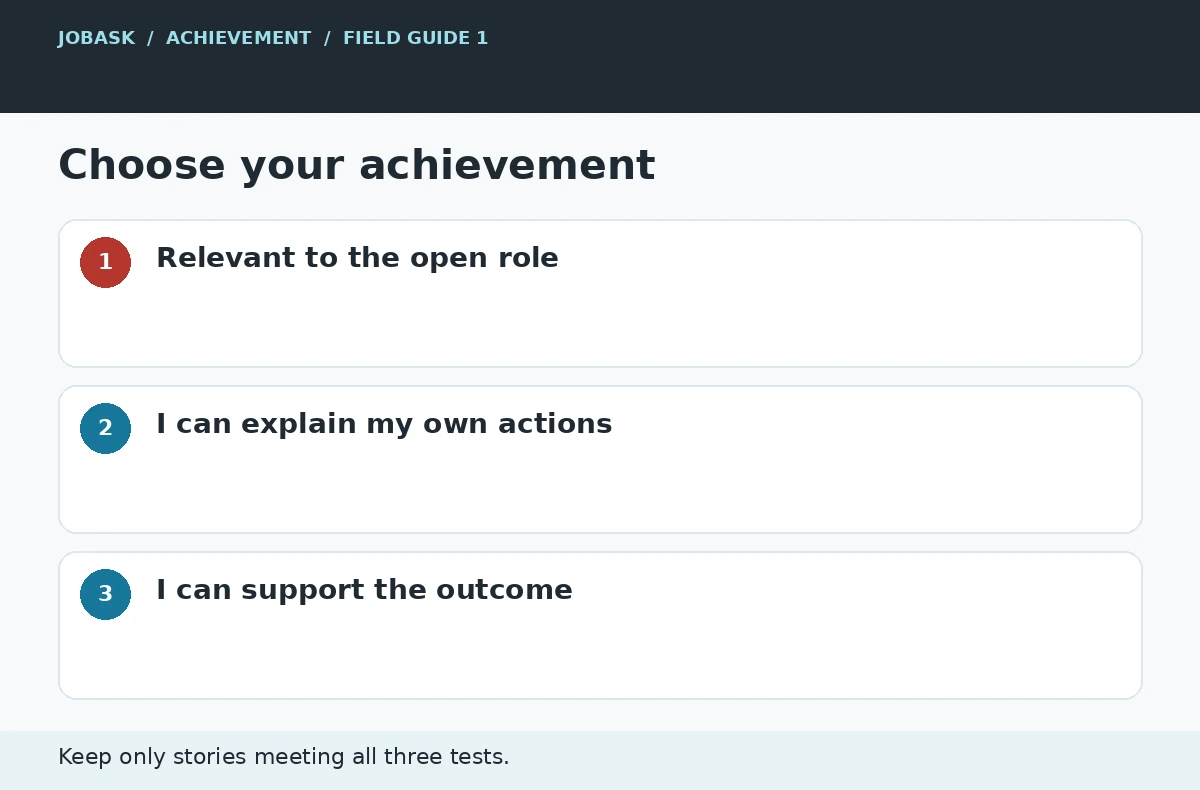
Use a three-part test: relevance to the prospective role, a contribution you can describe in the first person, and an outcome you observed. A small improvement that removed confusion for coworkers can outperform a glamorous group win where your role is vague. Avoid sharing information covered by confidentiality obligations, naming clients without permission, or calling someone else’s project your own. The best choice is one you can discuss naturally if a follow-up question asks exactly what you did.
Turn An Achievement Into A Specific Answer
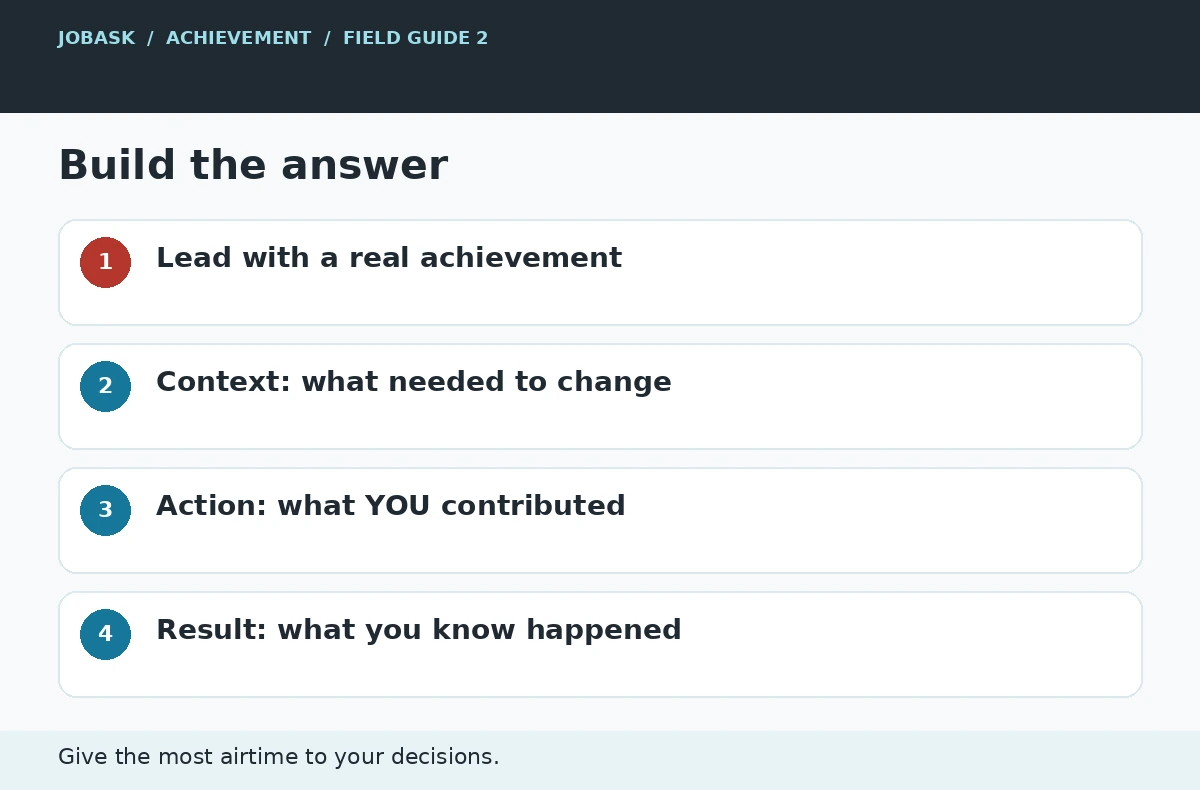
A practical answer has four movements. Start with the achievement in a single sentence; provide only the background needed to understand why it mattered; spend the most detail on your decisions and work; and finish with the observable result and its relevance. The STAR structure described by university career centers can organize the middle of your response, but it is a memory aid rather than an employer-mandated scoring formula. If you do not have a trustworthy measurement, explain a documented or directly observed change instead. Our work under pressure interview answer guide goes into more detail.
Suppose a team received clearer instructions after you reorganized shared notes. You can say what the old instructions made difficult, which parts you revised, how colleagues tested the new version, and what changed in the way they found information. Do not manufacture a percentage reduction in errors. Where outcomes are still uncertain, use a restrained phrase such as “the team adopted the updated checklist” only if that really happened. This preserves a strong story while making it easy to withstand thoughtful follow-up questions.
Compare Two Hypothetical Achievement Answers
Hypothetical example — early-career applicant: “I’m proud of coordinating a campus volunteer sign-up process. Volunteers were receiving inconsistent shift details, so I built a shared schedule, checked conflicts with organizers and sent one final confirmation. The event team used that schedule for the day. It taught me how important it is to make information understandable before people need it.” This is illustrative wording, not a real applicant outcome. A reader should replace every activity and outcome with their own experience.
Hypothetical example — experienced applicant: “One achievement I value was simplifying our weekly handoff notes. Questions kept returning because different shifts recorded decisions differently. I worked with colleagues to agree on key fields, wrote a short template and collected feedback after a trial. The teams continued using the format. I would bring that same attention to reliable handoffs here.” This example avoids invented statistics and gives the interviewer actions they can probe.
Notice the difference between a result and a personal slogan. “I’m a natural leader” tells little about your choices. “I asked the team what was being missed, tested a template and incorporated their suggestions” reveals a process. A credible outcome may be a completed deliverable, an agreed workflow, feedback you actually received, or a documented lesson. It need not be a promotion, award, employer citation or fabricated savings figure.
Check Ownership And Evidence Before Speaking
Split the story into a quick evidence ledger: what happened, what you personally did, what another person did, what changed, and how you know. Distinguish “I drafted the guide” from “our department launched the program.” If the outcome depended on several people, acknowledge them and describe your part. Numbers belong in the answer only when you know how they were calculated or can defend a reasonable approximation as an approximation.
If your top story is not directly related to the position, say which skill transfers. For example, coordinating a student event may show planning and communication for an office role without pretending you managed a corporate department. If the interviewer asks for your single biggest accomplishment, choose one story and go deeper instead of listing awards. When an interviewer asks a different question about teamwork or obstacles, change the emphasis rather than recycling the exact same speech.
| Story candidate | Evidence risk | Editorial decision |
|---|---|---|
| High-volume team win | Unclear personal role | Use only if you can isolate your actions |
| Small documented process improvement | Clear steps and outcome | Often a strong, defensible choice |
| Private client result | Sensitive details | Anonymize or select another example |
| School or volunteer achievement | No paid-work history needed | Connect the transferable skill to the role |
Rehearse For Follow-Up Questions And Ambiguity
Practice saying the answer once without notes, then ask a partner to interrupt with “What exactly was your contribution?”, “How did you know it worked?” and “What would you improve?” Listen for claims that sound bigger than your evidence. Revise the sentence instead of memorizing an impressive-sounding phrase. As a useful self-check, your action should take more room than the setting, but there is no universal prescribed interview length. Our time management interview questions guide goes into more detail.
The question can also be framed as “What are you most proud of?” or “Tell me about an accomplishment.” If personal and professional examples are both possible, prioritize an appropriate example for the job and briefly explain its relevance. For a candidate returning to work, an independently managed community or learning project can be appropriate if it is accurately described. Never claim that one particular response will guarantee a callback or offer.
Make A Final Answer You Can Verify
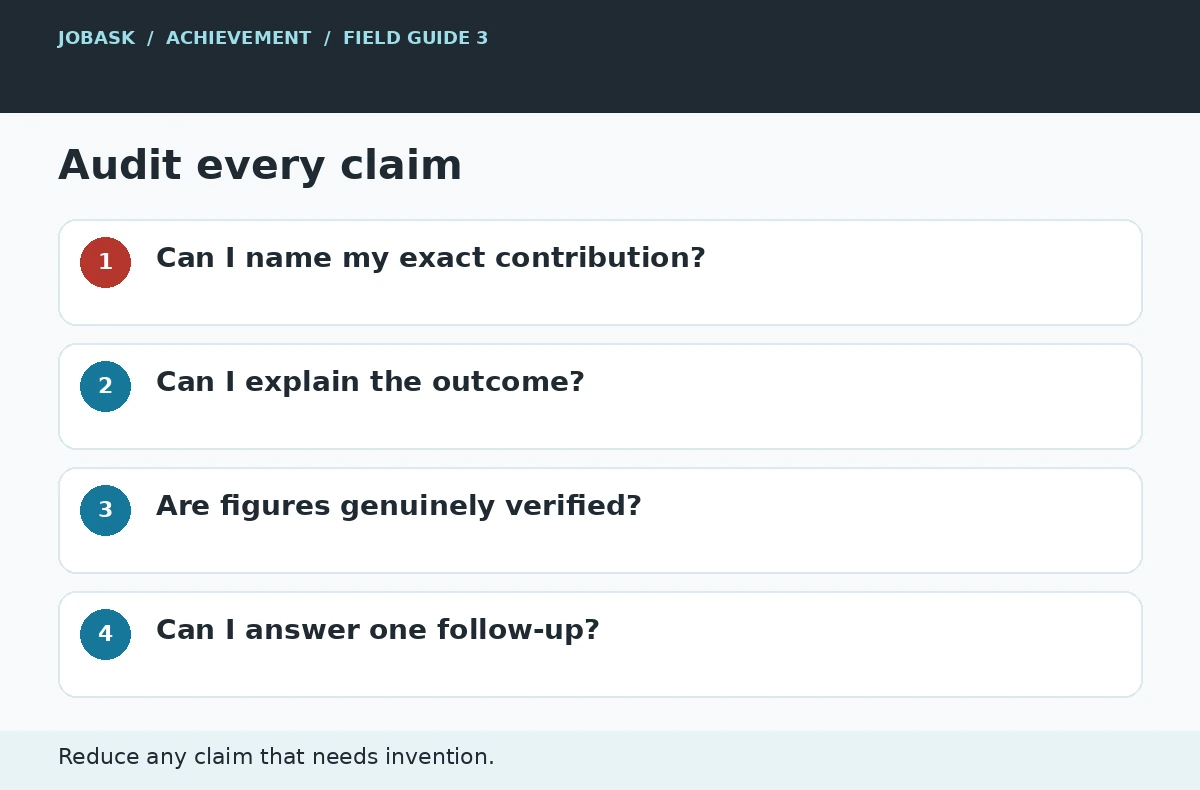
Before rehearsing, circle every statement that names a person, tool, result, award or deadline. Can you justify each from your real history? If a sentence would require you to invent a meeting, metric, supervisor endorsement or company policy, delete or rewrite it. Treat the hypothetical passages above as teaching devices only. Rehearsing a truthful outline is more useful than memorizing a polished story that cannot survive a natural follow-up question.
Keep a short private note of the facts behind your answer: your role, the context, the steps you took, the result you actually observed and one honest limitation. Avoid sensitive customer, colleague or employer information. Review the open position before the interview so the final connection remains relevant, but never add achievements that did not happen. You can be prepared and still acknowledge uncertainty when an interviewer asks something you do not know. Our solved a difficult problem interview answer guide goes into more detail.
How We Research These Interview Answers
We used UC Davis and Colorado Boulder career-center guidance for relevance and structure, plus CSUSM for honesty and clarity. The story-ranking grid and examples are our editorial methods, not a validated employer assessment model.
Sources, Hypothetical Examples, And Disclosure
References reviewed October 20, 2026: careercenter.ucdavis.edu (Lists greatest achievement among general interview questions and recommends stories tied to the job.) ce.colorado.edu (Includes greatest professional achievement and STAR-based narrative preparation.) www.csusm.edu (Emphasizes authenticity, honest accomplishments and tying answers to the position.). Sources explain the interview-preparation principles; none verifies the fictional examples. All sample answers are hypothetical. No compensation, hiring-rate or ATS-performance figures are asserted. These pages inform interview preparation and do not imply a hiring outcome.
JobAsk provides general informational guidance, not employer-approved interview scripts. No affiliate relationship or paid recommendation is asserted here. Read our affiliate disclosure before following commercial recommendations elsewhere on the site. There are no affiliate product links in this article.
More Interview Preparation Guides
- What Is Your Greatest Weakness? Give an Honest Interview Answer
- What Are Your Greatest Strengths? Prove Them in an Interview
- Why Should We Hire You? Match Job Requirements to Evidence
- Teamwork Interview Answer: Show Your Part in a Shared Result
- Career Goals Interview Answer: Explain Your Next Step and Plan
An achievement can be a reliable improvement, finished assignment, community contribution, learning milestone or team support. Choose a true story and clarify what changed.
Work examples can be convenient, but relevant college, volunteer or personal projects may work when they demonstrate a transferable skill and are accurately described.
Yes. Credit the team while identifying your distinct decisions and actions. Do not use “I” for work performed entirely by somebody else.
No. Use valid measurements when available, but a verifiable deliverable, observed change or specific lesson is more credible than an invented metric.
Explain what was accomplished and what you learned without concealing important limits. A balanced result can demonstrate judgment when the action was thoughtful.