
For “Why should we hire you?” identify two or three important needs from the job description and explain what verified experience you bring to those needs. State your contribution, not a claim that you are better than people you have never met. An answer works when a hiring team can connect each statement to a task and ask a meaningful follow-up.
This article is for U.S. applicants at different experience levels. Its sample answers are hypothetical illustrations, not reported hiring stories. There is no universal number of selling points that an interviewer demands, and an answer does not guarantee an offer.
Start With the Two Most Important Job Tasks
Do not start by listing every strength you like about yourself. Read the posted responsibilities and separate must-have duties from desirable extras. Choose two responsibilities you can discuss credibly. A role centered on scheduling, for example, may value accurate calendar coordination and handling changed priorities more than an unrelated software badge.
Make a two-column note: “what the employer needs” and “what I can demonstrate.” Under the second column write an actual task, tool, work sample, or observed outcome. The Boston College Career Center describes this question as a chance to correlate key requirements with previous jobs, internships, or other relevant activities.
Separate Direct From Transferable Evidence
Direct evidence means you have performed a similar task under a comparable scope. Transferable evidence means you practiced a component that might help you learn the target work. Neither guarantees identical performance in a new environment. If you maintained a school club budget, it does not make you a licensed accountant. But it may support a narrower claim about maintaining records and reconciling receipts with oversight.
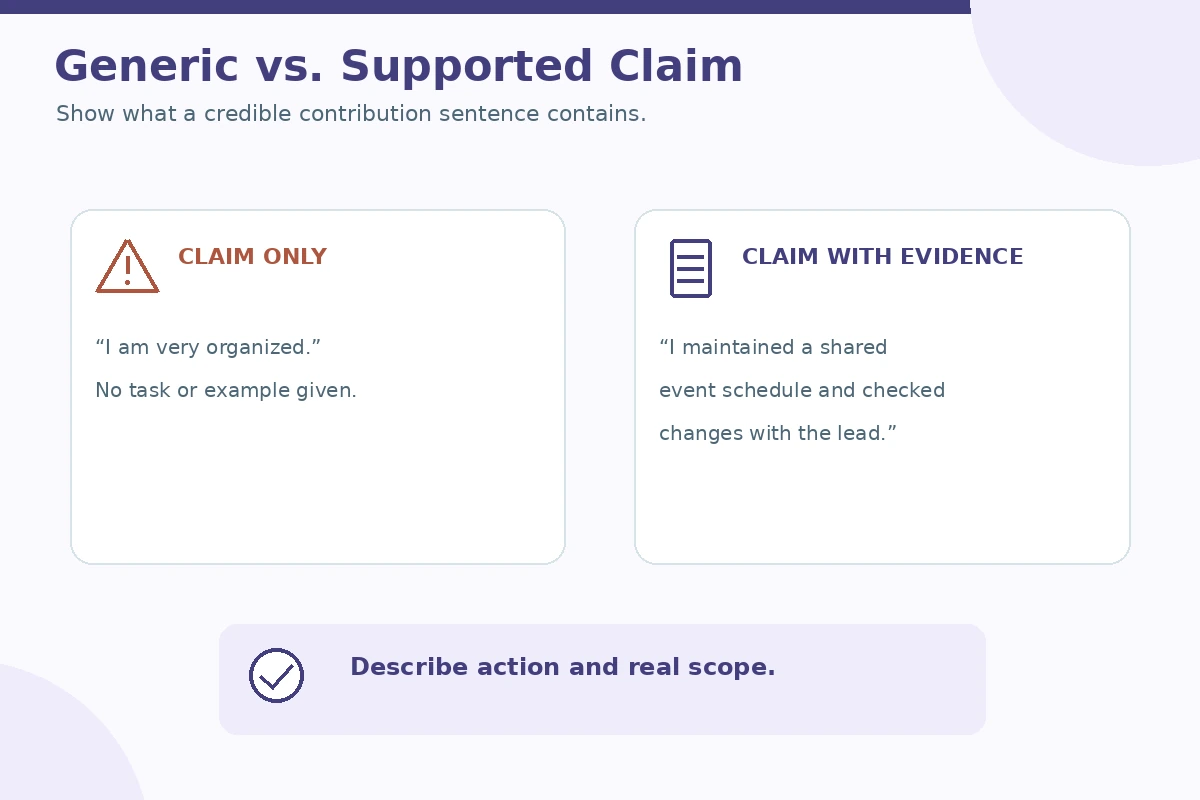
Tell the interviewer exactly what you did. “I checked and corrected event sign-up records before sharing them with our coordinator” is clearer than “I have exceptional attention to detail.” Where training, supervision, or authorization matters, say which part you know and which part you will need to learn. Honest boundaries are evidence of judgment, not something to hide.

Build a Short Contribution Statement
An effective structure is “need → example → useful next step.” For a hypothetical customer-support role: “Your posting emphasizes accurate issue notes and clear handoffs. In my library volunteer shift, I recorded visitor requests and passed unresolved questions to staff, rather than answering outside my role. I would bring that documentation habit and learn your actual support system.” The illustration makes no claim of prior contact-center experience.
You can finish with modest interest: “Those responsibilities are why I am applying.” Avoid saying you will reduce costs, increase conversion rates, or fix existing problems unless you have a grounded reason to make that prediction. Interviewers can evaluate a real past action more easily than an untestable promise.
Choose a Different Approach for Career Changers
Career changers sometimes answer by apologizing for a different title. Instead, isolate the required behavior and give a comparable example from the prior field. An office administrator pursuing project support might describe maintaining a deadline tracker, prompting owners about dependencies, and flagging overdue work. That proves organization and follow-up; it does not automatically prove advanced project-management certification.
Say what changes with the new role. “I have not administered this team’s platform, but I have tracked multi-person assignments in a shared spreadsheet and learned new record systems under supervision.” Acknowledging a learning need keeps the claim credible. Harvard FAS similarly frames interviewing around qualifications, fit, and how candidates can contribute.
Fix Answers That Sound Like Unsupported Claims
“You should hire me because I am hardworking and positive” says little about a job. Translate it into an observed behavior: “When our event schedule changed, I updated the duty list, asked for approval, and notified the next team.” You can still name a quality such as reliability, but use a specific, bounded incident to show what it looks like.
Another weak pattern is criticizing hypothetical competitors: “Others might have the degree, but I have real-world ability.” You do not know the other candidates. Explain your own evidence rather than inventing their shortcomings. Also avoid numerical improvements you have not recorded. An accurate description of a process can be valuable without a percentage.
Prepare Follow-Ups Without Memorizing Ten Stories
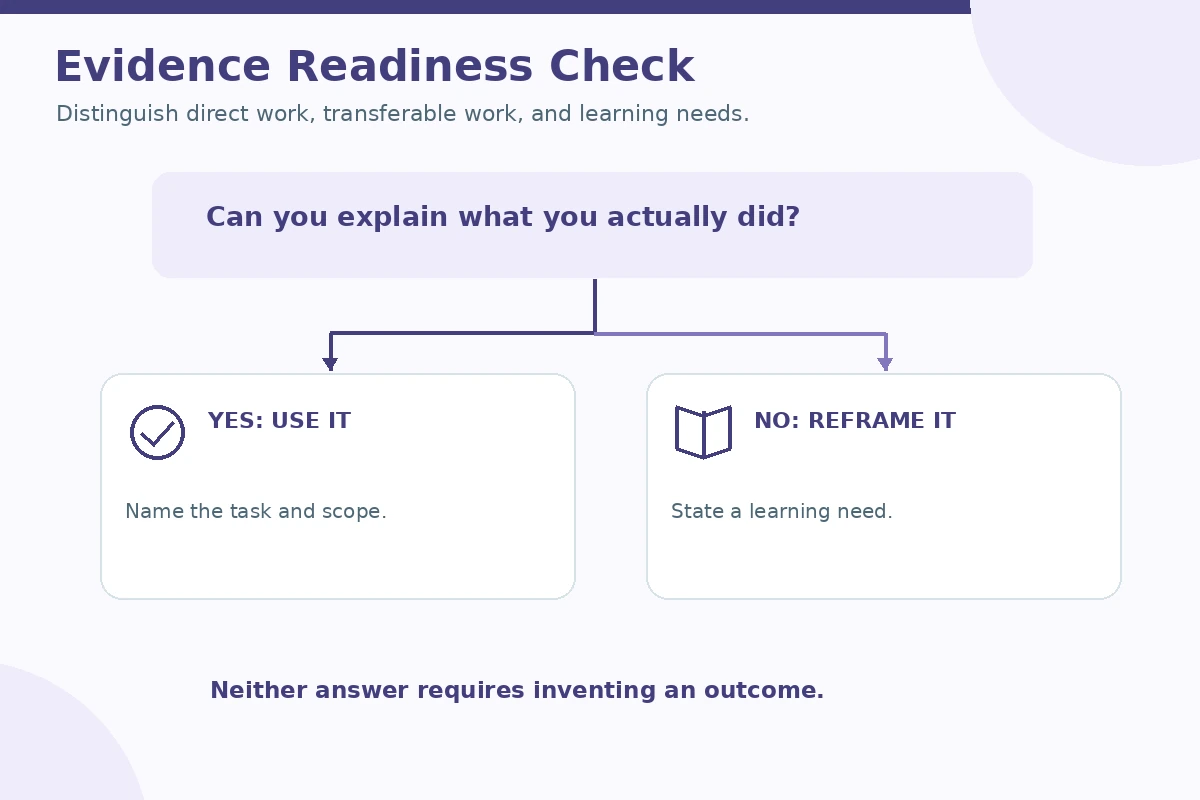
Practice with two short work examples that support the two main requirements. For each, be able to answer: what did you own, who approved decisions, what did you produce, and what was the outcome you actually observed? A class project, volunteer task, or internship can provide enough detail if it is authentic.
If you notice a requirement you cannot demonstrate, do not construct a fictional experience. Identify what you could learn, the relevant preparation you do have, and an honest question about onboarding. This converts uncertainty into a practical discussion without presenting intention as established competence.
Use a Final Evidence Check
Read your draft answer with the posting beside you. Mark each skill you named and the sentence that supports it. Remove any strength that is unconnected to the role; cut claims like “industry-leading” or “the strongest candidate” that cannot be evaluated. Use the time saved to explain the concrete task.
Be prepared for a follow-up such as “What exactly was your contribution?” Make clear whether you worked alone, shared responsibility, or followed a supervisor’s instructions. The ability to draw that boundary is especially important when the advertised job involves restricted systems, customer accounts, or safety-sensitive work.
How We Research These Interview Answers
JobAsk reviewed Bc career guidance, Careerservices career guidance, Career career guidance on October 27, 2026. We used these sources for the purpose of common interview questions, evidence-based answers, and candid role-fit discussions. The practical diagrams are our original teaching aids, not employer policy. All sample wording is hypothetical and must be adapted to actual job descriptions, experience, and the candidate’s circumstances.
JobAsk does not guarantee an interview, an offer, or a particular employer decision. The examples contain no paid referral. For site-wide commercial relationship information, read the affiliate disclosure.
Keep one evidence-backed statement for each major requirement. If you cannot defend a claim with a real example or training history, replace it with a candid learning need. A truthful, specific answer does more work than enthusiastic labels.
More Interview Preparation Guides
- Why Did You Leave Your Last Job? Give a Clear, Truthful Interview Answer
- STAR Interview Answer Preparation: Build Real Stories That Fit the Question
- Solved a Difficult Problem Interview Answer: Show Your Decisions
- Conflict With a Coworker Interview Answer: Show a Fair Resolution
- What Motivates You in an Interview? Connect Real Drivers to the Job
No. You cannot know other candidates’ qualifications. Match your own evidence to the posted role.
Two or three well-supported job requirements are often easier to explain than a long list of adjectives; follow the question and the time available.
Use transferable experiences at their true scope and state what training you still need.
Yes. Describe the actual assignment, your individual contribution, and what you produced, without inventing business outcomes.
Do not claim you already have it. Discuss related work honestly and ask whether the employer trains new hires for that responsibility.