
Seeing the same job advertised again after an interview can be unsettling, but the posting alone does not tell you whether your candidacy is active. Compare the employer, requisition number, location and duties with the role you interviewed for. Keep the original application record and the decision date the recruiter gave you. If that date has passed, ask your known contact for a status update; if the new posting has a different requisition or substantially different role, ask whether it is a separate opening before applying again. A repost is a signal to verify, not a rejection message.
Compare the Requisition Before Reading the Date
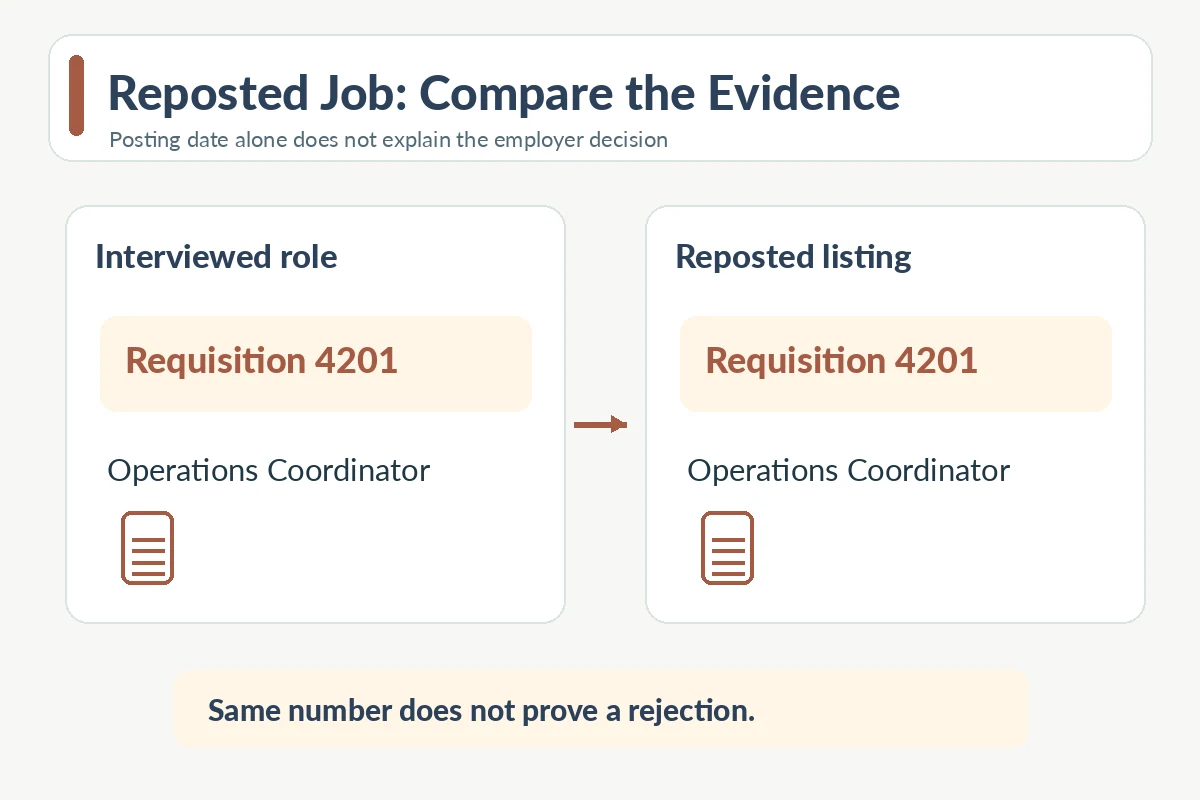
Capture only the details necessary for a private comparison: the original role title, employer’s requisition ID, location, department, major responsibilities and date you interviewed. Compare those with the current listing on the employer’s official careers page. Job boards can display new posting dates for refreshed advertisements without proving a new selection process. If a role appears on several boards, that also does not establish multiple vacancies. Prefer the organization’s official record over a third-party snapshot.
A fictional example: you interviewed for ‘Operations Coordinator, ID 4201,’ and the same ID appears again with identical responsibilities. This may be a refresh, but you cannot know the employer’s internal reason. A different ID such as 4279 with a new shift requirement may be a separate opening. Avoid telling the recruiter that you have been rejected because the site says ‘new.’ The observable facts are the IDs, dates and content, not the employer’s intention.
Separate Four Possible Posting Situations
The first possibility is a routine renewal of the original advertisement. Another is ongoing recruitment for several hires. A third is a changed description: location, experience threshold, team or hours may have changed. A fourth is a genuinely new requisition with its own applicant pool. Indeed’s career guidance describes more than one reason employers repost jobs, but none guarantees an interpretation in your case. A posting change is not equivalent to an official employer decision.
If you received an explicit rejection, follow that instruction and any stated reapplication rules; do not treat a repost as an invitation to bypass it. If you have not received a decision, preserve the existing interview correspondence. Reapplying immediately to an identical posting might add a duplicate record rather than improve visibility. When the ID and requirements differ meaningfully, a brief question about eligibility is more targeted than submitting the same application repeatedly.
Time the Status Message to the Stated Process
Check whether the recruiter promised a date for the next update. University of Alabama career guidance encourages waiting until after the date supplied before sending a polite status question. If no timeline was given, use the organization’s stated hiring process or a reasonable period rather than treating every repost as a deadline. Boston University’s career center notes that hiring delays do not automatically mean someone is no longer being considered. The posting is context; the employer’s communication governs what is confirmed.
Illustrative email: ‘Subject: Operations Coordinator, requisition 4201 — status question. Thank you again for the opportunity to discuss the role on Tuesday. I noticed a new listing with the same requisition number and wanted to confirm whether my application remains under consideration. I remain interested and would appreciate any updated timing you can share. Thank you.’ The example is fictional, and it asks one verifiable question without arguing about what the repost means.
| Posting detail | If unchanged | If different |
|---|---|---|
| Requisition ID | Keep original record | Ask if separate opening |
| Location or shift | No new assumption | Check whether suitable |
| Employer decision | Wait for direct notice | Follow explicit instructions |
Decide Whether a Second Application Helps
Use a three-way check. Same requisition and no new instructions: ordinarily keep the existing application and wait for the agreed contact window. Different requisition and duties that suit you: confirm whether it is a separate opening and apply through its official route if appropriate. Explicit rejection with a new job: examine employer eligibility and any cooling-off or reapplication policy, rather than assuming the new listing reopens the original interview. None of these branches guarantees a response.
For a role with multiple locations, verify whether the new listing uses a different work site or schedule before calling it a duplicate. A hiring system may assign separate IDs to locations and teams even if the title is the same. Conversely, the same position can show several dates due to distribution on different platforms. Do not invent inside knowledge of the applicant tracking system or imply that a change in posting date proves the recruiter saw your resume.

Keep a Repost Evidence Log Private and Minimal
Record the interview date, original requisition, employer-supplied timeline, posting URL, changed fields and the exact status inquiry you sent. This protects you from forgetting whether you saw the same role or a different one. Avoid collecting employee contact details, scraping internal systems, or distributing screenshots of recruiter correspondence. The purpose of the log is making one accurate decision, not monitoring every edit on the employer’s careers page.
When the recruiter responds, update the status with their words, such as ‘still reviewing’ or ‘different opening,’ without upgrading that into an offer or rejection. If they give a new date, note it. If they ask for a new application under another ID, follow the official instructions. If they do not respond, continue your broader job search; the public posting cannot substitute for a personalized decision.
Know What the Repost Cannot Tell You
A repost does not measure your interview performance, disclose the number of finalists or predict whether an offer is coming. A candidate may be considered while recruiting continues, and an ad may remain live after decisions change. Avoid framing the message as ‘Why did you reject me?’ unless the employer has actually said so. Good follow-up asks a limited factual question and leaves room for normal hiring processes.
Use the interview to judge your own fit too. If the new description adds duties you do not want or a location you cannot reach, reassess rather than chasing the posting. The goal is not to win a social-media debate about why companies repost roles. It is to keep your own application accurate and find out whether there is a legitimate next step for the job you actually discussed.

How We Research and Verify Interview Guidance
This U.S.-focused guide was checked on 2026-11-13 against career-center and consumer-protection guidance: www.indeed.com; career.sa.ua.edu; careers.bu.edu. The sources support general professional communication and the specific boundaries identified above; they do not predict an individual employer’s response. Every sample message, job title, personal anecdote, requisition number and person in this article is an illustrative fictional example, not a documented real hiring exchange. Always follow the instructions in your own interview invitation and verify a recruiter through an official company channel. See our affiliate disclosure; this page does not claim a paid employer or service partnership.
More Interview Preparation Guides
No. It can reflect renewal, ongoing recruitment or a changed role. Only the employer can confirm your status.
Usually first check the application record and employer instructions; a duplicate submission may be unnecessary.
Yes, neutrally, if it changes a useful question about the role or if the promised update has passed.
Compare responsibilities and location, then ask whether it is a separate opening and apply through the official route if appropriate.
No. Public listing status does not reliably reveal its internal interview or selection schedule.