
If you left an interview with an important unanswered question, send a concise follow-up only when the answer affects your next action or understanding of the role. Choose one or two specific questions: for example, whether the next stage requires a work sample, which team owns a named responsibility, or when the employer expects to contact candidates. Questions about minor office preferences can usually wait. Thank the interviewer, state the precise question and avoid a long list that makes the team repeat the job description. Follow any instructions already provided.
Separate Action Questions From Curiosity Questions
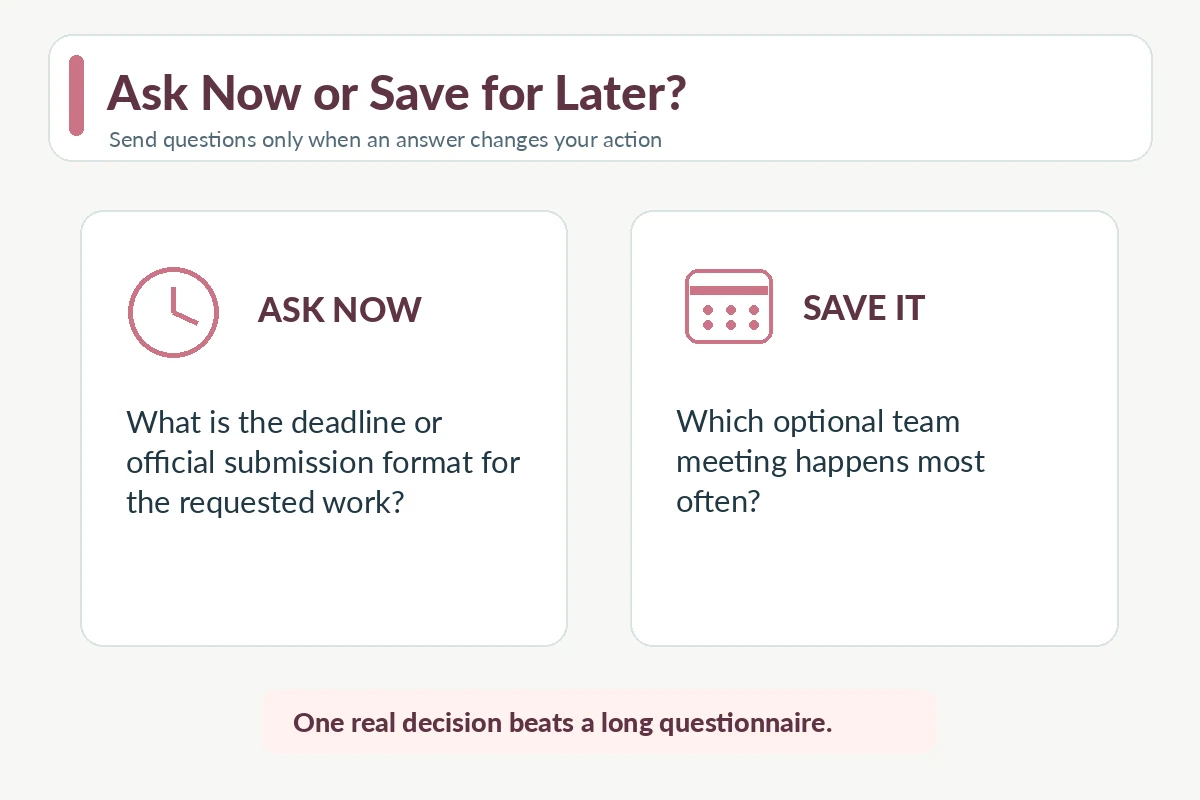
An action question changes what you need to do: prepare a presentation, submit a requested document, confirm shift availability or choose whether to continue in the process. A curiosity question can improve your understanding but often belongs in a later interview: which software the team may adopt next year, what office snacks are provided or who attends optional meetings. Write the specific decision the answer will affect. If you cannot identify one, consider saving the question for the next scheduled round.
For a fictional lab coordinator role, ‘Should I prepare a five-minute process demonstration for the next stage?’ is actionable if the interviewer mentioned an assessment without details. ‘What are all the instruments I might ever use?’ is too broad. The goal is not to demonstrate interest through volume. A brief precise question shows you understood what was discussed and can distinguish missing information from material already in the job posting.
Check Notes and Existing Materials First
Review the original posting, invitation, handouts and any recruiter email to see whether your question is already answered. If the recruiter gave a decision date, do not ask the same question the next morning. UW Bothell’s career guidance says candidates may use a follow-up message to ask when and by what means they will hear from an employer if the interview did not clarify those details. That is narrower than demanding an immediate hiring decision.
Check the name of the role, interview date and whether different interviewers gave apparently conflicting information. If there is a real discrepancy—such as an invitation that says ‘portfolio review’ while a recent message says ‘technical assessment’—ask the coordinator which format currently applies. Do not accuse either person of an error. Keep contact with the established recruiting channel unless directed otherwise.
Use a Small Priority Matrix for Your Questions
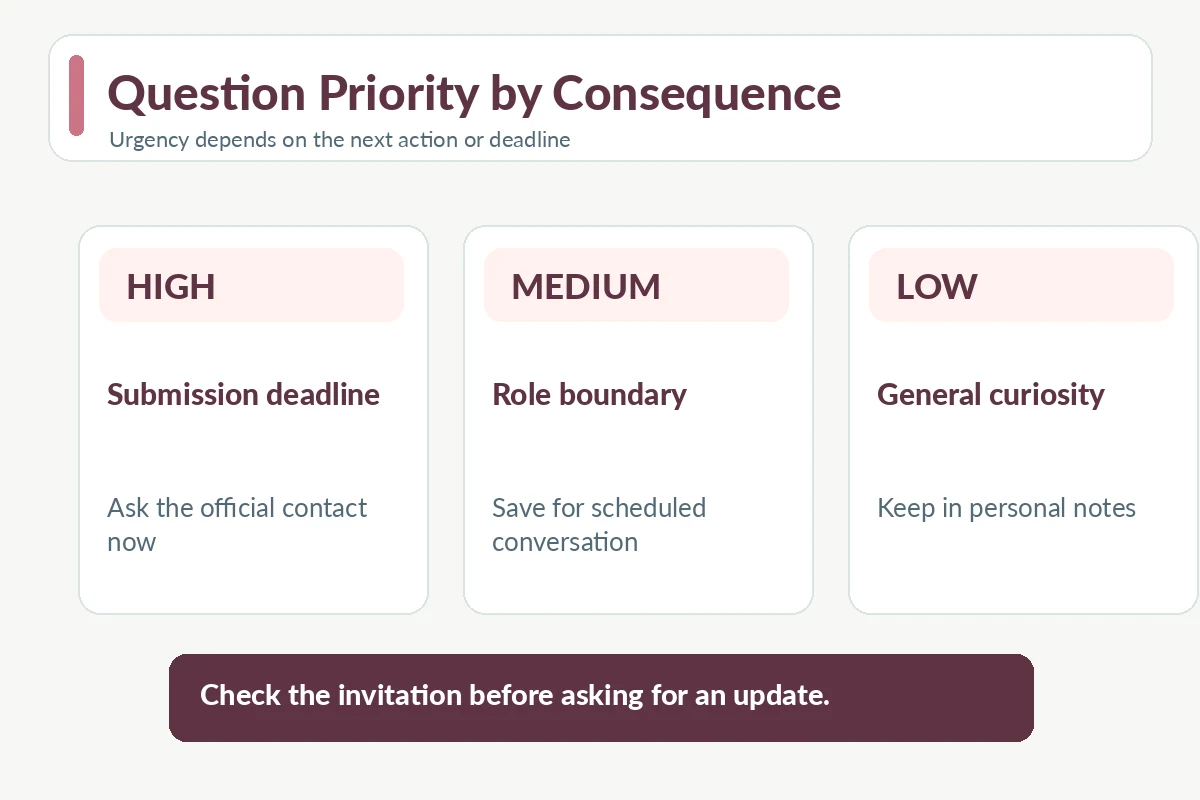
Rank each draft question by urgency and relevance. High priority: where to submit an expressly requested sample before a stated deadline. Medium priority: how two teams divide a responsibility that affects whether you accept a future offer. Low priority: a detail that would be interesting but does not change your preparation or decision. Send the high-priority issue; save the medium question for a planned conversation if no immediate answer is needed; remove the low-priority item.
Avoid requests for confidential information, names of other candidates, exact interview scores or an explanation of an unannounced internal decision. You can ask about the hiring process without demanding access to private evaluation materials. A useful follow-up respects the interviewer’s time and the employer’s boundaries, even when the process itself is uncertain.
| Question type | Decision | Why |
|---|---|---|
| Requested sample deadline | Ask promptly | Changes required next action |
| Unclear next-stage format | Ask coordinator | Prevents preparation mistake |
| General future team curiosity | Save for next conversation | No immediate action depends on it |
Draft a Two-Question Maximum Email
Illustrative message: ‘Subject: Follow-up question — Facilities Coordinator interview. Thank you for explaining the role and the handoff process yesterday. I have one question before the next stage: will the team want a sample shift handoff checklist, or is the next conversation discussion-only? I am happy to follow the format you prefer. Thank you again for your time.’ It identifies the decision, provides enough context and does not insist on a response by the end of the day.
When a second question is essential, make it genuinely distinct, such as ‘Is the next stage on site or virtual?’ Do not smuggle five subquestions into two sentences. If the interviewer requested questions by a particular time or through a portal, follow those directions. For a question that concerns pay, benefits or conditions necessary to accept an offer, use the appropriate hiring contact and stage rather than treating a thank-you note as a negotiation ultimatum.

Decide When the Email Should Be Sent
Thank-you notes are generally prompt, but a status follow-up should respect the employer’s decision schedule. University of Alabama recommends waiting briefly beyond an employer-provided date before checking status. The right timing for a clarification that affects a requested near-term assignment can be earlier. Do not combine an urgent logistics question with ‘Have I been hired yet?’ if the decision date has not arrived. Separate the two purposes so the coordinator can answer efficiently.
If you only remembered an optional informational question after the interview, there may be no reason to send another note immediately. Keep it for a later round or informational conversation. Avoid repeatedly emailing different staff with small changes to the same question. Record the outgoing message and the reply in your private application tracker to preserve consistency.
Handle No Answer and Conflicting Instructions Carefully
An unanswered post-interview question is not an implicit rejection. When the question affects a real deadline, contact the official coordinator using the approved channel and briefly cite the outstanding task; do not keep guessing at assessment requirements. When the question does not affect a deadline, wait for the next scheduled contact. If two people give inconsistent directions, quote the instructions neutrally and ask which is current, without forwarding private team commentary beyond those who need it.
If the answer changes your interest in the position, update your own notes and take time to assess fit. Following up is not simply a technique to make the recruiter remember you. It is a way to avoid mistakes and make informed decisions while respecting that the hiring team owns its timeline. Never claim that asking more questions makes an applicant more likely to receive an offer.
How We Research and Verify Interview Guidance
This U.S.-focused guide was checked on 2026-11-13 against career-center and consumer-protection guidance: www.uwb.edu; career.sa.ua.edu; careercenter.ucdavis.edu. The sources support general professional communication and the specific boundaries identified above; they do not predict an individual employer’s response. Every sample message, job title, personal anecdote, requisition number and person in this article is an illustrative fictional example, not a documented real hiring exchange. Always follow the instructions in your own interview invitation and verify a recruiter through an official company channel. See our affiliate disclosure; this page does not claim a paid employer or service partnership.
More Interview Preparation Guides
Usually one or two tightly related questions are easier to answer than a long questionnaire.
Respect the timeline the employer provided. A status follow-up is separate from an immediate clarification.
Yes, describe the exact scope distinction and why it matters rather than requesting a complete rewrite of the job description.
Send a second message only if a meaningful new question affects an action or deadline; otherwise save it for later.
For an urgent requested task, use the approved channel once more; for nonurgent curiosity, await the next planned contact.