
Work-from-home jobs without phone calls do exist as a search category, but a job-board label cannot establish that a particular position is voice-free. Look at the actual work: written support tickets, quality checks, editing, records, or document production may be largely asynchronous, yet the same title can include customer calls, video meetings, or urgent voice escalations. Treat “no phone” as a requirement to verify with the employer, not as a promise based on a search filter.
This guide separates three questions often mixed together: Are customer calls part of daily duties? Are internal meetings conducted by voice? Can an exception require a live conversation? The Bureau of Labor Statistics describes customer service as spanning phone, email, live chat and other channels, depending on the employer. The examples here are hypothetical; they are not current vacancies, salary estimates or assurances that any company hires without calls.
Separate Written Tasks From Voice Requirements
A job may revolve around email responses, ticket notes, updating a knowledge base, editing drafts, or checking incoming records. Those are written tasks, but the job may still include scheduled customer calls or internal standups. Read the entire duties section and search for “phone,” “inbound,” “outbound,” “voice,” “dialer,” “video,” “escalation,” and “coverage.” The absence of these words is only a missing disclosure; it is not verification of a no-call policy.
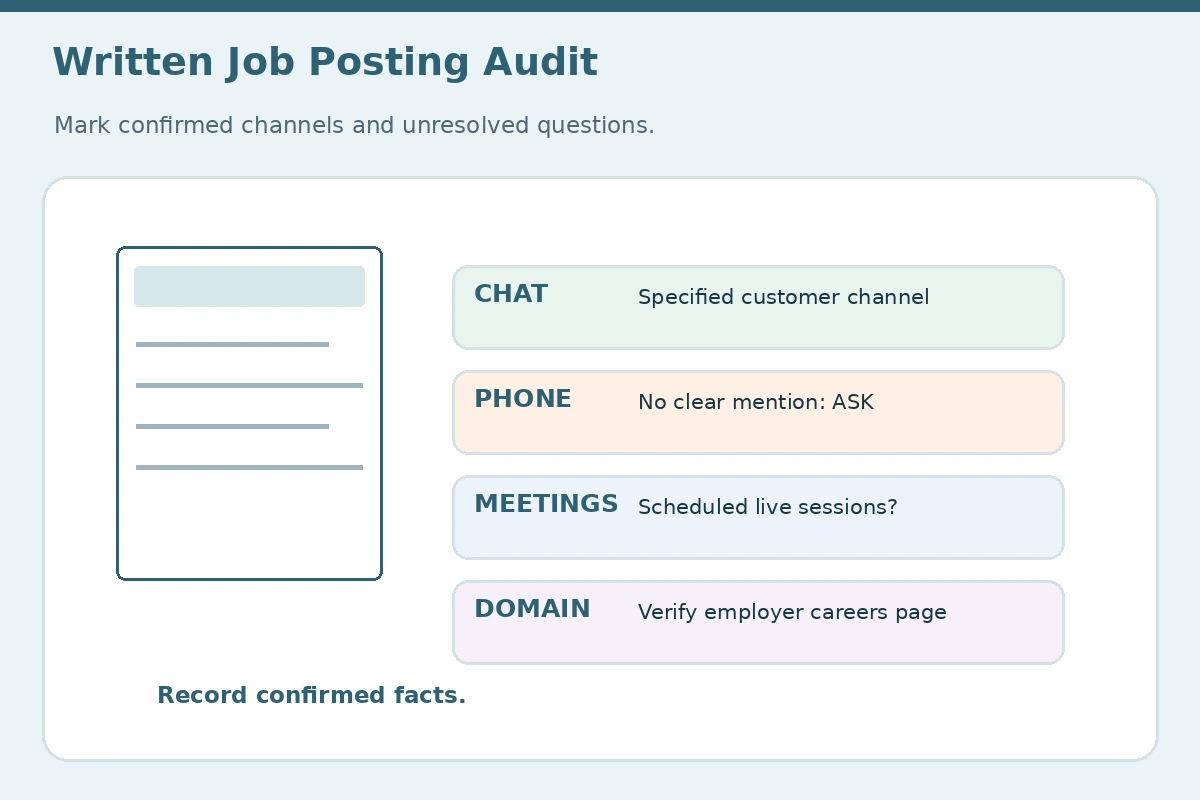
Create three separate checkboxes: customer-facing voice work, internal meetings, and exceptional escalations. A prospective written-support specialist may accept internal weekly video meetings but need to avoid a customer phone queue. Another candidate may need no required live voice interactions at all. These are different requests. Ask the employer which channel carries each responsibility, how frequently it occurs, and whether voice coverage is essential to the role.
Compare Role Families Without Assuming Every Job Is Silent
Written customer support can involve chat or email, yet BLS notes customer service duties vary by workplace and may include phone calls. Office support can involve records and documentation but also telephones. Writing, proofreading and programming can prioritize documents and code while still requiring meetings. The correct unit of comparison is a specific posting and team workflow, not a generic industry label such as “data,” “creative,” or “online.”
For a hypothetical support vacancy, copy a sentence stating “respond to customer chats and assigned ticket updates,” then look for an additional sentence requiring callback coverage. If one exists, the job is not strictly phone-free, even if most work happens in chat. For a document-review position, ask who clarifies unclear instructions and whether the process is written or verbal. Build a small role-by-role comparison before applying.
| Listing phrase | What it confirms | What to ask |
|---|---|---|
| Chat and email support | Written customer channels appear | Any required callbacks? |
| Async communication | Some written collaboration | Voice meetings or escalations? |
| No phone listed | The ad is silent | Confirm the actual channel mix |
| Fully remote | Work location label | Location and equipment conditions? |

Ask Precise Questions About Required Live Contact
A question such as “Is this really non-phone?” invites a vague answer. Instead try: “Does this position have a customer telephone queue? Are there recurring voice meetings, and can urgent cases require a call?” Ask about training too: an employer may use live onboarding even when the daily queue is written. A truthful response about mixed channels helps you decide whether the position fits your needs.
Distinguish required communication from optional practices. A recruiter might describe most handoffs as written but still have daily voice coordination. You can ask for the expected frequency and duration of required meetings, time-zone overlap, and exceptions. Do not assume that a posting offering flexible hours also lets you ignore scheduled meetings or that a chat-only label means no identity verification or legitimate interview.
Check Equipment, Access, and Employer Legitimacy
For written work, employers might require a computer, approved support software, secure login and reliable connectivity. But you cannot infer exact equipment, privacy or location conditions from the job title. Read the posting and verify any device policy through the employer. Never install unfamiliar software or send private identification documents merely because someone promises immediate no-phone work by unsolicited message.
The Federal Trade Commission warns about fake remote jobs that ask applicants to pay for equipment or training, handle checks, or transmit sensitive details early. Confirm the vacancy on an independently located employer career page and look for a recognizable hiring process. If a supposed recruiter uses an unrelated address or pushes for payment, stop. A professional-looking text or chat invitation does not establish that an employer is real.

Build an Evidence-First Application for Written Work
Once a posting is verified, show evidence of the required written process. A customer-support candidate can describe accurate ticket summaries and escalation notes. An editor can show a permitted before-and-after sample. A records assistant can demonstrate careful reconciliation without exposing customer data. In each case state what you personally did, the tool category you actually used and how your work was reviewed.
A hypothetical resume bullet could read: “Documented customer requests in a shared ticket queue and routed unresolved questions to the shift lead.” That does not claim the candidate handled only chat unless that was true. Prepare examples of concise status updates and clear question handoffs because those skills matter in writing-heavy teams. Do not fabricate typing speeds, error rates, productivity scores or a fully asynchronous employment history.
Use a Short Decision Log Before Applying
For each promising vacancy, record employer domain, advertised channel, required meeting schedule, possible voice escalations, location restriction, application link and date verified. Mark unanswered questions as “ask,” not as “no.” If telephone tasks are truly prohibited for your situation, do not submit an application solely on the assumption that a role will be converted into written work for you.
Before sharing contact data, revisit the original employer posting and compare it with the recruiter’s instructions. An independently confirmed opening with clearly described channels is more useful than a large list of alleged no-phone jobs. Save the wording of employer answers, not screenshots containing other applicants’ information. The goal is a role that fits the actual workday and has a real, accountable hiring contact.
How We Research Work-From-Home Jobs
On 2026-11-14, we checked these sources: BLS: Customer Service Representatives — BLS explains that customer service can involve telephone, email, live chat, social channels and escalation, varying by employer.; BLS: General Office Clerks — BLS lists document updates, clerical correspondence, data entry and telephone duties that vary among office positions.; FTC: How to Avoid Work-from-Home Job Scams — FTC advises independent employer checks, no up-front payment for a promised remote job, and caution about fake checks.; FTC: That Job Offer Text Is Probably a Scam — FTC warns that unexpected remote-job texts and job offers with no specific duties may be scams.. We reviewed search results and compared topics with the supplied WordPress export and the preceding packages, distinguishing role-specific facts from our original application frameworks. All sample statements are hypothetical and should be replaced with true experience. This guide does not verify open vacancies, employer promises, individual eligibility, hiring outcomes or compensation. Always check the employer and current posting independently. Read our affiliate disclosure. No sponsored placement or affiliate approval is claimed here.
Related Job Search Guides
No. Some support teams combine chat with telephone coverage. Ask whether callbacks, urgent cases or training require voice contact.
Yes, depending on the posting and the team. Confirm scheduled internal meetings separately from customer-facing calls.
No. Check the independent employer site and duties, and avoid fee demands, fake checks and unsolicited task offers.
Treat the channel requirement as unverified. Ask the employer before accepting or relying on a phone-free arrangement.
Use actual ticket notes, editing samples or recordkeeping examples that demonstrate clear written work without confidential material.