
For work-from-home proofreading jobs, first identify which version of a document you would review, what kinds of changes you may make, and who signs off on the final file. A genuine posting should describe an identifiable editorial deliverable, its turnaround time, the format used to mark corrections, and the person who resolves disputed changes. Proofreading is not automatically copyediting, ghostwriting, or a promise that a manuscript is ready to publish. Remote access changes the handoff, not the need for clear ownership of corrections.
Identify the document stage before applying
A final proof is the near-finished version of a file. The assignment might be to mark punctuation, typesetting, cross-reference, capitalization, or repeated header errors while preserving approved wording. Copyediting may reach further into clarity, consistency, style and sentence structure. A listing that says “proofreader” but expects restructuring a chapter or choosing what to publish is asking for broader editing work. Read the actual task description rather than relying on a title or a search filter.
Ask which version is authoritative, whether there is a style guide, and whether corrections should be tracked, commented on, or entered directly. For example, a hypothetical marketing PDF might need a final pass on dates, captions and spacing; a manuscript may need to return marked changes to an editor. The differences affect the skills, tools and time needed. If the employer cannot explain the starting file and desired output, do not assume you can safely complete the assignment.
Separate error detection from publishing authority
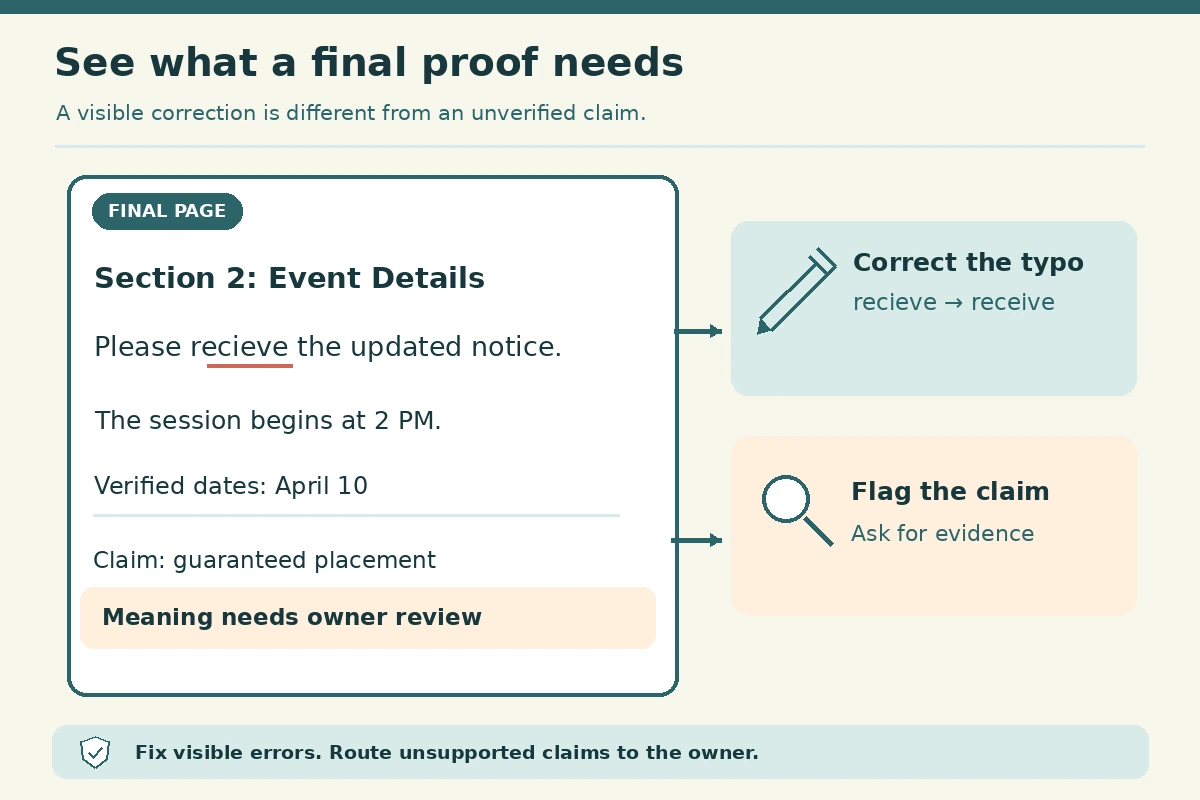
An accurate proofreader records problems clearly and lets the assigned decision-maker resolve ambiguous edits. A wrong heading number may be directly verifiable; a proposed change to a technical claim might require author or subject-matter review. Do not promise to approve legal, medical, financial or scientific accuracy unless the role explicitly includes that qualified review. The distinction is especially important when documents contain confidential information or customer records.
Build an example correction log with four columns: location, visible issue, proposed correction and reviewer decision. Label the examples as fictional, not samples from an employer’s private document. Show two clear typographical fixes and one uncertain item that you would flag rather than silently change. This demonstrates judgment and makes it obvious when you would escalate. It also creates a more persuasive portfolio piece than merely saying that you “have an eye for detail.”
Test how your revisions reach the next person
Remote editorial teams may circulate PDFs, word-processing files, layout proofs or content-management previews. Some allow inline tracked changes; others require comments, page-and-line references or a proof form. Ask whether work comes through an employer system, whether locally saved copies are permitted, and how the team verifies that corrections were incorporated. A simple correction can be lost if it is made to the wrong version of the file.
Before accepting a sample task, verify the project contact, instructions and permitted sharing location. For a legitimate test, use a sanitized or provided sample and confirm whether the work is an assessment or paid production. Never publish client pages in a portfolio without permission. If the task would require installing an unknown program or sending identity documents before the position is verified, stop and use official contact information to investigate.

Read deadlines and workload in context
A short document can require meticulous checking; a long one may contain repetitive items best handled with a consistent checklist. Ask whether deadlines mean a fixed clock time or a flexible submission window, whether multiple proofs can arrive together, and how urgent changes are assigned. Work-from-home does not mean all jobs are asynchronous. Editors or layout teams may need an immediate response to resolve a final proof before publication.
For example, suppose a fictional listing says “review articles each morning.” That does not reveal the document length, frequency, editing depth, or coverage hours. Ask for a representative brief and an explanation of the handoff. A realistic work sample should let you describe which errors you caught and how you tracked them—not claim a universal speed or guaranteed zero-error publication. Avoid fabricated production volumes in an application or résumé.
Build a truthful proof sample from clean material
Create your own short fictional document and intentionally insert a small, disclosed set of inconsistencies: a misspelled heading, an incorrectly repeated word, mismatched table labels and one unclear factual reference. Mark ordinary errors with precise corrections and flag the questionable claim for review. Attach an explanatory note describing the rules you followed. This shows the difference between checking visible copy and taking ownership of information you cannot verify.
If you already proofread at work, school or for a nonprofit, describe the actual assignment, software and reviewer relationship without disclosing confidential text. State whether you were the final proofreader, a peer reviewer or a volunteer helping with documents. Put the best evidence first in an application, then match terminology to the posting. An employer may value consistency and clean handoffs more than a stack of unverified online certificates.

Verify the organization and payment process
Look for the position on the organization’s own careers page or contact an independently found official address. Compare the sender domain, business identity, assignment type and hiring sequence. The FTC warns that remote job scams may request fees for useless training or use a fake check to fund supposed equipment. A convincing email template or polished website is not enough to establish that a particular role exists.
Do not deposit a check and return funds, buy gift cards for a “supervisor,” or pay an application fee to access promised proofreading work. Preserve suspicious messages and report a potential scam through the FTC resources. A real freelancer may have normal business expenses, but that is different from an unverified recruiter requiring a transfer before offering work. Be especially careful with offers promising effortless income for a tiny amount of typing.
Use this comparison before committing
Compare openings on five dimensions: document stage, correction rights, tools and file access, deadlines, and who accepts the completed proof. Note the answers in a job tracker with the listing URL and date checked. If two postings look identical, do not treat them as two independent employers until you verify the source. If a job is described only as “easy typing from home,” research whether there is a real editorial workflow at all.
Choose opportunities where you can show relevant proof and understand the responsibilities. A plausible next step is to prepare one labeled sample, write a short application that names the proof stage you can handle, and ask a focused question about the review loop. Nothing about that process guarantees selection. It does, however, reduce guesswork and keeps you from claiming editorial authority beyond your experience.
How We Research Remote Job Roles
We compare occupation descriptions and relevant official guidance with the precise work-from-home search intent. We distinguish repeatable job-search decisions from employer-specific terms, credentials, publication authority and task availability. Every example in this article is fictional and intended as a worksheet, not an actual vacancy, employer policy, compensation estimate, legal conclusion or promise of hiring. We checked the linked resources on November 11, 2026 and do not claim to have verified private WordPress drafts or current openings.
Primary and consumer-protection sources checked November 11, 2026: www.onetonline.org — O*NET identifies proofreaders as checking typographical and compositional errors, comparing records, and routing marked corrections.; www.bls.gov — BLS describes broader editorial work such as revising content, verifying facts and approving final versions, useful for separating editing from proof checks.; consumer.ftc.gov — FTC advises verifying work-from-home hiring and avoiding any demand for payment or check-based equipment purchases.. These sources explain duties or warnings; they do not certify any specific advertised job.
Our guidance is informational and editorially independent. See the JobAsk affiliate disclosure for the site’s relationship and link policy. The internal next steps here are not paid endorsements.
Related Job Search Guides
No. Proofreading often focuses on errors in a near-final proof, while copyediting may involve broader clarity, style and consistency revisions. Check each posting for its actual scope.
You can assess whether an entry-level posting accepts a careful self-created sample or relevant school or volunteer work. Never present a fictional test as client work.
Flag the claim and identify the source or subject-matter reviewer needed. Do not silently invent a correction or claim expert sign-off.
Expect clear instructions, a document or excerpt, an editing method and a submission channel. Confirm how the employer will handle confidential content and assess lengthy unpaid requests cautiously.
Verify the opening independently and avoid recruiters requesting upfront payments, bank transfers, identity information too early, or equipment-check schemes.