
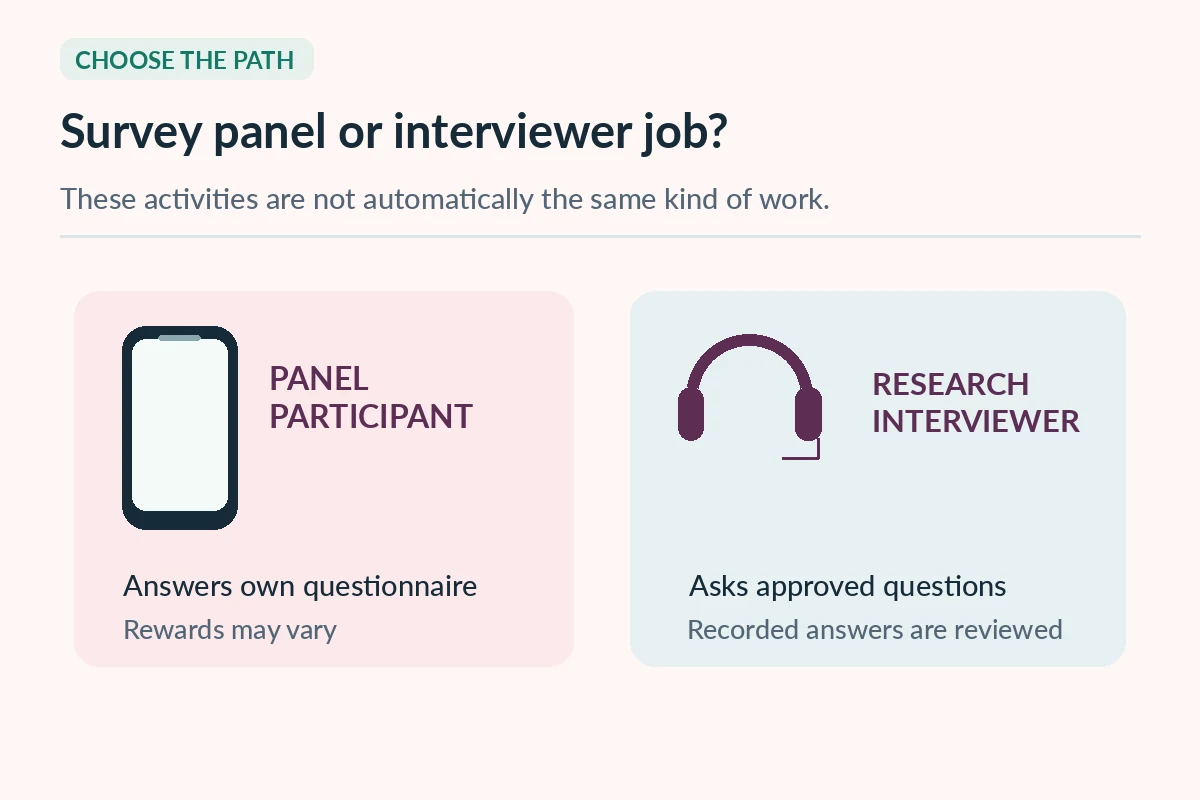
Searching for work-from-home survey jobs leads to two very different activities. A rewards panel may invite you to answer questionnaires as a participant, while a research-interviewer job pays someone to administer questions, record responses, and follow a data-collection protocol. The second is a workplace role; the first should not automatically be described as employment. O*NET lists tasks for interviewers that include following instructions, recording information accurately, and reporting problems with data. Before giving personal details, identify which path the offer actually provides, how compensation is described, and whether an accountable organization stands behind it.
Separate panel participation from research employment
A consumer survey panel asks for your opinions or experiences and may offer modest, variable rewards. It does not normally mean you have been hired to interview other people. A research-interviewer position can involve scheduled calls or online sessions, standardized questions, and quality checks from a supervisor. Search terms like “survey taker” and “telephone research interviewer” should not be treated as interchangeable. Your first screening question is: am I a respondent, a trained collector of responses, or a survey designer? That distinction determines what skills, records, and privacy obligations are relevant.
Understand why scripted questions matter
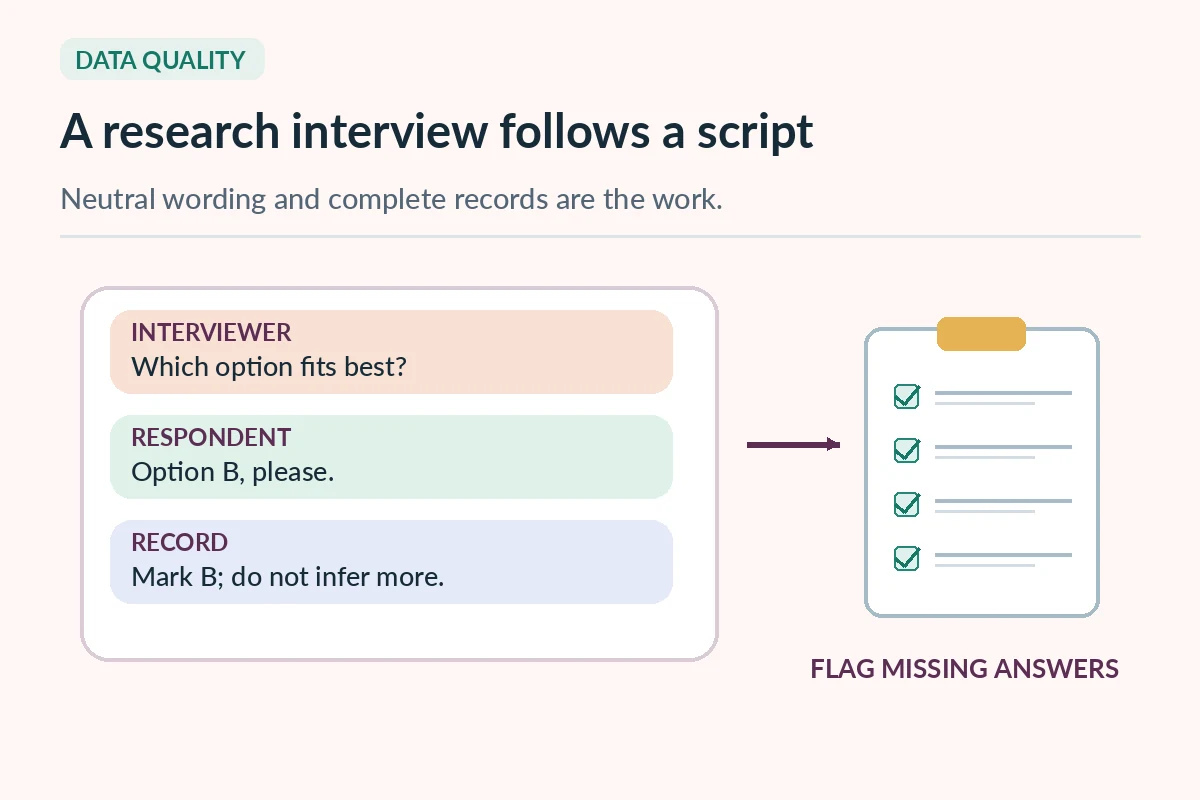
In interviewer work, wording and order can influence data quality. A project may require reading an approved script, explaining participation as instructed, recording a respondent’s answer precisely, and flagging questions that could not be completed. O*NET describes the practical work of interviewers, including following specified questions, checking forms for completeness, and identifying problems. It does not authorize improvising new consent terms or collecting more information than the project requests. Ask what interviewer training is provided and who reviews difficult cases. Your strength is consistency and accurate recording, not steering respondents toward a preferred result.
Check whether the listing is for collection or design
A survey researcher may develop questions, select methods, analyze results, and assess potential bias, a different responsibility from collecting responses. The BLS discusses survey researchers’ planning and analytical work, while O*NET covers interviewers who execute questionnaires. Some ads use “research assistant,” “survey coordinator,” or “market interviewer” loosely, so inspect the actual tasks. Do not claim statistical analysis or survey-design authority because you once completed consumer polls. A job seeker interested in beginner data collection should look for supervised interviewer training, required communication skills, and documented quality procedures.
Ask what counts as a completed interview
Some structured roles involve call attempts, screening for eligible respondents, handling refusals respectfully, and flagging incomplete questionnaires. Ask whether the employer measures calls placed, validated completed interviews, or time on shift, and who audits the work. Do not assume a high “per response” figure is a wage guarantee; clarify whether it is employee compensation, contract pricing, or a panel reward. If scheduling depends on respondents’ availability, your hours may not be entirely self-chosen. Keep a personal log of the employer’s stated basis of pay without recording private respondent information.
Protect respondent information during home work
Interviews can involve personal opinions or other sensitive details. Work through the approved questionnaire and software, use any required quiet space or secure connection, and follow instructions about recording, storage, retention, and participant consent. Avoid writing identifiable answers in a personal notebook or emailing raw responses to yourself. If a respondent asks to stop, the project should have a documented procedure rather than an improvised promise. Questions about privacy and authorization are legitimate ones to raise before accepting the assignment; they do not prove a specific law applies to every survey.
Build a small practice interview without real data
A fictional interview script can demonstrate neutral tone and accurate notation. Try asking an imaginary respondent a simple question about preferred library hours, reading every answer option consistently and marking “no response” when appropriate. Then review whether your record matches what was said. State clearly that it is a practice exercise, not paid fieldwork or a validated research study. For a resume, previous customer conversations, appointment scheduling, or data-entry checks may be relevant if described honestly. Do not invent research clients, participation counts, consent documents, or results.
Evaluate remote equipment and real coverage hours
Some interviewer roles require a headset, approved calling software, a quiet room, a reliable connection, or scheduled evening and weekend blocks. Other data-collection tasks may be asynchronous but have deadlines and review cycles. Ask whether work calls use an employer-provided platform and whether personal numbers are exposed. Distinguish being available to start from being authorized to contact respondents. A legitimate employer should explain how trainees learn the script, report technical issues, and reach a supervisor. A home location alone does not make a survey role independent or flexible.
| Question | Survey panel participation | Research interviewer job |
|---|---|---|
| Your role | Provide your own responses | Ask approved questions to respondents |
| Work product | Completed participant questionnaire | Recorded and checked interview responses |
| Schedule | Eligibility and invitation dependent | Defined project or shift requirements |
| Evidence | Panel terms and privacy policy | Real employer, job posting, training contact |
Spot task scams disguised as survey income
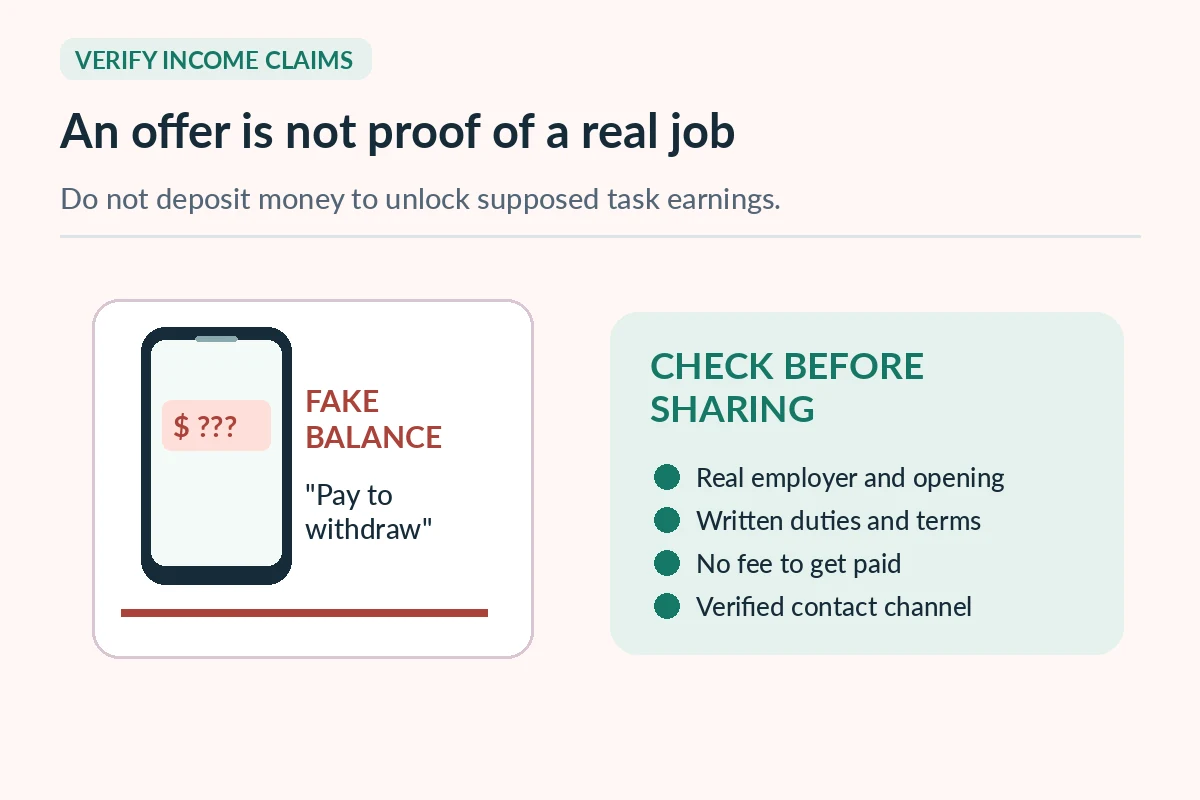
The FTC warns that fraudulent task platforms may show fake growing balances, sometimes make small initial payments, then demand a deposit—often cryptocurrency—to unlock additional tasks or withdraw imaginary earnings. This is not a normal survey-interviewer pay process. A promotional message that offers extraordinary returns for effortless tapping, product boosting, or rating work is not evidence of research employment. Never deposit money to release purported wages. Avoid offers sent through unsolicited chat accounts if the identity and position cannot be independently confirmed. Verify the organization using a website or contact channel you located yourself.
Compare an advertised panel’s actual terms
If you choose to participate in a consumer panel rather than seek employment, read the eligibility, frequency, reward threshold, privacy, and account-closure rules. A panel may screen you out of some questionnaires, and participation may not produce reliable income. Do not present estimated rewards as wages or assume a stable schedule. Think carefully before sharing demographic or contact details and avoid platforms that demand financial login credentials. This guide does not recommend a particular panel or certify that one is legitimate. Its decision method helps you identify the activity and judge the terms.
Search for employer-directed interviewer work
Use more precise searches like “remote survey interviewer training,” “telephone interviewer research firm,” and “remote data collection assistant,” then review the organization’s career site. Check if the job lists a supervisor, project or study purpose, tasks, training, and scheduling. Keep separate folders for employee job applications and optional survey-panel signups; they serve different goals. Verify that the recruiter represents the actual organization before you upload identification. If an ad says “research” but only describes clicking ratings to increase a balance, it may be task fraud rather than an interviewing role.
Use the two-track comparison before applying
On paper, compare who chooses the questions, who answers them, how records are checked, what a participant can decline, and who pays. A panel respondent supplies opinions; an interviewer collects answers under a procedure; a survey researcher designs or analyzes methods. A posting that mixes all three without clear responsibilities deserves questions. If you want steady employment, look for defined paid shifts or projects, a verified hiring channel, and relevant training. If your goal is occasional personal participation, do not confuse a reward estimate with a job offer.
Know when to walk away from the application
Stop if the company cannot explain the activity, demands deposits to release earnings, pressures you to install untrusted software, or asks for unrelated financial details before genuine onboarding. An email from a famous survey brand can be forged; independently locate the employer and vacancy. You can also ask how participants’ data is used, who reviews disputed records, and how results are secured. The best next step is a transparent position with a clear work product and review process—or a knowingly optional panel, not a vague promise to get rich by filling forms.
How We Research These Remote Job Options
We reviewed these original public sources on 2026-11-07: www.onetonline.org (O*NET describes interviewers who ask prescribed questions, record responses and check data completeness.); www.bls.gov (BLS distinguishes survey design and analysis work from interview collection methods and describes research tasks.); consumer.ftc.gov (FTC details fraudulent gamified task offers and demands to deposit money to access purported earnings.). Sources describe occupations, hiring cautions, or general rules; they do not verify any specific vacancy, recruiter, compensation offer, or individual candidate. The sample situations and application lines on this page are hypothetical teaching examples. Compare each listing with its current official employer description and the terms offered to you.
JobAsk provides independent educational information and does not claim an affiliate relationship with the organizations cited. We do not promise employment, earnings, placements, or acceptance by any employer. See our affiliate disclosure. Never include private customer or student records as evidence for a public application.
Related Job Search Guides
No. Rewarded panel participation is not automatically a job; an interviewer role has assigned work and a responsible employer or client.
Typically follows an approved questionnaire, records responses, flags issues, and follows the project’s contact and privacy procedures.
Not necessarily. Data collection and survey design are different roles, and postings may require different education or training.
No. The FTC identifies deposit demands and fake task balances as major scam indicators.
Do not present participating as a respondent as professional research design or interviewing work. Describe relevant actual duties accurately.