
An animal care assistant resume with no experience should show what you can safely and truthfully contribute: cleaning an approved work area, restocking supplies, recording an observation, following an animal-handling instruction or referring a concern to authorized staff. Do not present caring for your own pet as professional shelter employment, and never claim veterinary procedures, medication decisions or handling authority you do not have.
BLS describes animal caretakers as feeding animals, cleaning areas, observing conditions and keeping records, with training varying by role and workplace. Shelter tasks may be physically demanding and require safe procedures. This article shows how to translate approved volunteer work and relevant routines into accurate first-role evidence, rather than duplicating a veterinary assistant resume or promising that personal pet ownership qualifies someone for clinical care.
Read the Animal-Care Role Before Selecting Skills
A shelter attendant, kennel assistant and veterinary assistant are not interchangeable titles. Start with the employer’s specific duties and note whether the role involves cleaning enclosures, preparing supplies, feeding under instructions, visitor assistance or record updates. BLS describes many animal care responsibilities, but a listing does not mean a new applicant may perform them all unsupervised. Mark each task as done before, trained under guidance, or not yet learned.
If you helped at an approved adoption event, you might describe welcoming visitors, moving approved supplies and noting questions for a staff member. That does not establish an ability to assess an animal’s health or suitability for adoption. Use the actual activity label and dates. A role-specific resume is based on actions you can explain, not on a general affection for pets.
Turn Volunteer Help Into Verifiable Support Bullets
A safe example from a fictional volunteer role is: “Prepared clean towels and replenished labeled supplies as directed by the kennel team.” Another is: “Recorded observed changes in feeding notes for a supervisor to review.” These statements highlight careful routines and handoffs. They do not claim that the volunteer prescribed food, diagnosed illness or decided medical treatment. Only use analogous bullets if you performed those steps.
If your experience consists of pet sitting for family, describe the setting as informal or personal and state the actual tasks. You can mention following written feeding instructions, noting when supplies ran low or communicating with the owner; avoid suggesting you worked in a shelter. For team activities unrelated to animals, demonstrate punctuality, clean workspaces and accurate notes as transferable habits.
| Experience type | Safe resume proof | Do not infer |
|---|---|---|
| Shelter volunteer | Approved cleaning or supply task | Unsupervised animal handling |
| Observation | Reported condition to staff | Diagnosis or medication decision |
| Pet sitting | Followed owner instructions | Professional veterinary experience |
| Training | Earned course and date | Uncompleted credential |
Keep Handling, Health and Escalation Boundaries Explicit
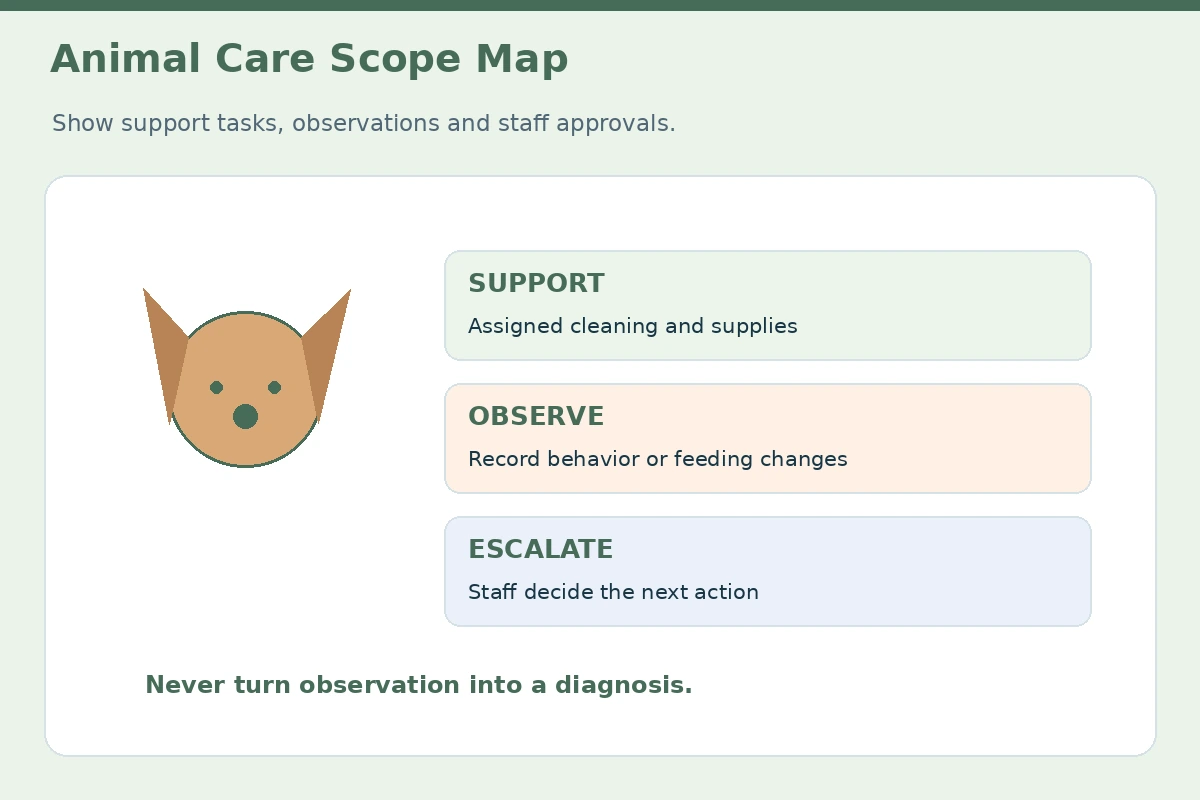
Describe a concern you escalated, not a condition you diagnosed. For example, “Alerted assigned staff when an animal appeared unusually inactive” is a record of an observation if true. “Treated an animal for illness” would be a different, more advanced claim. Shelter rules may limit who handles a frightened animal, operates equipment or performs procedures. Your resume must not imply authorization just because you witnessed that work.
In a job interview, be prepared to discuss how you would follow site instructions and request help when a situation is outside your training. Do not invent universal shelter policies or state-specific legal requirements. If you have training, identify its real provider and date. Claiming an unearned credential creates both hiring and animal-welfare risks.
Show Record Accuracy and Clean Work Habits
Recordkeeping can be as important as direct animal interaction. A support worker might check a cleaning checklist, report a missing supply or forward a feeding observation to a lead. When you describe these tasks, identify the document, who received it and what you actually completed. Do not include a real adopter’s address, an animal’s private medical file or screenshots from restricted systems in an open resume or portfolio.
A candidate with no shelter work may still show a demonstrated habit of following checklists through a school laboratory, supervised community event or other legitimate activity. State the original context clearly. A phrase such as “followed a documented setup checklist for volunteer tables” is more honest than relabeling the same work “kennel sanitation management.” Demonstrate process readiness without borrowing a professional title.

Structure the Resume Around the Real Source of Experience
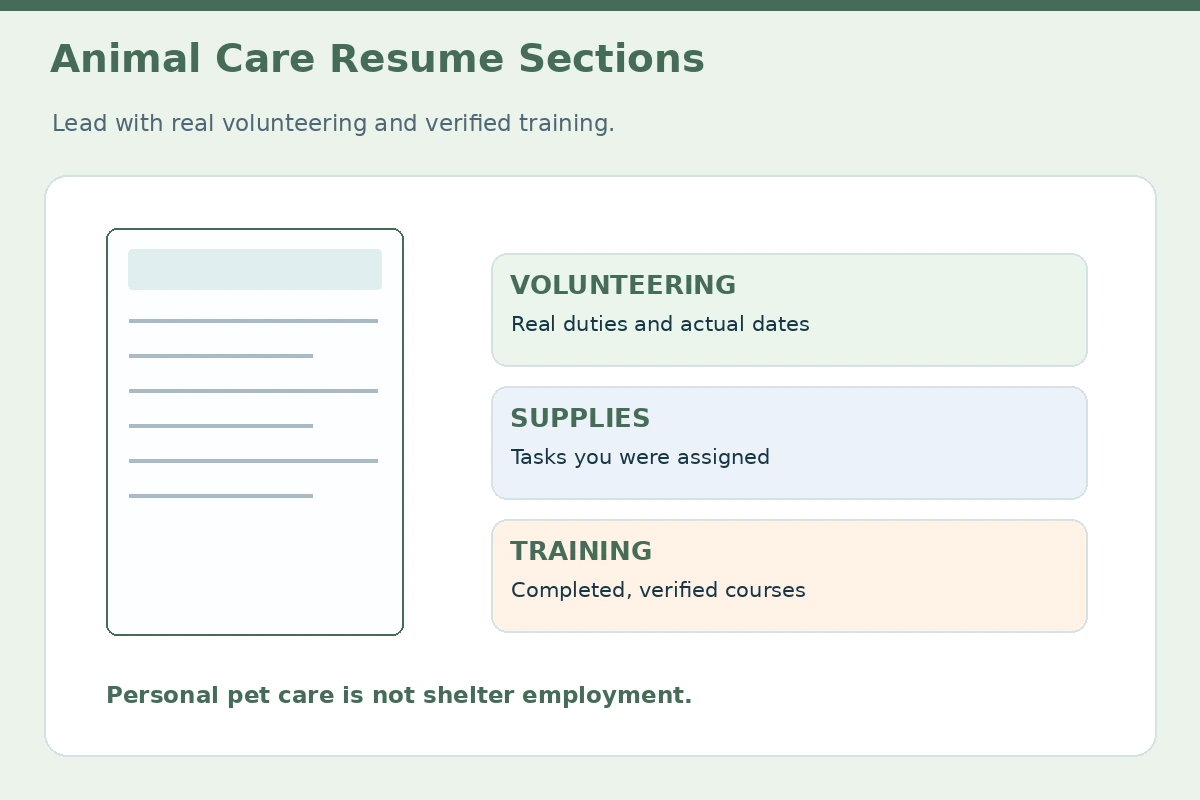
For a first animal-care application, consider contact details, a concise role-specific profile, Volunteer Experience or Relevant Activities, Education, and verified training. If animal work is limited, a “Transferable Experience” section can accurately describe cleaning, records or public assistance. Put the most relevant proof near the top, not an oversized list of personality traits such as compassionate, hardworking and dedicated.
A hypothetical profile might say: “Applicant with community volunteer experience in supplies organization and checklist-based work, seeking training in kennel support.” It should not say “experienced animal care technician” unless that is true. If the job asks about lifting, schedules or driving, answer through the employer’s application fields rather than inventing qualifications in the resume. Keep education status and dates precise.
Audit Claims for Animal Welfare and Privacy
Check each claim against what you did and were allowed to do. Did you actually hold the leash, or did a staff member handle the animal? Did you observe a symptom or make a medical assessment? Did you enter a record or merely hand it to a supervisor? Those distinctions matter. Do not share photos of animals or restricted notes without permission; a text-only task description is often enough.
Open the final PDF and verify the spelling of organizations, volunteer dates and any course titles. Use realistic wording rather than invented animal counts or safety scores. If you lack hands-on experience, seek a legitimate supervised opportunity and update the resume only after completing it. Presenting the limits of your experience is part of being a responsible candidate for animal care.
How We Research First-Job Resume Evidence
On 2026-11-14, we reviewed these primary and professional sources: BLS: Animal Care and Service Workers — BLS describes animal shelter and kennel support, feeding, cleaning, observation and recordkeeping; training and safety matter.; NACE: Career Readiness Competencies — NACE career-readiness framework describes communication, teamwork, professionalism and technology as demonstrable competencies.; Harvard FAS: Resume and Cover Letter Resources — Harvard career resources show action verbs and emphasize expressing accomplishments with clear, accurate, role-relevant descriptions.. We compared the intended queries and article titles with the supplied WordPress export and earlier available drafts. Sample resume lines and visual scenarios are hypothetical; use only your own true history. We do not verify a particular employer, vacancy, interview outcome, credential or resume parser behavior. Refer to the actual job posting and the latest source guidance, and read our affiliate disclosure. No sponsored employment or affiliate endorsement is claimed.
More Resume and Cover Letter Guides
No. It can show personal familiarity, but label it as personal experience rather than paid or shelter work.
Only describe the approved actions you actually took. Do not imply independent handling when staff retained responsibility.
No as performed duties. Observation or shadowing should be labeled accurately and does not give professional authorization.
Yes, if genuine and permitted. Describe specific cleaning, records, supplies or visitor duties with dates.
Only with explicit permission and appropriate privacy controls. Public resume materials generally do not need restricted records.