
A teaching assistant resume should name your setting and supervisor, then show the classroom tasks you actually carried out. The job title can refer to a K–12 paraprofessional who reinforces a licensed teacher’s lessons, a graduate assistant who leads university discussion sections, or a childcare assistant who prepares activities. Those roles differ in responsibility and qualifications. Use your official title and a short, concrete description; do not turn assisting with a lesson into claiming that you independently planned the curriculum or held a teaching license.
Specify the school level and actual appointment
Start with your exact title, the school or department, dates and the age or course level you supported. The Bureau of Labor Statistics describes teacher assistants working alongside licensed teachers, helping with individual or small-group reinforcement and class records. University graduate TAs may have different assignments, including grading, labs or leading discussion sections. If you were a college TA, identify the course or discipline; if you were in a primary school, name the grades rather than using ambiguous “students.”
Do not treat all assistant roles as interchangeable. A K–12 classroom aide may set up materials and support recess supervision, while a graduate TA may run office hours under the instructor of record. University of Wisconsin–Milwaukee outlines duties for graduate assistants that vary with assigned responsibilities. State the institution and its exact position label, then choose verbs reflecting what you personally did. The reader should not have to infer the context from a generic “Education Experience” heading.
Turn classroom routines into credible work evidence
Useful bullets tell the reader what was prepared, recorded, explained or reported. For a hypothetical K–12 aide: “Prepared literacy center materials and checked attendance records under classroom procedures.” For a fictional college TA: “Facilitated scheduled discussion sections using faculty-provided prompts and referred assessment questions to the course instructor.” These are examples, not actual candidates or measured outcomes. Include real numbers only when you have records that permit disclosure and they improve the explanation.
Replace filler phrases like “helped the teacher a lot” with task verbs such as prepared, organized, reinforced, monitored or documented. Do not present classroom satisfaction scores, grade gains or changed behavior as your result unless you can substantiate them and are authorized to share aggregate data. A clear description of handling materials and following school procedures is stronger than a fictional claim to have transformed student achievement.

Differentiate educational assistance from lead teaching
A K–12 assistant may reinforce instruction introduced by the teacher, rather than independently write a year-long curriculum or make special education decisions. Some assistants support students with additional needs; exact duties depend on the school, training and individual assignments. A college TA may lead a lab section yet still report to a faculty instructor. Avoid the blanket phrase “taught classes” when you mean small-group review under direction. Conversely, do not hide legitimate delegated instruction if the job specifically included it.
For each bullet, ask who made the core decision and who reviewed it. If you followed a lesson plan, say so. If you developed supplementary materials approved by the teacher, name that approval when meaningful. If you graded assignments using a rubric supplied by an instructor, describe the rubric and review process; do not imply that you set grading policy. This boundary protects accuracy while demonstrating professional judgment.
Mention credentials without assuming a universal rule
Teacher assistant qualifications vary by school system, program, grade level and position type. BLS describes college coursework or an associate degree as common preparation for public-school assistants and notes that some roles involve state or local assessments. This does not make any one credential a universal requirement. Include earned degrees, approved training, current certificates and school-specific assessments only when they truly apply to your role.
A resume can show a currently enrolled college course separately from a finished degree. If a certification has expired or is still pending, mark its status rather than presenting it as current. If you are seeking a paraprofessional position that calls for a particular assessment, check the employer’s posting and the relevant education authority. Do not assert that a generic training workshop authorizes activities reserved for licensed staff.

Protect students and confidential records
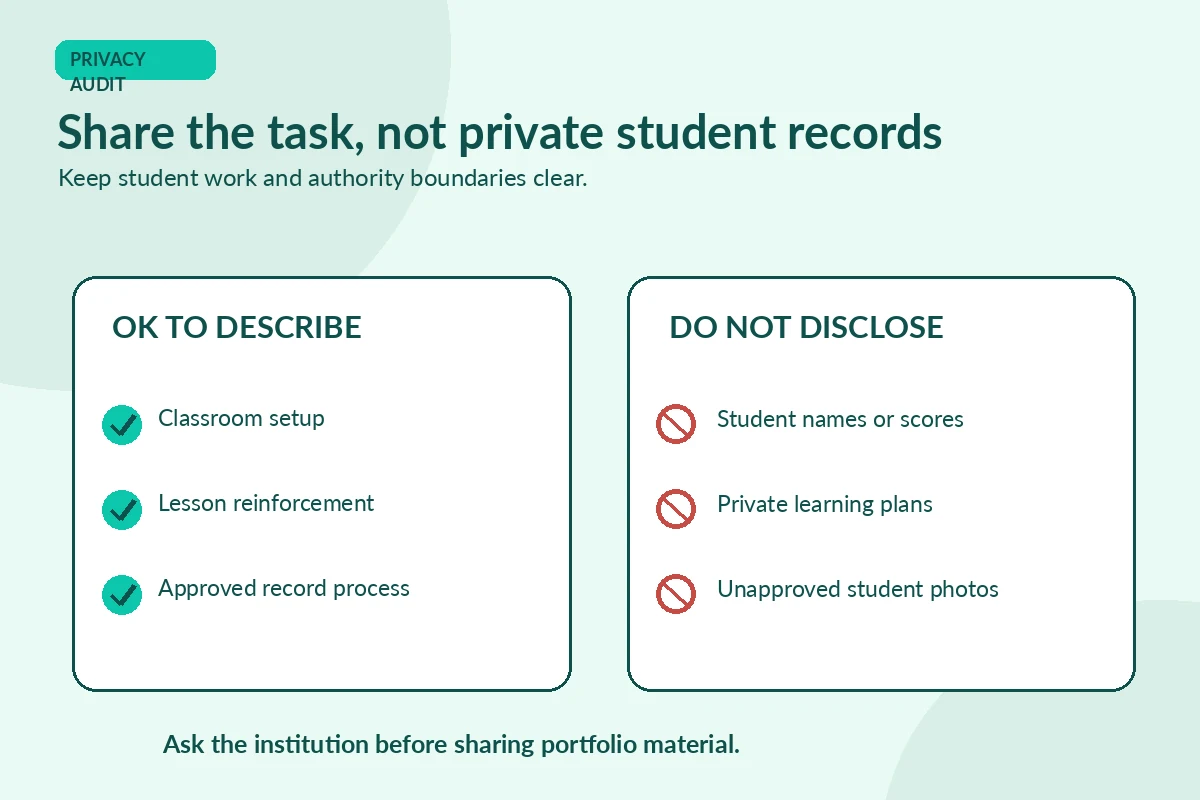
Experience working with attendance, grades, learning plans or parent communications can be relevant, but the resume is not a place to reproduce private records. Describe the workflow without names, individual diagnoses, student photographs or exact case details. A statement such as “entered attendance in the school’s approved system and referred exceptions to the classroom teacher” demonstrates accurate record handling without exposing a family.
If the institution uses protected educational records, the school’s privacy and disclosure procedures govern what may be shared. Do not assume that a student project, incident form or email exchange is portfolio material. Ask the supervising teacher or institution before publishing an example. Even an anonymized story can be recognizable in a small classroom, so it is usually safer to talk about your method and the general task.
Tailor to instructional aide versus graduate TA postings
For an elementary classroom aide, prioritize classroom preparation, lesson reinforcement, attendance routines and safe transitions. For a graduate TA application, prioritize the assigned course, sections facilitated, grading procedures, lab preparation, office hours or learning platform support if those tasks were real. A role in disability support should mention only your actual training and duties; avoid copying a job advertisement’s clinical phrases into your own background.
Compare two advertisements and mark the activities you can substantiate from past work. If the position requires language support, a software system or behavior-related training, show the specific experience rather than claiming a broad aptitude. When you have only volunteering, use a Volunteer Experience heading with the correct organization and dates. A candidate with no school experience can use tutoring, youth program assistance and carefully labeled course projects when genuinely relevant.
Finish with a role-boundary review
Read every action verb as though the principal, cooperating teacher or professor were in the interview. Would that person agree you taught the class, wrote the policy, changed a grade or supervised a program? If not, revise the language. This is particularly important when duties involve safety, discipline, confidential data, assessments or accommodations. You can show initiative with “identified a need and brought it to the lead teacher” rather than claiming the lead decision.
Check title, school, dates, real grade level or course, credentials and supervisor relationship. Keep the most specific evidence near the top. The BLS job description is useful context, but the actual district or university job posting determines the qualifications and role. A resume that shows practical educational support and judgment will be easier to defend than one full of generic accomplishments.
Compare the credential or experience with verified evidence
The comparison below is an editorial worksheet. It illustrates how to name your educational record, academic experience or application claim without exceeding what is documented. The real school, awarding body and application instructions determine your exact wording; examples in this page are fictional where labeled.
| Setting | Useful evidence | Authority to clarify |
|---|---|---|
| K–12 aide | Lesson reinforcement, attendance, transitions | Lead teacher plans instruction |
| University TA | Discussion sections, grading rubric, office hours | Faculty instructor of record |
| Childcare assistant | Activity setup, supervised support | Program-specific safeguarding rules |
How We Research Education and Resume Guidance
We reviewed the primary career-service, educational and occupational resources listed below on November 6, 2026, compared intended search purposes with the supplied JobAsk WordPress inventory, and checked current public search context. The examples are editorial illustrations, not actual academic awards, endorsements or hiring outcomes. Institution and employer policies always govern credential verification and permission to disclose student data. See the JobAsk affiliate disclosure.
Source references checked on November 6, 2026: www.bls.gov — U.S. Bureau of Labor Statistics guidance on teacher assistant duties, training and working under teacher direction.; uwm.edu — University of Wisconsin–Milwaukee description of graduate teaching assistant tasks and course support.; teaching.uchicago.edu — University of Chicago description of varied graduate TA assignments and accountability to faculty and students..
More Resume and Cover Letter Guides
No. Assistants generally support instruction; a particular school or university may assign defined instructional duties under supervision.
Only if the measure is accurate, attributable and permitted to disclose. Otherwise describe your verified tasks and process.
Usually in Teaching Experience or Professional Experience, with the course, department, dates and tasks actually assigned.
Yes, accurately list completed relevant training and the issuer. Do not represent attendance as a license.
Describe the recordkeeping procedure, not identifying information, diagnoses or private student work.