
A library assistant resume with no work experience should lead with your education, the tasks you can actually demonstrate, and one or two relevant examples from school, volunteering or community projects. Do not put a fictional library job under Work Experience. Libraries need people who can sort materials accurately, help visitors find the next step, communicate courteously and follow local procedures. A school collection project or a real volunteer shift can demonstrate a small part of that work without pretending you have used a circulation database. Start with a simple contact header, a brief role-focused profile if useful, relevant skills, and clearly labeled projects or service experience.
Match the posted library duties to evidence you genuinely have
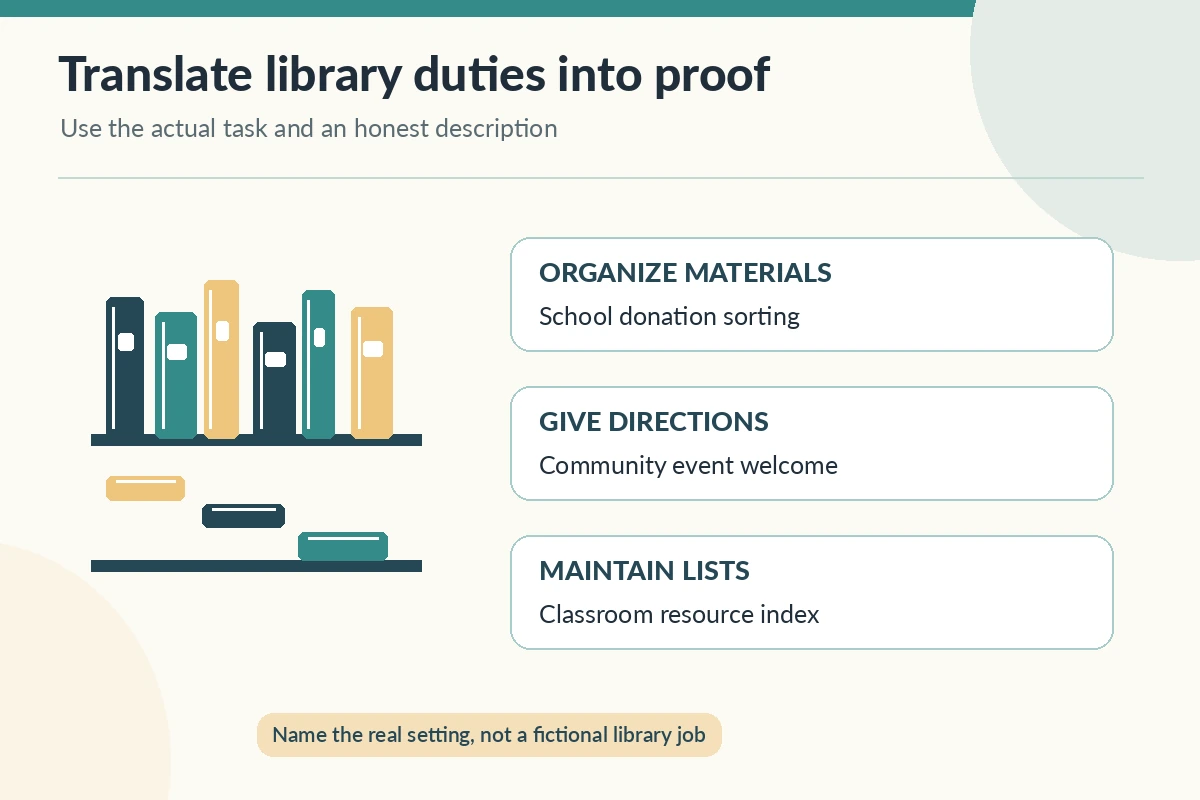
Read the exact job listing rather than importing every task from a generic library description. The Bureau of Labor Statistics identifies shelving and organizing materials, routine patron assistance, records and library programs as common assistant activities. A particular library may assign different duties to students, pages, aides or technicians. Mark what the posting requires and which parts you have personally done: alphabetical sorting, building a clear index, preparing a community event table or explaining directions calmly.
Keep an evidence list with three columns: the posted task, an example you can verify, and any part you have not done. ‘Organized materials for a school donation drive’ may connect to shelving accuracy. ‘Helped classmates locate items in a shared resource list’ is not the same as registering actual library patrons. If you have no related experience, use a short classroom example where accuracy and communication mattered, and say that you are ready to learn local procedures.
Choose sections that do not disguise a lack of paid employment
Put contact information at the top: a professional email, reliable phone, city and state if useful, and a working profile link only if relevant. You do not need a street address or private identifiers. After that, Education and Relevant Projects or Community Activities can appear before a general skills list. A section named ‘Library Experience’ should appear only if you have actually held a library role. The University of Michigan Career Center explicitly recognizes clubs, service and leadership as distinct experience categories.
An example order for an applicant who has completed a school book-collection project is Education, Relevant Project, Community Service, and Skills. If you have relevant paid work in another setting, include that real job and describe the transferable tasks instead. You can use ‘Volunteer — Community Collection Drive’ for genuine volunteering, but never label a self-directed hobby as an employer. Keep dates, organizations and your role consistent with the activity’s records.
Write one project entry that shows organization without invention
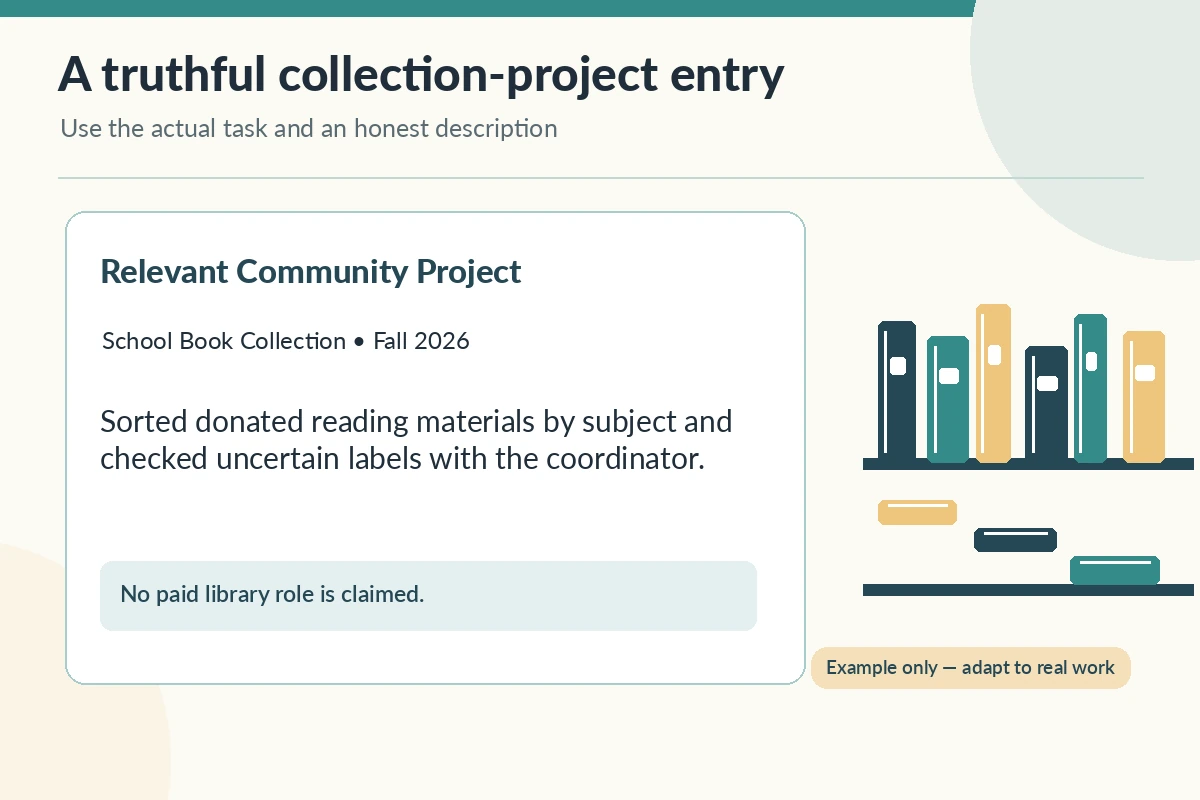
Hypothetical example, only if true for you: ‘Book Donation Sorting Project | School Service Club | March–April 2026. Grouped donated books by subject and alphabetical author labels; used a shared checklist to flag uncertain categories for the club leader.’ This does not claim you handled a library account or knew a professional cataloging system. If you only attended the project rather than leading it, replace the verbs with your actual contribution.
A stronger bullet names the object, action and check: ‘Sorted donated reading materials by listed category and checked uncertain labels with the coordinator.’ A weak bullet says ‘Excellent librarian’ or ‘Managed all circulation.’ For a personal reading log, you might write ‘Created a searchable reading list with title, author and subject fields’ under Independent Projects if it is genuine; do not turn that into official library database experience.
Handle patron service and privacy as a readiness skill
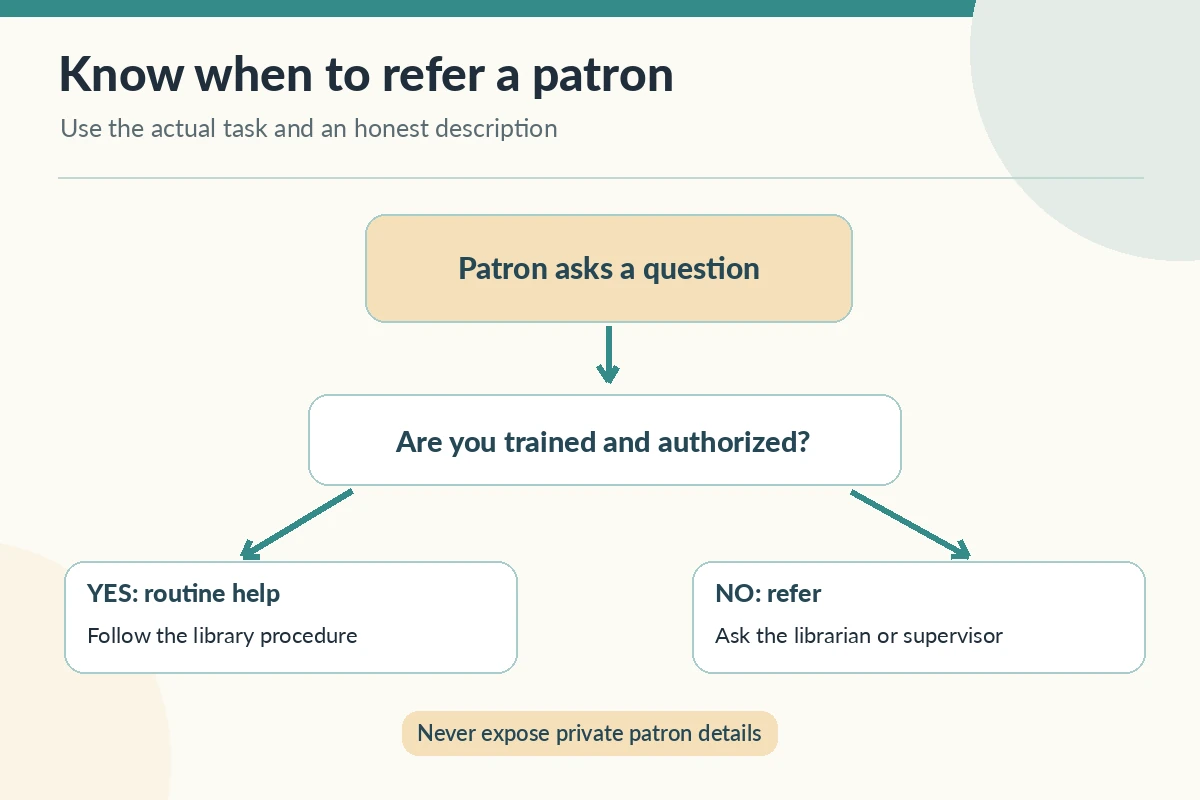
A first-time applicant may have helped visitors at a school event, answered basic questions at a club table or directed people to organizers. Those are credible service examples. Write what you did: ‘Explained event location and referred schedule questions to the event coordinator.’ Do not claim you provided reference services, issued borrower cards, resolved fees or accessed private patron records if you did not. Even where circulation duties are part of the posted role, an applicant can truthfully express a willingness to learn the approved system.
Ask what you would do when a patron requests a service you are not trained to deliver. A useful example is to listen, confirm the request and ask a librarian or designated supervisor for assistance. That is not a weakness to conceal; it shows that you understand role boundaries. Keep any hypothetical examples generic, and do not include names, borrowing histories, contact details or screenshots from real patrons in a public portfolio.
Select basic skills only when you can explain their source
Potential skills are alphabetical sorting, spreadsheet lists, basic document editing, clear instructions, punctual volunteer attendance and respectful customer communication. List a particular tool only if you have used it, and use the context that demonstrates it. If you helped create a class spreadsheet, write ‘Spreadsheet tables and basic filters (class assignment)’ rather than claiming expert library inventory software. A posted library system name is not a license to copy the keyword into your skills list.
You do not need a padded objective that promises to be ‘passionate about books.’ A short profile might say, ‘Organized student with experience sorting community donation materials and writing clear resource lists; seeking a library assistant role with training in local circulation procedures.’ Use this only if you can support the underlying facts. If a skill is still in progress, place the learning activity in its actual education or training context rather than claiming demonstrated proficiency.
Finalize the first resume for a specific library posting
Compare each sentence against the posting one final time. Does the resume show neat records and helpful service rather than repeating vague adjectives? Are section headings honest and dates consistent? Check that the PDF displays readable type, normal text selection, correct bullet order and working contact details. Upload the format the employer requests. A one-page document may be appropriate when you have little material, but clarity matters more than a magic page-length rule.
Before submitting, delete any invented examples in a template and verify that your actual school, project and organization names are correct. Do not include a staged library barcode, another person’s record or a made-up certification to fill space. If the library requests a separate application or references, follow its instructions. Your resume should offer accurate evidence of how you learn and organize—not claim you already know the employer’s system.
How We Research First-Job Resume Examples
We reviewed the University of Michigan career-center resume guidance and the occupational references relevant to a library assistant role, then compared practical examples with the specific duties and limitations described in those sources. Examples in this article are hypothetical templates only: use them only after replacing them with your own truthful activities, dates and results. Source references: University of Michigan Career Center resume resources; BLS library assistants; American Library Association library-assistant path; BLS office clerks. This material provides general resume-writing information, not a hiring guarantee. Read the JobAsk affiliate disclosure for information about commercial links.
More Resume and Cover Letter Guides
Yes, depending on the employer’s requirements. Use honest school, volunteer or personal-project evidence. Do not imply you have already performed professional circulation duties.
Only if it was genuinely employment. Otherwise put your actual role under Activities, Leadership or Relevant Projects, with accurate dates and tasks.
It can illustrate record organization when clearly labeled Independent Project. Explain the fields and checks you actually used, without calling it a library cataloging system.
No. Describe the school-event service honestly; it may demonstrate transferable communication, but it is not library patron service.
Lead with the strongest relevant, verifiable evidence. For a first-time applicant this often means education and a short relevant project before general skills.