
If you are interviewing for a quality inspector or technician position, arrive with three or four questions that reveal the actual work rather than asking only about culture. For a quality inspector, the central question is what happens to a part and its recorded measurements when the result is unclear or outside specification. Start by checking the job description, choose questions the interviewer can realistically answer, and take brief notes on who reviews or approves the important steps. The questions below are designed for candidates learning about a role; they are not claims about the policies of any particular employer.
Inspection jobs may involve drawings, measurement tools, sample plans, rejected materials, and documented reviews. The scope of a particular inspector is determined by the work process. Do not assume that every inspector has authority to change acceptance criteria, recalibrate equipment, release material, or certify product conformity. According to the University of Michigan Career Center, preparing approximately three to five employer questions helps you learn whether a job fits, and the right questions depend on the interview stage and the person answering. The wording below is a practical starting point: adapt it to what you have already been told instead of reading a script. All example conversations are hypothetical.
Ask what defines a pass or fail result
Ask: ‘Which drawings, specifications, or work instructions tell an inspector what to measure and how to record it?’ A useful interviewer answer explains where current criteria are stored and who controls revisions. Ask whether a new inspector works from standard check sheets, visual comparison standards, or a supervised test plan. Do not request confidential product designs or tolerance values during the interview. You want to know how the team distinguishes an observed measurement from an authorized acceptance decision. That distinction also helps you describe your own training accurately rather than claiming authority you may not have held.
Understand training on instruments and methods
Try: ‘How are new inspectors trained and assessed before they use a gauge or testing method independently?’ A role may require calipers, gauges, visual checks, or specialized equipment depending on products and the employer. Knowing a tool’s name is different from knowing its approved setup, calibration checks, or the procedure for questionable readings. Follow with: ‘Who reviews an unexpected result while the employee is still learning?’ Look for training records and a designated reviewer, not a promise that every task will be taught in the same way. Do not offer to improvise calibration or equipment repair outside authorization.
Trace a nonconforming item without guessing
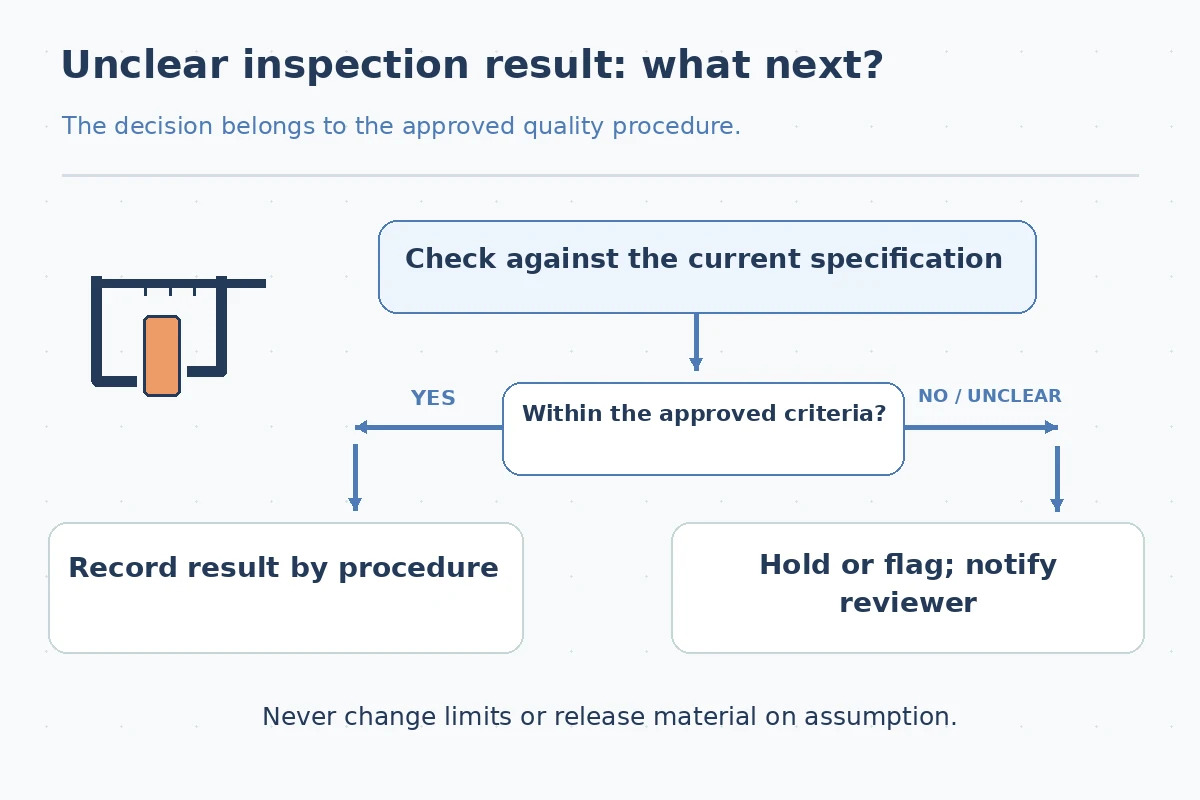
Ask: ‘When an item appears outside specification, how is it identified, segregated, and referred for disposition?’ The interviewer may describe an exception label, a hold location, a nonconformance record, or a quality engineer review. These are illustrative mechanisms, not a universal standard. Ask whether the inspector marks or reports the item or also has delegated authority to reject or release it. If the employer says ‘operators usually handle it,’ clarify how inspection findings stay visible and traceable. The question reveals whether the job is about detecting problems, documenting them, or making final product decisions.
Use a question-to-evidence comparison table
A question is useful when the answer tells you something you can verify later: the person who approves, the document the team uses, the training step, or the process for reporting an exception. This comparison grid captures the decision behind each question, so you can tell whether the interviewer actually answered it. If a topic was already covered naturally, replace the prepared question with a brief, relevant follow-up rather than forcing a repeated conversation.
| Decision point | Ask the interviewer | Listen for |
|---|---|---|
| Test criteria | Where is the current spec? | Controlled instructions |
| Equipment | Who verifies readiness? | Training and checks |
| Nonconformance | Who decides disposition? | Recorded hold and reviewer |
| Report | Who uses the result? | Traceable finding and handoff |
Find out how production and quality resolve disagreements
Ask: ‘If production needs material urgently but the reading is uncertain, who decides the next step?’ This is a responsible way to learn about escalation without implying production and quality are always in conflict. Listen for a defined decision owner, an approved process for rechecking a reading, and a record of the decision. Avoid asking whether supervisors ever ignore quality concerns as an accusation. A calmer follow-up is: ‘How are conflicting readings reconciled before an item changes status?’ Good process allows staff to surface uncertainty without silently changing recorded measurements or arguing over blame.
Review reporting and repeat defects
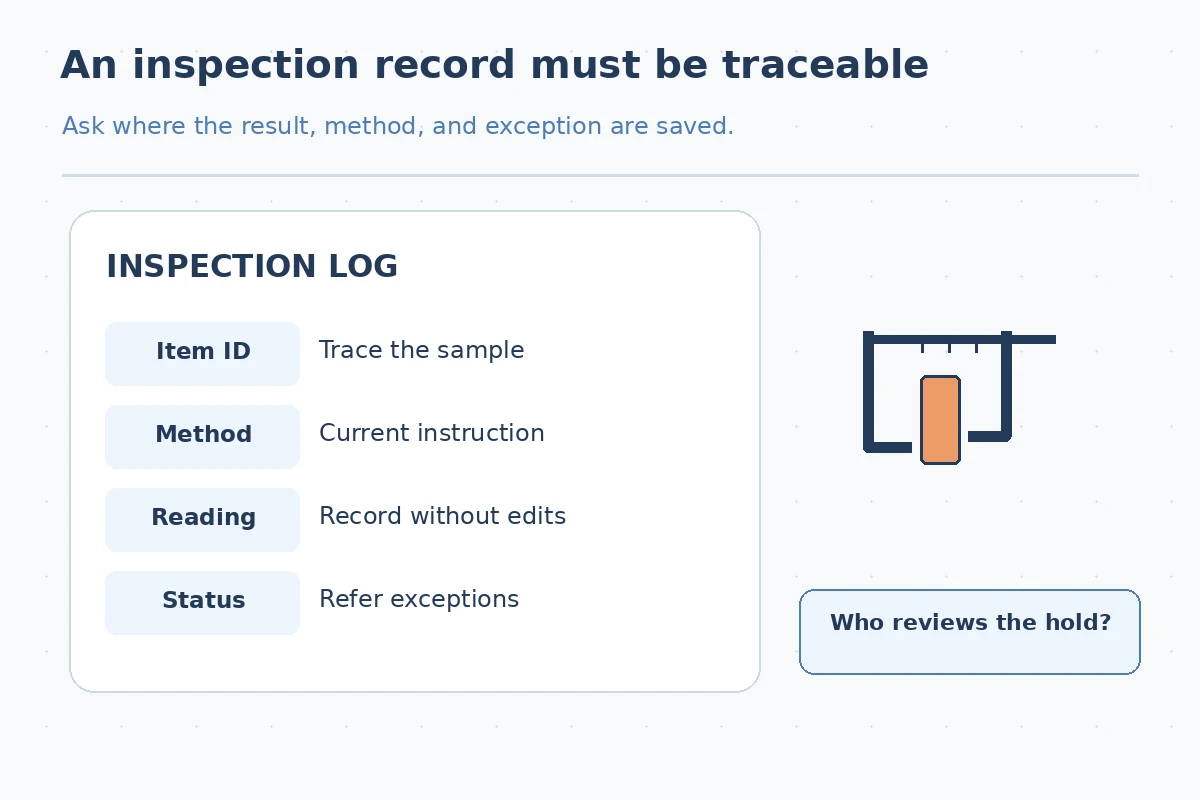
Ask: ‘What information belongs in an inspection report, and who uses it after the shift?’ You might hear about sample identifiers, method, result, equipment, time, exception notes, or a follow-up owner. Ask how recurring issues are summarized and how inspectors learn about approved changes to procedures. A report is useful when someone else can trace what happened, not when it merely says ‘passed.’ The interviewer may describe statistical methods or improvement meetings; ask which parts are within the advertised role. Do not assume an entry-level inspector designs sampling strategy or signs certifications.
Turn vague questions into useful follow-ups
Instead of “Do you have good quality?” ask “When a measurement is borderline, what is the approved recheck and escalation process?” If the interviewer says “we just know whether it passes,” ask “Where are the acceptance criteria documented and how do new staff learn revisions?” Neither example should be asked verbatim if the interviewer already explained the process. A considerate candidate connects a follow-up to the employer’s answer: “You mentioned a shared queue. How does a new hire learn when to escalate an item?” That demonstrates listening while keeping your goal to understand the job rather than impress someone with jargon.
It is also useful to avoid questions that ask for restricted account details, identifiable personal records, private supplier terms, or internal performance numbers. Ask for the method and boundaries instead. If an interviewer cannot give a detailed response in a short screening call, note the subject and return to it in a later discussion with a manager. Silence or a partial answer is a reason to clarify at an appropriate stage, not proof that the organization lacks a policy.
Close on independent scope and first-month evidence
Near the end, ask: ‘Which inspections should a new hire be ready to perform after initial training, and what still requires review?’ This makes the onboarding plan concrete. Follow with: ‘How do you evaluate accurate records and appropriate escalation, not just inspection volume?’ A team that values data integrity should be able to explain how quality is reviewed. You can then discuss your experience with documented checks, careful measurement, and following instructions without inventing reject rates or guaranteed defect reductions. The question also helps you decide whether the position offers support for learning unfamiliar methods.
Choose three priorities before the meeting
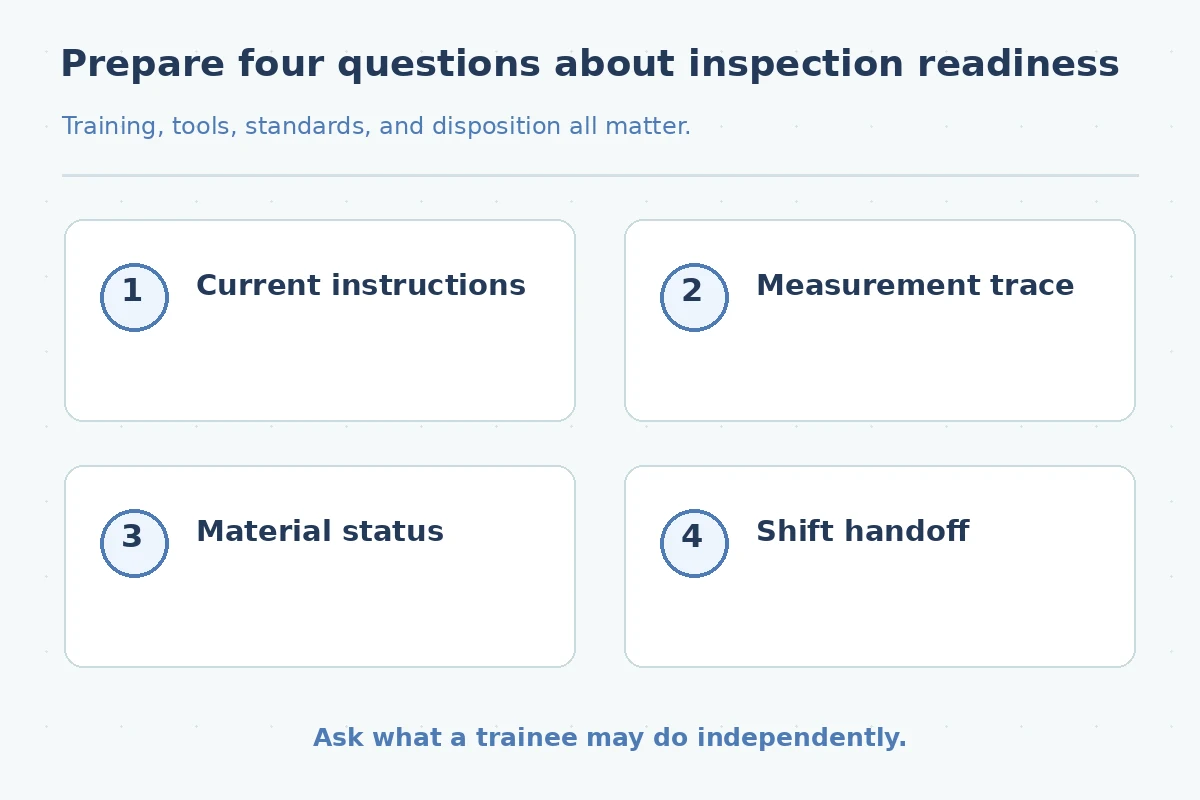
Prepare one operational question, one training or scope question, and one question about how good work is reviewed. If there is time, retain a fourth question about inspection record and handoff to the next employee. Put the highest-value question first so a short interview still produces useful information. In your notes, mark whether the interviewer gave a specific example, named a reviewer, described a documented process, or deferred the answer. This is an organizing device for your decision, not a score for the employer.
A short follow-up email should thank the person for the conversation without requesting confidential examples. If a concrete gap remains, ask one narrow question such as ‘Who normally reviews this step during onboarding?’ rather than sending the entire list again. Before accepting an offer, compare the interview account with the written job description and any practical terms you receive. Do not treat an exploratory answer as a contractual promise. Your own goal is to understand expectations accurately and decide whether the day-to-day work matches the position you applied for.
How We Research and Verify Interview Guidance
We reviewed the University of Michigan and Santa Clara University career-center guidance on preparing role-relevant questions, together with the O*NET occupational description for quality inspector or technician work. O*NET lists testing, measuring, documenting findings, and notifying others of production problems among inspector responsibilities; release permissions still depend on the workplace. We distinguished broad occupational duties from employer-specific authority and used only hypothetical interview exchanges. Source review date: November 15, 2026.
Sources consulted: University of Michigan Career Center — Interviewing Resources; Santa Clara University Career Center — Practice for Interviews; O*NET — role duties. Each source helps frame questions; none tells us the policies of a specific employer.
Reader trust and commercial relationships are explained in the JobAsk affiliate disclosure. This page is independent career education; it does not guarantee an interview outcome.
More Interview Preparation Guides
Usually you can ask how specifications are controlled without requesting confidential drawings or numerical tolerances.
No. Duties and delegated authority vary. Ask who documents a hold, approves disposition, and changes the status.
Ask which readiness checks and training you must complete before using each instrument; do not claim independent calibration if you have not done it.
Ask who reviews disputed measurements, how rechecks work, and where final decisions are documented.
Ask which inspection tasks a new hire performs under review first and which evidence shows they are ready for more responsibility.