
For an administrative assistant resume, the strongest keywords describe work you actually performed: coordinating appointments, keeping records accurate, routing requests, and preparing documents. Start with the employer’s own job posting, then match each important term to an example you can discuss. A label such as “calendar management” is useful only if you managed a calendar or helped maintain one; “confidential records” requires genuine authorized work with protected files. Applicant tracking systems are configured differently across employers. The goal is a resume that a recruiter can read and trust, not a secret score or a trick to defeat screening software.
Separate the four kinds of office support keywords
Office descriptions often combine scheduling, document control, communication, and tools in one long list. Treat them as separate clusters. Scheduling may involve confirming meeting times, resolving ordinary conflicts, or coordinating rooms. Document work may include file naming, version updates, entering records, and routing items for signature. Communication may be visitor intake, phone screening, or meeting notes. Tool names may include spreadsheets, calendars, shared drives, or a company database. Do not transfer a term from one cluster to another merely because it sounds more impressive. A person who maintained an appointment list did not necessarily supervise the office calendar or approve leave requests.
Identify the exact actions supported by your evidence
Before editing your resume, make a private list of tasks you can substantiate. Example: in a hypothetical volunteer office, you received reservation emails, updated a shared calendar, confirmed availability with a coordinator, and sent approved notices. That could support “appointment scheduling” and “email correspondence,” but not “executive calendar ownership” unless you truly had that responsibility. Ask what you touched, what you produced, and who checked the final action. A completed spreadsheet, permitted sample agenda, or supervisor-confirmed description may help you remember details, but do not disclose private records or attach an employer’s files to your resume.
Write scheduling bullets without claiming authority
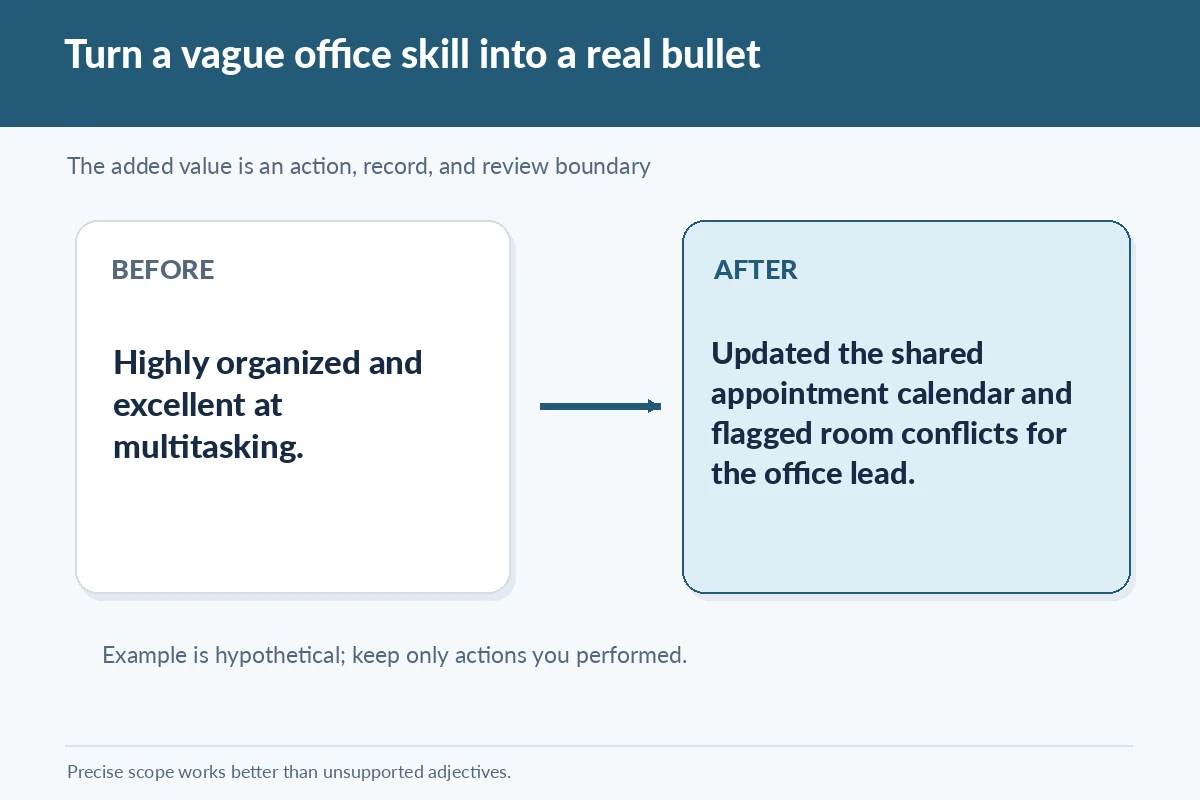
A weak line reads “Good at multitasking and organizing.” A more informative hypothetical example is “Updated a shared appointment calendar, checked room availability, and flagged conflicts for the office coordinator.” The revision shows the work, its object, and the handoff point. If you only scheduled your own classes or student meetings, label that context rather than presenting it as paid administrative experience. If an employer requests “travel coordination,” do not borrow that phrase from unrelated calendar work. Describe only the booking support you personally performed. Precision helps both a person reading the resume and any system indexing relevant wording.

Show records and correspondence with a quality check
Record accuracy is more specific than the word “detail-oriented.” Consider a hypothetical bullet such as “Entered visitor requests in the office log, checked required fields, and forwarded exceptions for review.” If your actual experience was filing paper forms rather than entering data, write “file organization” or “document filing,” not “database administration.” For correspondence, distinguish drafting a template, proofreading, distributing an approved message, and making an independent policy decision. A posting that names “document management” does not authorize you to claim a software platform you never used. Where the product name is accurate, use its ordinary spelling and connect it to a credible action.
| Job posting term | Evidence you could describe | Important limitation |
|---|---|---|
| Appointment scheduling | Updated a shared calendar | Do not claim executive approval |
| Records maintenance | Entered and checked office log fields | Keep private data out of samples |
| Correspondence | Drafted and sent approved notices | Do not claim independent policy decisions |
| Excel | Used a tracker to verify entries | List only software used |
Place important terms where the supporting work appears
Use a clear work-experience section with accurate job titles, dates, employers, or plainly labeled volunteer projects. A compact skills section may list Excel, calendar scheduling, or records maintenance if those are truly your capabilities. But the stronger evidence generally appears beside the work: “maintained an appointment tracker” says more than a disconnected “organization” keyword. You do not need to copy every phrase in the posting. Put the terms most relevant to the role in readable sentences, and keep standard headings so dates and employment context are easy to locate.
Check an office resume for overclaiming and privacy
Read your draft as a hiring manager who might ask follow-up questions. Can you explain how a meeting was arranged? Could you show a redacted, permitted sample rather than actual internal correspondence? Do your verbs imply that you approved expenses, signed documents, or held keys to sensitive files when you did not? “Prepared expense documents for approval” differs meaningfully from “approved expenses.” Omit protected client names, medical details, student records, or personal contact lists. A strong administrative resume communicates reliability by respecting the real approval and privacy boundaries around office work.
Customize one document for one specific posting
Create a master inventory of your office experience, then make a separate copy for the actual role. Highlight required tasks that you can verify, note which are preferred, and delete irrelevant claims rather than adding buzzwords. If the posting calls for “meeting coordination” and you arranged sessions for a school club, you may say exactly that with the school-club context. If it demands several years in an executive assistant position, do not change your title to satisfy the phrase. Recheck spelling, simple formatting, readable headings, and the file instructions in the application portal before submitting.
Use the final review to catch missing context
Have someone unfamiliar with your experience read the resume. Ask them to point to the sentence showing scheduling, record accuracy, and communication. If they can find only an isolated skill list, add an honest action example. If your bullets describe a different level of responsibility from your actual role, revise the verbs. Save the version you submitted and record which job description it addressed. This produces a traceable document for interview preparation without pretending that keyword placement guarantees a response.

How We Research Resume Keywords and Evidence
We compared university career-center recommendations about resume tailoring and ATS readability with O*NET OnLine occupational task descriptions. The occupational task inventory describes possible work, not what any reader personally performed; the hypothetical resume lines demonstrate how to show scope without inventing responsibility. The sources linked below were checked on November 15, 2026. Employers configure application systems differently and descriptions can change, so use the current posting and your actual records before submitting.
Sources consulted: University of Maryland resume guide; Georgetown resume and ATS advice; O*NET Admin Assistant occupational tasks; University of Florida application tailoring. These references support process advice and occupational context, not ATS acceptance guarantees.
For site partnerships, promotional links, and editorial disclosures, see the JobAsk affiliate disclosure.
More Resume and Cover Letter Guides
No fixed number applies. Choose the terms central to the posting that you can prove with your actual tasks.
Yes, if you label the volunteer setting honestly and describe what you performed.
Only if you genuinely managed office processes. Otherwise name the specific scheduling or record tasks.
Include a named tool when you used it and can describe the relevant work. Do not infer tool experience from general computer use.
Put relevant terms in clear bullet statements and, when accurate, a compact skills section; retain standard headings.