
Environmental technician behavioral interview questions focus on past evidence that you followed the approved field or laboratory process, noticed deviations, and kept a usable record. A strong answer states the sampling or monitoring context, what you were trained and assigned to do, which record or instrument check you used, what seemed inconsistent, and who reviewed the next action. BLS describes field sampling, sample identification, lab analysis, reports, and supervised work as common duties. Procedures depend on the job and site. This article does not teach hazardous-material handling; it helps you explain your actual work without inventing technical credentials or implying you could approve a sampling deviation.
Select an example with a checkable observation
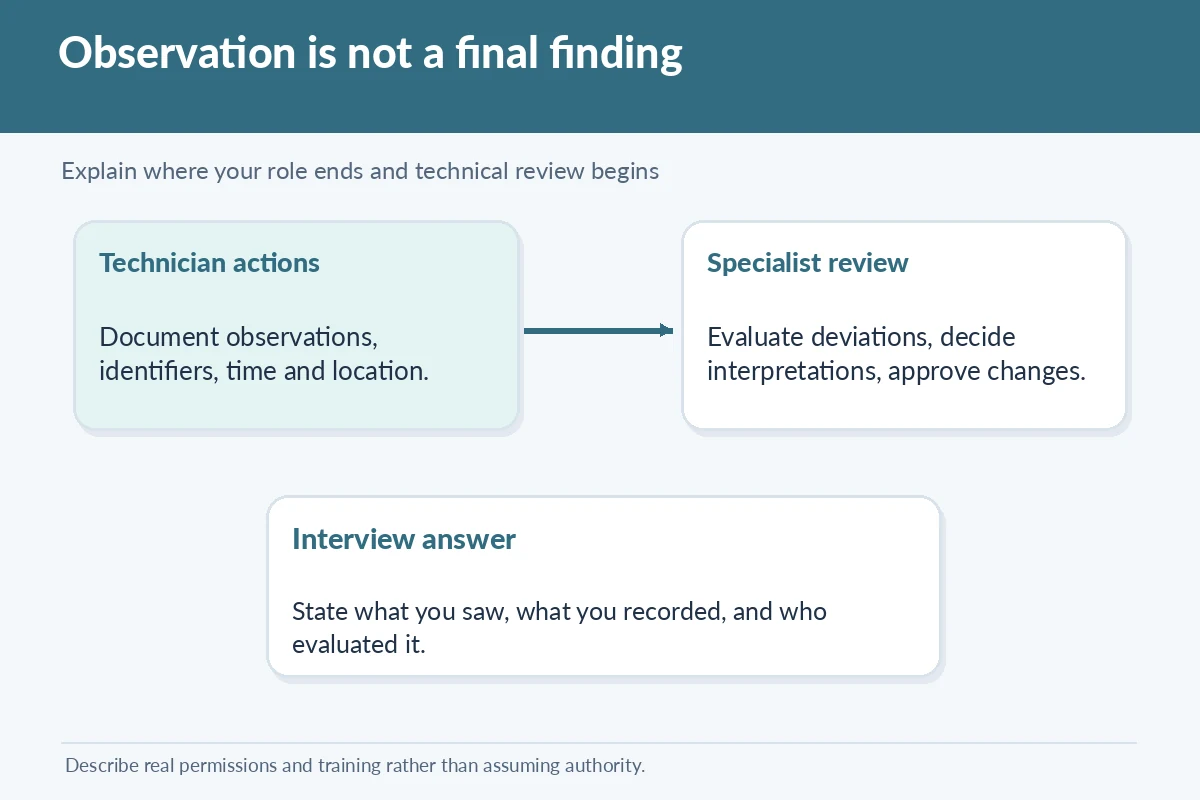
Start with one event you personally experienced: a mismatched sample ID, an unclear site location, a reading outside the expected pattern, a missing field on a log, or a weather change that affected scheduling. Choose something you can discuss without disclosing a client site, restricted sampling plan, or actual results. If you worked only in a teaching laboratory, call it a class laboratory. Distinguish the plan the team followed from your role in carrying it out. You may have collected observations, written down time and location, or alerted the project lead without being the scientist who interpreted the final findings.
Discuss a sample-label mismatch responsibly
A behavioral prompt might be: ‘Tell me about a time you caught inconsistent identifiers or documentation.’ Explain where you noticed the mismatch: specimen label, field log, transfer record, or lab intake form. Describe pausing the affected handoff and notifying the responsible lead according to your actual protocol. Do not claim you guessed the correct identity, changed a label without documented authorization, or continued working as though the discrepancy did not matter. The result might be that the affected material remained clearly flagged until a supervisor reviewed it. This is stronger evidence of integrity than an invented claim that no errors ever occur.
Explain how you reported an unexpected field observation
Interviewers may ask about a reading, site condition, or observation that did not fit the plan. Focus on the communication and review process rather than inventing a technical fix. State what appeared unusual, what basic checks you were authorized and trained to perform, which facts you recorded, and who decided whether the team should repeat, reject, or investigate the observation. A field technician should not present an unexpected reading as confirmed contamination or delete it because it looked inconvenient. Avoid naming a result you cannot verify or providing an operational hazardous-site procedure beyond your training.

Offer a truthful STAR story about records
Illustrative classroom example only: **Situation:** Our supervised environmental lab assignment had a sample code written differently in two student records. **Task:** I was responsible for checking the paperwork before it reached the teaching assistant. **Action:** I compared the visible identifiers, kept both original entries, marked the inconsistency, and asked the instructor how to document the correction under the class protocol. **Result:** The group submitted an annotated record that explained the discrepancy; I did not claim to determine a sample’s identity or certify any laboratory result. In a real interview, substitute only a genuinely remembered experience and its actual outcome.
| Situation to discuss | Evidence of your action | Limit you should state |
|---|---|---|
| Identifier mismatch | Flagged label/log discrepancy for review | Do not guess a sample identity |
| Unusual observation | Recorded facts and notified supervisor | Do not declare contamination |
| Work disruption | Logged incomplete work and requested direction | Do not bypass site requirements |
| Data review | Described exact check and assigned role | Do not claim independent certification |
Show that schedule pressure did not erase review
A prompt may ask: ‘Describe a time conditions made it hard to finish planned fieldwork.’ You can discuss blocked access, weather, equipment availability, or late transport at the level relevant to your role. Explain who determined whether the task could proceed, how you updated the schedule or log, and whether you recorded work not completed. Do not suggest ignoring controls to finish on time. When the next action required technical judgment, a permit, or site authorization, describe seeking the responsible person’s direction rather than presenting yourself as the person who made it unilaterally.

Distinguish using equipment from approving data
A follow-up may ask what instruments you used or what a check revealed. Name a tool only if you actually operated it under the right supervision and can explain your assigned step. Recording a meter value is different from interpreting a laboratory result or approving a regulatory conclusion. If the task was observation, labeling, or data entry, those may be valuable competencies when accurately described. Avoid unsupported statements such as ‘certified the sample,’ ‘verified compliance,’ or ‘ruled out contamination’ unless they refer to authorized work with evidence you can discuss responsibly.
Protect site details and chain-of-custody information
Interview examples can become too detailed if you describe real client locations, private land access, confidential measurements, or sample tracking identifiers. Prepare a generalized narrative with the type of record and the type of issue instead of exposing exact records. Chain-of-custody is about traceability, not a phrase to claim casually; discuss whether your responsibility was preparing, checking, receiving, or transferring documentation. If you only observed a trained coworker doing the task, say so. Do not offer screenshots of private lab software or internal sampling plans as proof during a general interview.
Practice explaining the limit of your conclusion
Rehearse three distinct examples: a data-quality observation, a communication handoff, and an adjustment caused by field conditions. For each, identify the precise outcome you witnessed and which parts remained under review. Expect probing questions such as ‘How did you know?’, ‘Who reviewed the change?’, and ‘Where was that recorded?’ It is acceptable to say the final test result or regulatory decision was outside your role. Read the employer’s job posting for the correct mix of lab, field, client, or reporting duties; not every technician role involves the same sampling methods or instruments.
How We Research Behavioral Interview Questions
We used the U.S. Office of Personnel Management’s structured interview guidance to distinguish behavioral questions about past experience from hypothetical situational questions. University of Maryland’s interview guide informed the use of STAR and practice with real experiences. For this occupation, we reviewed the linked public occupational source for representative duties and carefully separated possible tasks from work a particular candidate actually did. These sources were checked on November 15, 2026. The sample response is explicitly illustrative; the questions are preparation prompts, not a claim about the exact questions any employer will ask.
Sources consulted: OPM structured interview guidance; University of Maryland interview preparation; BLS environmental science and protection technician duties.
For site partnerships, promotional links, and editorial disclosures, review the JobAsk affiliate disclosure.
More Interview Preparation Guides
Yes. Label them as coursework and explain exactly which task you performed under supervision.
Not if they are confidential or unnecessary. Describe the check and process without revealing restricted client information.
Explain how you preserved the record and referred the mismatch according to the actual process; do not claim you silently changed it.
No. Use experiences relevant to the posting and be candid about any training or experience you do not have.
Only if that conclusion was genuinely within your authorized work; observations and approved conclusions are different.