
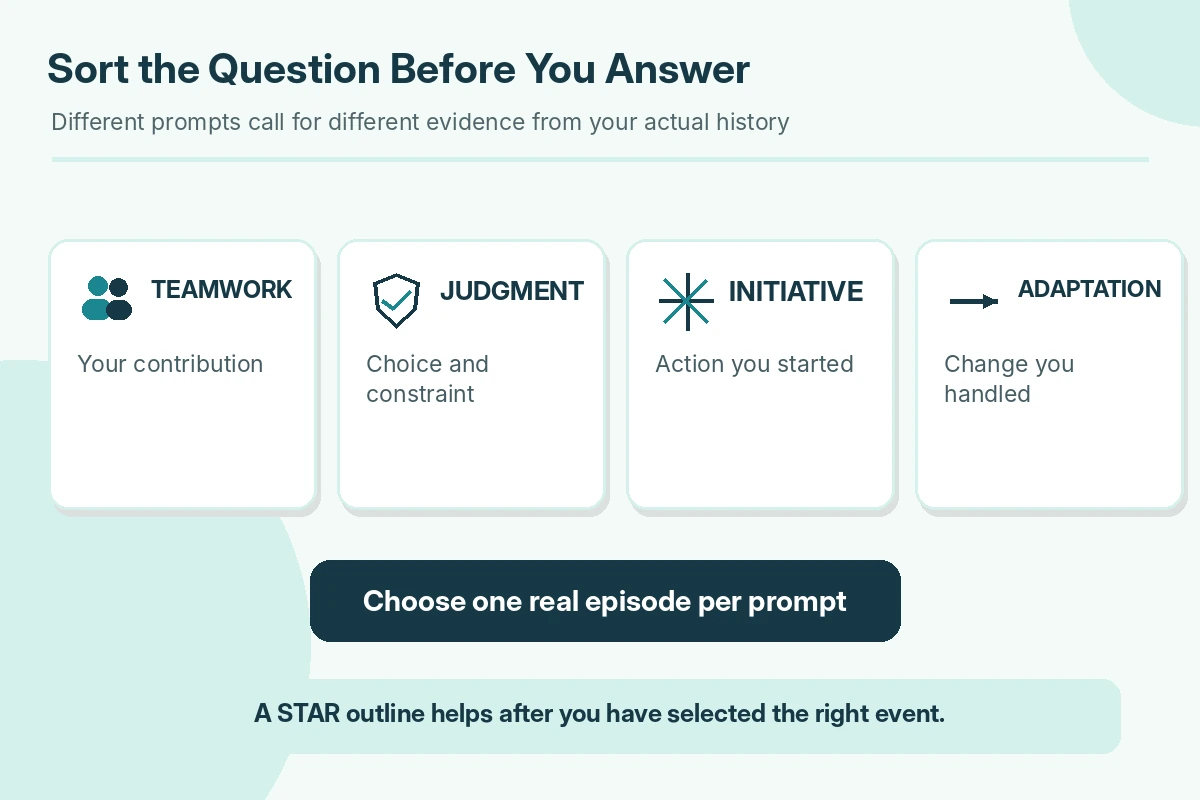
Behavioral interview questions ask what you actually did in a past situation, not what you would ideally do. A strong response selects a specific event, identifies your responsibility, explains the actions you personally took, and reports an outcome or lesson you can defend. Before memorizing answers, identify whether the interviewer is asking about teamwork, judgment, failure, initiative or change: the same story will not establish all five equally well.
University of Pennsylvania Career Services recommends a particular past example with your role and result. MIT Career Advising provides sample prompts about initiative, conflict, leadership and unfamiliar colleagues. The question bank below is a sorting guide rather than a claim that employers always ask one official list or award points using a universal scoring system.
Sort the Prompt by What It Actually Tests
“Tell me about a time you helped a teammate” invites a different event from “Tell me about a time you challenged an incorrect assumption.” The first concerns contribution and coordination; the second concerns reasoning and respectful challenge. Underline the action verb and the condition in the prompt. If the word is “failed,” a story about unbroken success avoids the real question. If the prompt is about learning, describe what changed in your next attempt.
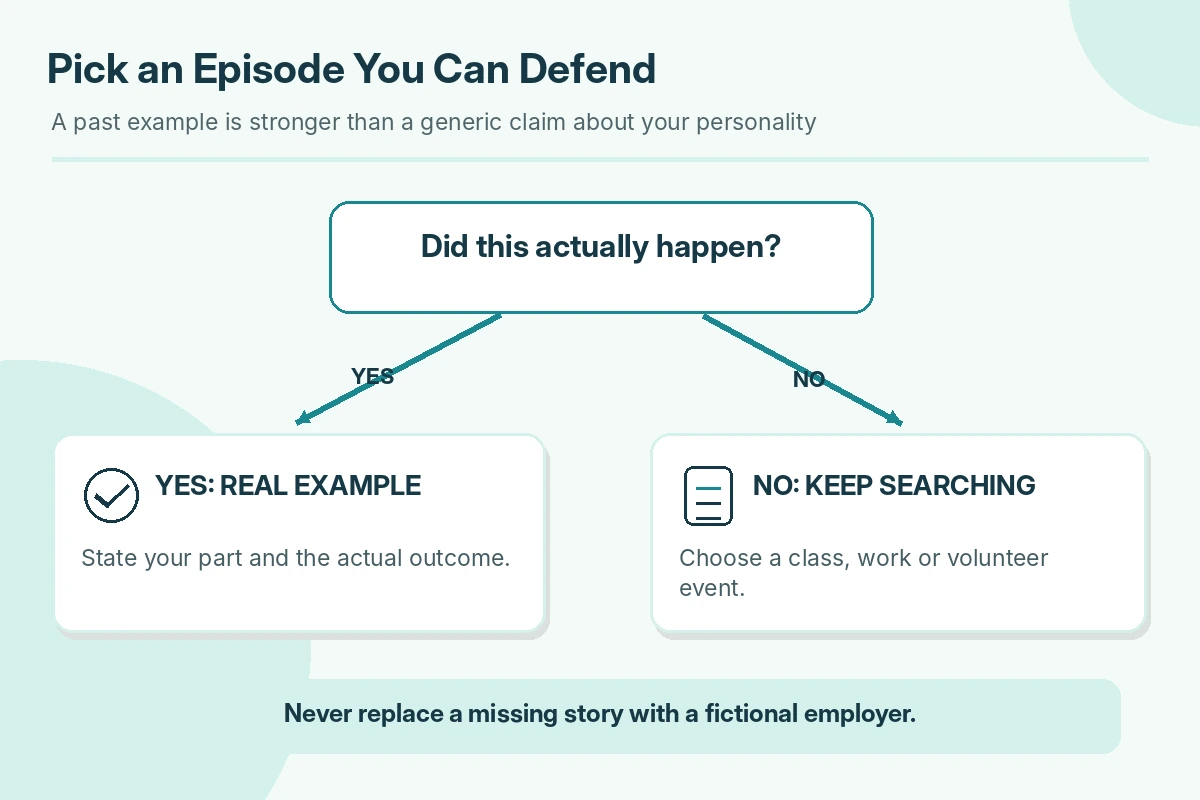
Make a simple question bank with columns for prompt, competency, chosen episode, your action and observed result. For example, planning may point to a real deadline conflict; adaptability might point to a revised customer requirement; influence may point to agreement gained without formal authority. Mark episodes you genuinely experienced, including class, volunteer or internship work when relevant. A made-up job story is never a safe substitute.
Practice Questions About Teamwork and Disagreement
Useful practice prompts include: “Describe a team project that depended on coordination,” “Tell me about a time a colleague disagreed with you,” “How did you handle an unclear handoff?” and “When did you need to explain a concern without making the situation personal?” A teamwork response should name your task and what you did rather than credit yourself with everyone’s work. For disagreement, demonstrate that you listened and considered a legitimate alternative.
For a project with shared credit, distinguish the team deliverable from your own draft, check, presentation or handoff. You do not need to reveal a coworker’s name, the contents of a personnel dispute, or sensitive internal information. If no dispute ended with full agreement, a clear plan for escalation and continued cooperation may be the truthful outcome. Michigan’s interviewing guide stresses your own action within a group example.
Practice Questions About Judgment and Ownership
Common prompts ask when you made a mistake, solved a difficult problem, managed competing priorities, or received critical feedback. For mistakes, explain when you noticed the issue, whom you informed where appropriate, what you corrected and what prevention step followed. For priorities, name the competing constraints and how you confirmed what mattered most. Avoid implying that every situation had a dramatic measurable improvement.
Try writing one sentence for each of the following: the actual decision, the alternatives you considered, the restriction you could not ignore, the information you sought, and the result you verified. This produces more useful evidence than stock descriptions like “I am a perfectionist.” You may choose an ordinary, low-risk event if it shows honest responsibility and sound boundaries. Make sure the action was yours rather than your supervisor’s.
Build the Answer Around Your Own Actions
A practical response can cover situation and task briefly, spend most of its detail on what you did, and end with the real result or reflection. Case Western Reserve’s STAR guidance explicitly distinguishes individual action from what the whole team did. It is fine to say you asked for support, followed a procedure or escalated a risk. A candidate who describes authorization and follow-through can be more credible than one who claims to have personally solved everything.
Hypothetical example: “Our student event changed rooms the morning of the program. I checked the updated room capacity, posted the new location in the attendee channel, and asked a second volunteer to verify signage. Attendees received a consistent location update, although we did not measure attendance impact.” This invented example supports coordination and adaptation, not financial performance. Replace the details with something that genuinely happened to you.

Choose a Story for Each Prompt, Not One Story for Everything
A strong example of learning from feedback may be weak evidence for conflict management unless another person’s differing view was central. Keep three to five flexible experience notes with one-line labels such as “deadline trade-off,” “customer correction,” “changed plan,” and “team handoff.” A flexible note is a memory aid, not a script to read word for word. If an interviewer asks an unfamiliar prompt, request a moment to choose a truthful example.
Do not double count a result: helping prepare a proposal does not mean you won the contract, and submitting a report does not mean your advice was adopted. In the result, separate what you observed, what someone else later reported, and what remains unknown. Reflection can explain a better approach next time without treating a lesson as proof of an invented success. This prevents confident sounding but untestable answers.
Rehearse With a Simple Evidence Rubric
Use five yes-or-no checks: Did I answer the specific question? Did I identify my responsibility? Are my actions concrete? Did I state an outcome or genuine lesson? Can I defend every claim without confidential details? Ask a practice partner to flag the moment your answer becomes vague. If the strongest action is missing, shorten the setup rather than adding more background. Practice clarity, not identical delivery.
A mock interview can expose where one episode is doing too much work. After practice, rename each example according to the behavior it best proves and keep weaker examples as backups. The checklist below is our editorial teaching device, not an official scoring rubric or evidence that a particular answer guarantees an offer. Interview formats and evaluation vary across employers; use the job description to determine the most relevant behaviors.
How We Research Behavioral Interview Answers
This guide draws from University career center, career services guidance, University career center, career services guidance. The sources explain the purpose and format of behavioral questions, show example prompts, or discuss how to specify individual actions. They do not prove any hypothetical outcome, official interview score, universal script, or guaranteed offer. Source pages were checked on October 26, 2026; the article’s decision models are independent educational tools.
Every modeled candidate experience above is explicitly hypothetical and is not a true hiring success story. Do not disclose confidential details, invent credentials, take credit for team results, or present unverified numbers as your own. No paid affiliate relationship is claimed. Read our affiliate disclosure.
More Interview Preparation Guides
- Common Interview Questions: What They Ask and How to Prepare Real Answers
- Marketing Interview Questions: Campaign Evidence and Clear Reporting
- Customer Service Interview Questions: Resolve Complaints With Evidence
- Questions in a Second Interview: Practice Evidence and Ask Better Questions
- Why Should We Hire You? Match Job Requirements to Evidence
It asks for a real past example showing how you acted in a particular situation, rather than only what you would hypothetically do.
No. Situation, task, action and result are a helpful structure; prioritize a natural, accurate account that answers the actual prompt.
Yes, if you identify it as academic experience, name your own actions, and do not imply that it was paid employment.
Take a short moment to think; choose a genuine episode rather than inventing an employer or event.
Prepare a manageable set of different real episodes covering the advertised skills, rather than memorizing a fixed number of universal answers.