
A career change after 50 should start with the kind of work you want and can document, not an online list of supposedly age-appropriate jobs. Compare specific postings on tasks, required preparation, schedule, physical conditions, and training. Build recent proof of relevant skills where needed and present prior experience accurately. The Equal Employment Opportunity Commission explains that federal age-discrimination protections apply to covered hiring decisions; those protections are separate from an employer’s legitimate role requirements. This guide is about practical job search choices, not a claim that age guarantees or prevents employment.
Choose occupations by working conditions and interests
Write a short list of tasks you want more of and tasks you wish to reduce. Consider schedule predictability, travel, standing or lifting requirements, pace, interaction, and whether the work involves supervised training. Avoid assuming that an older applicant must choose quiet desk work or that physical jobs are automatically unsuitable. An individual’s interests, capabilities, and circumstances matter more than stereotypes. Compare the specific job description, not broad assumptions about an entire occupation. If an essential physical duty is unclear, request the employer’s actual description rather than making guesses.
Use experience as evidence, not as a seniority claim
Long employment history can provide strong examples of documentation, stakeholder coordination, equipment familiarity, or reliability. Choose only the duties relevant to the new vacancy. For example, a former store lead might have scheduled coverage and coached new hires; those are tangible skills, but they do not automatically qualify the person for a regulated HR or training position. Describe what was personally performed, when it happened, and what process or record supports the description. A concise evidence-focused resume is usually more useful than repeating every past job task.
Check whether your skills are current enough
Tools, terminology, platforms, and documentation standards can change. Instead of claiming that decades of experience make further learning unnecessary, identify which skills transfer and which need refreshed practice. A small spreadsheet audit, completed short course, or familiarization with a new ticketing workflow may provide recent evidence if described honestly. Do not represent a demonstration account as production system administration. If the new role requires a current license, test, or official qualification, verify the precise requirement with an authoritative issuer or employer.

Research training needs before rejecting yourself
The BLS Occupation Finder organizes occupations by typical entry education and training. Use it to build an initial list, then read current employer postings to distinguish what is mandatory from what can be learned after hire. A national typical requirement is not an individual’s eligibility decision. Look especially for positions where a known process such as scheduling, record review, or customer guidance overlaps with your experience. Also compare pay arrangements, shifts and location, without treating an occupational average as the pay offered by a real employer.
Compare job postings without an age ranking
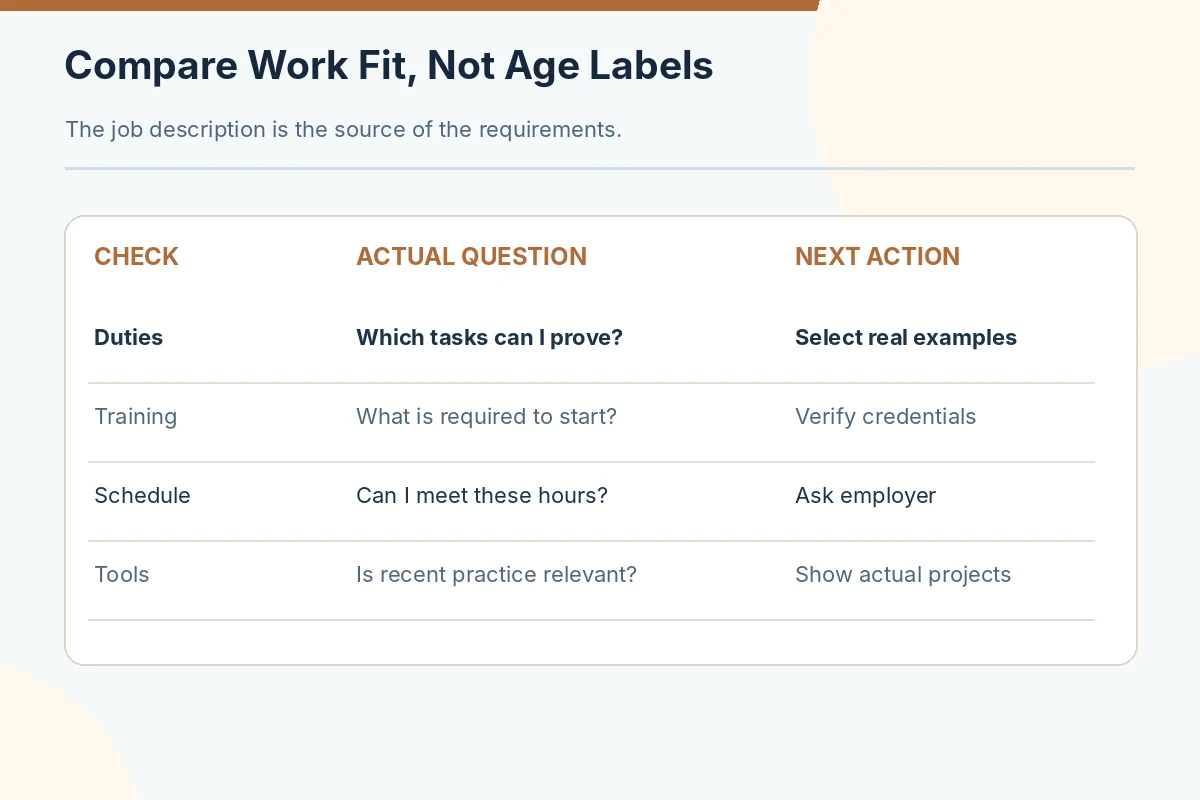
Create columns for core duties, credentials, training, work schedule, physical environment, employer verification and your supporting example. Two openings with similar titles may differ sharply: one might require independent certification while another provides structured onboarding for a support role. Do not label the second “better for older people”; it may simply better fit your documented skills and desired conditions. Record questions rather than guessing. A clear comparison helps prevent age-based assumptions from guiding your own search as well as preventing wasted applications.
| Route or question | What to compare | Important boundary |
|---|---|---|
| Core tasks | Do my real examples match? | Use verified work and recent practice |
| Training and credentials | What must I have before day one? | Check posting and official issuer |
| Schedule and environment | Can I meet the actual conditions? | Ask factual questions about the role |
Refresh one transferable example per target role
Draft a brief accomplishment showing what you did, which people or tools were involved, and the verified output. For example, “maintained shift schedules and documented change requests for supervisor review” is clearer than “managed all operations” if you did not authorize staffing changes. You may use older achievements when relevant, but recent practice can help demonstrate familiarity with current tools. Never invent a graduation date, delete required licensing information, or create a fictional modern employer to appear current. You can be selective while remaining truthful.
Check age-related assumptions against official guidance
The EEOC states that employers generally may not make hiring decisions based on age under the laws it enforces, subject to limited exceptions. These rules have coverage conditions and do not automatically make every difficult hiring outcome unlawful. If a job ad contains concerning wording, document it and consult the EEOC or an appropriate professional resource for your situation. This article is not individualized legal advice. For practical searching, focus your applications on real requirements and do not self-exclude merely because a posting seems aimed at an arbitrary career stage.
Use informational interviews to learn the day-to-day work
Ask someone in the desired field what new hires are expected to handle in their first month, what training is offered, and which tools change most frequently. Avoid asking them to share confidential information or promise an introduction. CareerOneStop recommends informational conversations when changing occupation or industry. A few well-chosen questions can help identify support roles and realistic bridge skills. If a person describes a required certificate, verify it independently; one person’s hiring experience cannot establish a universal rule.
Prepare a forward-looking transition explanation
Keep the answer about motivation and work fit: “I have experience keeping records accurate and coordinating handoffs, and I want to use those strengths in a role centered on service operations.” Add one recent example if relevant. You need not apologize for your age, compare generations, or disclose private medical or family information. Do not claim that all employers value mature workers equally, because hiring decisions vary. Keep the explanation tied to the target job’s tasks and answer follow-up questions about any actual gaps directly.
Verify scheduling and practical constraints early
Some role changes involve shift work, commuting to multiple sites, mandatory travel, on-call schedules, or extensive training. Ask the employer for the actual schedule and required duties before assuming the role is compatible with your life. Compare the position’s location, hours, and training commitments with what you can realistically provide. These are individual fit questions, not age restrictions. If a listing seems vague, a factual follow-up is more useful than relying on a review or a job-board label.

Stay alert to career-change and remote-work scams
Fraudulent recruiters sometimes target people seeking a new start with promises of unusually easy work, paid training, or immediate placement. The FTC recommends verifying the employer and avoiding payments or premature financial-information requests. An offer to “fast-track” an applicant based on decades of service is not independent proof of legitimacy. Use the official employer domain or a verified contact rather than a link sent in a surprise text. Keep copies of any legitimate applications and avoid forwarding identity documents before a verified hiring process requires them.
Run a search experiment based on work fit
Select two role families with credible task overlap and check a manageable set of current job postings. For each, save one concrete example of relevant work and one question about a requirement. Apply to positions where the essential qualifications match; investigate a training path for the rest. Track responses without inferring that an employer’s silence was caused by age. Review what you learn about tools, work conditions, and actual credentials after several applications. A clear, adaptable method matters more than any list of “best careers after 50.”
How We Research Career-Change Job Searches
We consulted federal and other publicly accessible primary career, workplace, and occupational resources. We distinguished typical occupational requirements from the qualifications of an individual employer vacancy and marked all illustrative scenarios as hypothetical. This research was checked on November 16, 2026. Sources cannot establish that a particular vacancy is open or that one applicant is eligible. Verify current job postings and any professional requirements independently.
Sources consulted: EEOC age and hiring guidance; BLS occupation finder; CareerOneStop change-of-occupation guide; FTC job scam guidance.
For affiliate and editorial relationships, see the JobAsk affiliate disclosure.
Related Job Search Guides
There is no universal age cutoff for changing careers. Evaluate real duties and preparation requirements; specific occupations may have special rules that should be verified.
Present accurate employers, dates, and qualifications according to the application instructions. Prioritize relevant evidence rather than inventing a different history.
The EEOC explains age-related hiring protections under laws it enforces, with coverage rules and exceptions. For a particular concern, consult official guidance or qualified advice.
No. Check recognized credentials, actual local job postings, program costs, and employer requirements before paying or enrolling.
Use clearly labeled coursework or non-sensitive practice to demonstrate recent learning. Do not represent practice as independent workplace responsibility.