
Production scheduler behavioral interview questions probe how you handled real schedule disruptions, shortages, work-order priorities, and communication between departments. A good answer is not ‘I work well under pressure.’ It names the order or planning context, the missing input or constraint, what you checked, which alternatives you raised, who authorized a revised sequence, and how the update reached the affected teams. O*NET identifies coordination of work and materials and schedule changes as common occupational tasks, but individual employers divide responsibility differently. Use only examples that reflect your actual access and decision authority.
Select a scheduling event with a traceable change
Pick one event in which a material, shift, equipment, or due-date change affected an existing plan. Review what you knew at the time: approved work orders, inventory status, the capacity board, a supervisor’s message, or the current revision of the schedule. The strongest story is reconstructable without exposing actual customer or vendor information. If your participation was updating a spreadsheet on instruction, do not turn it into a claim that you owned the factory’s scheduling strategy. A classroom simulation can demonstrate sequence logic, but it must be described as a simulation rather than a production incident.
Answer a material-shortage behavioral question
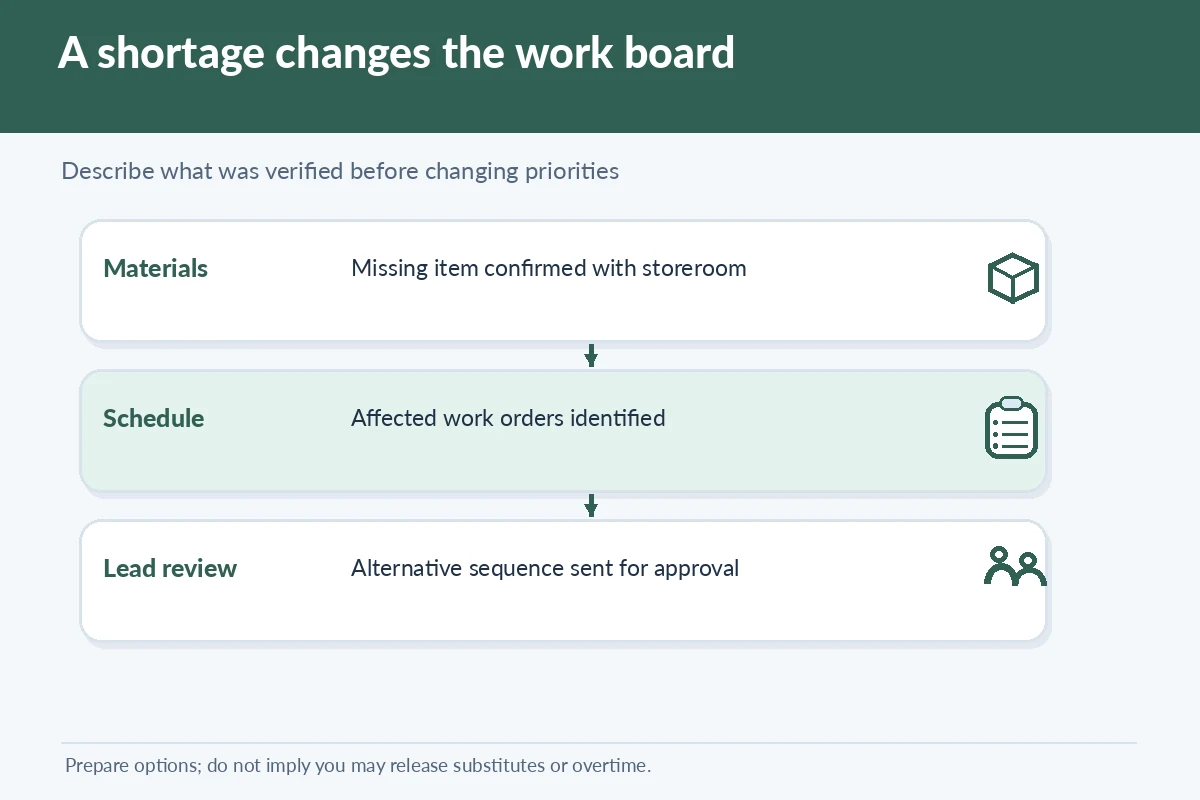
Practice: ‘Tell me about a time a needed item was not available when work was scheduled to begin.’ Explain what told you the part was unavailable, whether you confirmed that with stores or inventory staff, and what work orders could be affected. Describe reporting the gap before assuming that substitute materials were allowed. You might have prepared alternative sequence options for a lead to review or updated a work-order note after approval. Avoid saying that you unilaterally released a substitute, skipped a quality check, or promised a customer a new ship date unless that really was your authorized responsibility.
Describe a change to a plan across shifts
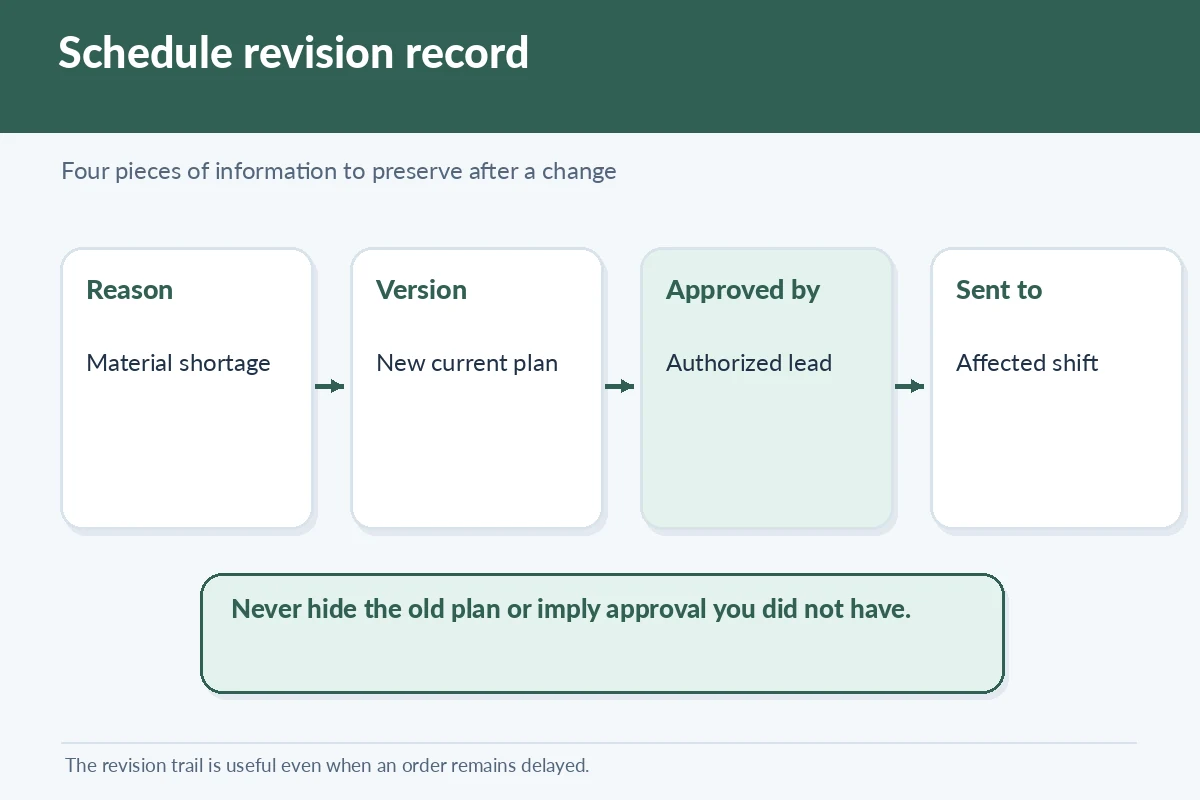
Another prompt: ‘Tell me about a time you updated a schedule that multiple teams relied on.’ Walk through version control. What made the change necessary? How did you mark which version replaced the old one, confirm the right group received it, and handle a shift that might still be using outdated instructions? Mention only tools you used, whether a wall board, ERP screen, or shared workbook. An effective result could be that the next shift acknowledged the revised sequence. Do not manufacture a percentage improvement in on-time delivery, and do not attribute the entire team’s performance to a single scheduling edit.
Use STAR to show a revision without exaggeration
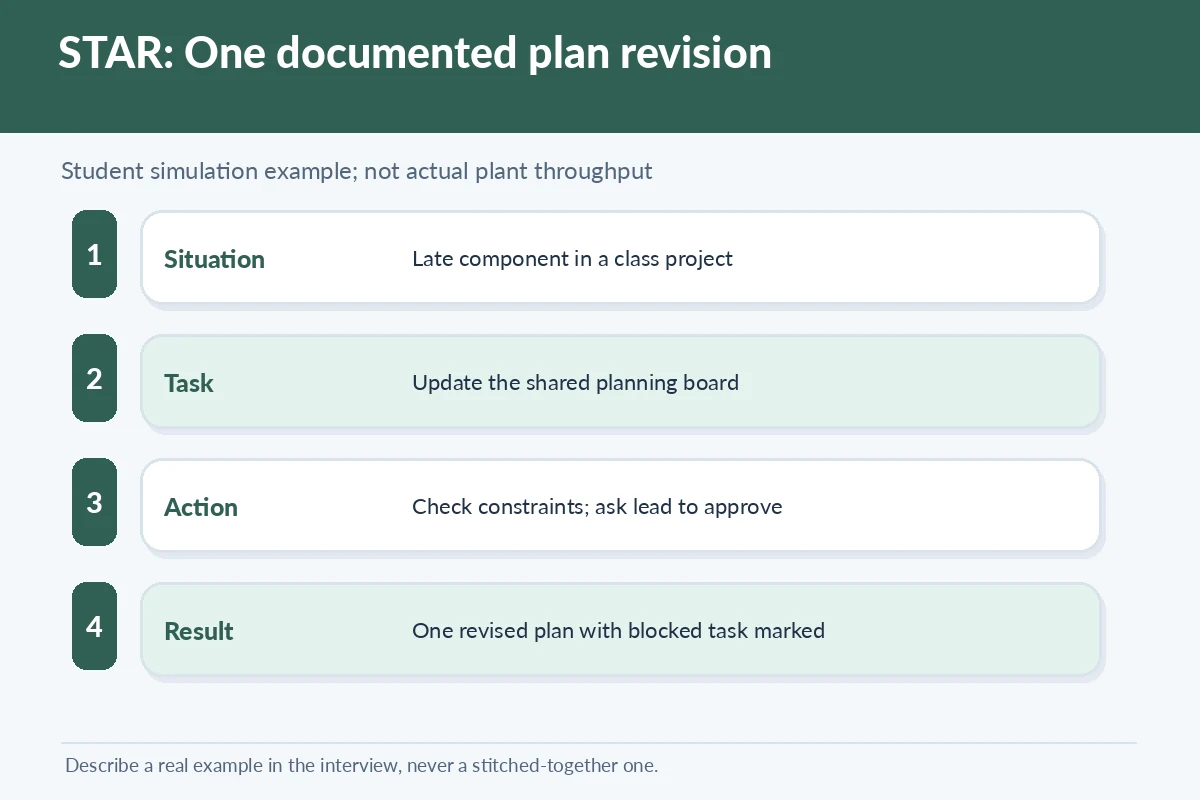
Illustrative example only: **Situation:** A student manufacturing simulation had a late component delivery in the second work period. **Task:** I was responsible for updating the shared plan for my project group, not making purchasing decisions. **Action:** I compared the available components with the remaining tasks, flagged which step could not start, drafted a revised sequence, and asked the project lead to approve it before circulating the new board. **Result:** The group worked from one documented plan and the blocked task stayed marked as pending. That result is accurate for a class project; it must not be described as actual plant throughput.
| Situation to discuss | Evidence of your action | Limit you should state |
|---|---|---|
| Shortage verified | Checked inventory status and notified the lead | Do not assume a substitute is authorized |
| Sequence option | Prepared a revised planning option | Do not imply final priority approval |
| Shift handoff | Shared approved revision with the next shift | Do not claim everyone read it without confirmation |
| Recordkeeping | Logged the reason and date for change | Do not reveal confidential order data |
Explain how you balance several due dates
Some interviewers ask for a time two priorities competed for the same equipment or workers. State the real constraint instead of asserting you can ‘do everything.’ Explain what information you checked and who had the authority to change priorities: production lead, customer contact, planning manager, or another function. If you prepared options, describe their trade-offs in ordinary language: keeping a committed order, reducing changeovers, or protecting a critical operation. A scheduler may coordinate information, but that is not automatic authority to extend a shift, approve overtime, or override a quality hold.
Show the handoff after a disruption
A schedule is useful only if the affected people can use the updated version. Describe how you informed the receiving departments, named the revision, and verified that the message reached the intended lead. If the update required customer notification or a supplier commitment, distinguish the team that owned those communications. A late work order that was correctly identified and escalated can still demonstrate careful work even if the final delivery date moved. Speak about the evidence you had at that moment rather than claiming foresight or control over every supply-chain dependency.
Expect questions about planning software and records
A follow-up might ask which system you used, how you confirmed inventory, or how you prevented outdated schedules from recirculating. If you worked with a shared sheet rather than an ERP, say so. A candidate who can describe worksheet columns, revision dates, work-order owners, and a confirmation step may provide stronger proof than a candidate who names a product without having used it. Discuss a sample record generically; do not upload or reveal customer data, internal costs, production targets, or restricted factory diagrams without permission.
Practice three incidents rather than one all-purpose story
Prepare a shortage story, a cross-shift update, and a conflicting-priority story. Each should have a different action and a clearly owned result. Practice the difference between a fact, an assumption, a recommendation, and an authorized change. Read the employer’s posting for the relevant products, lines, and approval structure; a production scheduler in a small shop may coordinate differently from a planner in a tightly controlled operation. Close your interview preparation by asking which function releases the final schedule and who updates customers when work moves.
How We Research Behavioral Interview Questions
We used the U.S. Office of Personnel Management’s structured interview guidance to distinguish behavioral questions about past experience from hypothetical situational questions. University of Maryland’s interview guide informed the use of STAR and practice with real experiences. For this occupation, we reviewed the linked public occupational source for representative duties and carefully separated possible tasks from work a particular candidate actually did. These sources were checked on November 15, 2026. The sample response is explicitly illustrative; the questions are preparation prompts, not a claim about the exact questions any employer will ask.
Sources consulted: OPM structured interview guidance; University of Maryland interview preparation; O*NET production planning and expediting clerk tasks.
For site partnerships, promotional links, and editorial disclosures, review the JobAsk affiliate disclosure.
More Interview Preparation Guides
State your exact support: checking materials, editing a schedule, or communicating an approved change. Avoid claiming ownership of the full plan.
Yes, if the interviewer knows it was a simulation and you explain the constraints and the work you personally did.
No. Explain the system or worksheet you used and your readiness to learn the employer’s platform.
No. An accurate revision, confirmed handoff, or prevented misunderstanding is a useful outcome if you can support it.
Focus on what you verified, which team controlled the decision, how you communicated the revision, and what you learned.