
CNA training on a resume must distinguish school program status, supervised clinical education, any state competency exam and verified registry standing. Completing classes alone does not always authorize use of a state-certified title. In the United States, requirements vary by jurisdiction. This guide offers a clear status checklist and hypothetical resume entries that protect against overclaiming both credentials and patient-care responsibilities.
Why nursing assistant education and CNA status need separate lines
A nursing assistant can complete classroom lessons and supervised practice before receiving the credential or registry listing an employer requires. BLS describes state-approved training, competency testing and state-specific certification practices. Those are related stages, not interchangeable names for one experience. If you are still in training, say so directly rather than introducing yourself as certified. If you completed training but have not finished the required exam or registry process, give the precise current status. A reader should be able to tell what the school confirmed, what the state confirmed and which patient-care activities you actually performed under supervision.
Identify the program and its current status
Begin with the official title from the enrollment or completion record. Include the training institution and a truthful stage such as “enrolled,” “completed” or “completion expected,” using a date only when you can verify it. Do not call a program “state approved” merely because it was advertised that way; check the relevant jurisdiction’s list. If the school changed names or the program has several tracks, copy the specific program title. A sample learning plan is not proof of enrollment. If the course was an informal caregiver workshop rather than a state-recognized nursing assistant program, describe it as that workshop.
Explain supervised clinical activities without exaggeration
Training programs may include clinical experience in a nursing home or another approved setting. A student can accurately describe assisting with allowed tasks under a named supervision arrangement if those activities genuinely occurred and program policy permits mentioning them. Never disclose patient names, images, medical details or facility records. Do not describe independent assessments, medication administration or clinical decisions unless your actual role and applicable state authorization permit them. A safe hypothetical example could describe practice with documentation, communication and reporting observations to supervising staff, without suggesting that a student managed a patient’s care plan.

Check the state competency test and registry separately
After approved education, many states require a competency exam and record eligible nursing assistants on a state registry. Exact titles, exemptions and renewal processes vary. Use the official state source before adding “CNA,” an aide credential number or an active registry claim. If an exam is scheduled but not yet taken, “State competency exam scheduled” is only accurate if the appointment exists. If you passed an exam but a registry entry is still pending, distinguish those two facts. Never invent a test result, expected approval or state reciprocity. Employers may have their own verification process.
Build an honest Education and Credentials structure
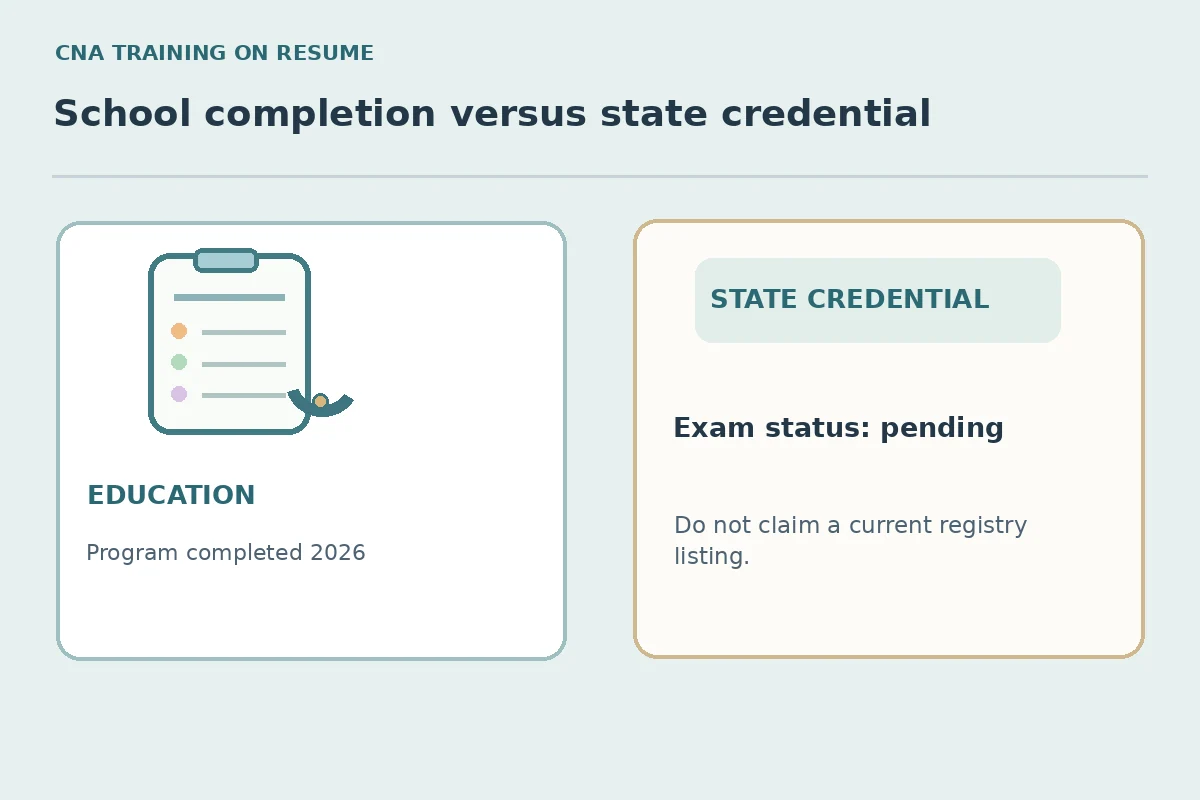
For an applicant who completed the program but is waiting for the exam, a hypothetical sample reads: “Nursing Assistant Training Program, Sample Community College — completed 2026; state competency exam pending.” If the registry later confirms an active credential, use a separate Certifications or Licenses entry with the proper state and current status. Keep the training title under Education even after receiving the credential; they serve different purposes. If a certificate from the school only proves completion of the course, do not silently rename it a state CNA license.
Describe the evidence a first healthcare employer can assess
Beyond program names, explain tasks you actually practiced in permitted settings: careful hand hygiene, reporting concerns, maintaining supply records or communicating observations to a supervisor, as applicable to the training. Do not list skills simply because the syllabus mentions them. Make clear whether the experience was classroom simulation, supervised clinical placement or paid employment. For instance, a simulated documentation exercise is useful learning but not evidence of independently managing patient records. If you have nonclinical work experience, add real examples of patience, scheduling, reliable handoffs and confidentiality while retaining the correct context.
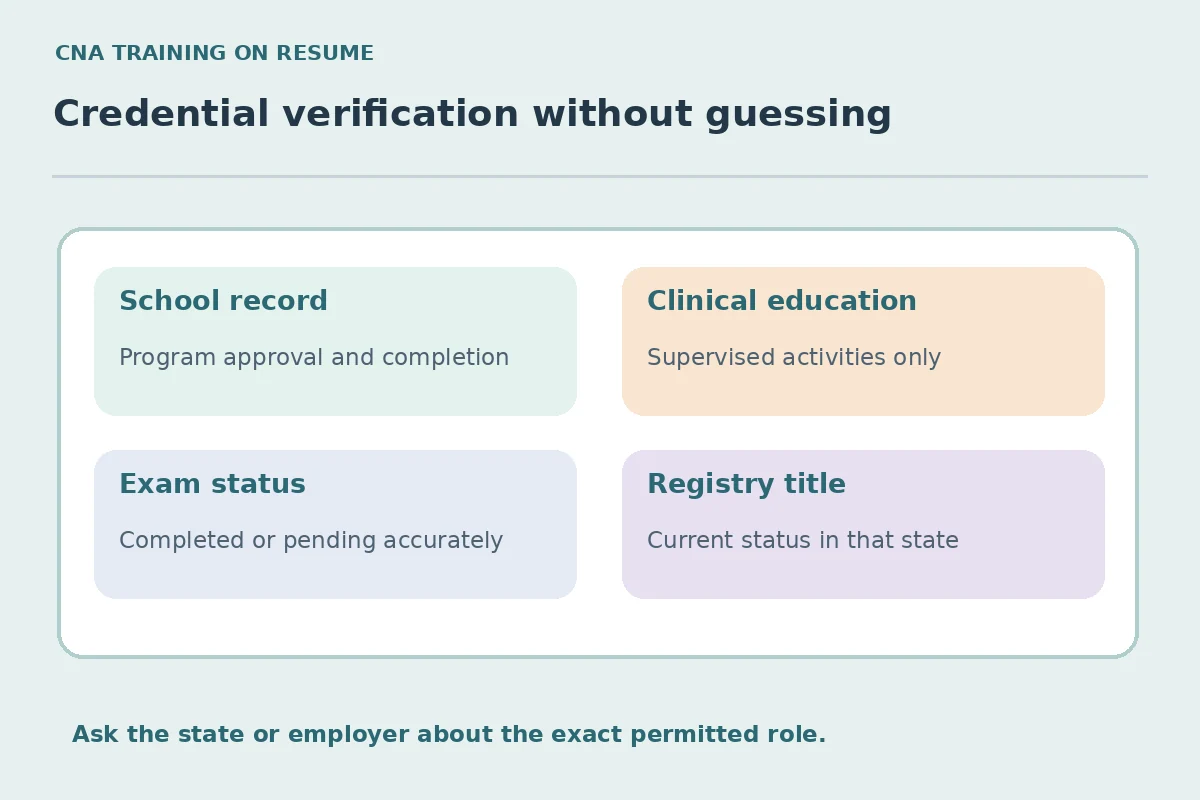
| Item to check | What the resume should show |
|---|---|
| School record | Program approval and completion |
| Clinical education | Supervised activities only |
| Exam status | Completed or pending accurately |
| Registry title | Current status in that state |
Know when to stop and request official guidance
A job posting might require active registry status, prior experience or a particular credential. You cannot satisfy such a requirement by changing the wording of your resume. Check your state’s nurse-aide registry or relevant regulator and ask the employer to clarify what documents it accepts. Do not rely on online comments about reciprocity, certificate expiration or permission to perform procedures. If a school taught skills that do not match local scope, follow current law and workplace policy. This article is about presenting records, not permission to perform clinical tasks.
Avoid three common resume misstatements
First, “Certified Nursing Assistant” before completing the required state process suggests a credential that may not yet exist. Second, “provided independent patient care” can wrongly claim authority that trainees did not have. Third, copying a school’s marketing claims as personal achievements can imply results you never demonstrated. Replace each with a precise enrollment or completion line and real, supervised practice if permitted. If your state issues a different aide title, use that exact title. Even if two states use similar terms, avoid assuming that a credential automatically transfers between them.
Prepare the documents before applying
Use a private checklist for school completion documentation, any verified exam results and the relevant registry record. Review the employer’s actual job requirements and do not upload personal health or identification documents to unverified recruiters. After completing additional training, update the resume with the exact new status; do not erase the education entry simply because a credential was awarded. A strong first healthcare resume gives an accurate education timeline, meaningful supervised learning and a clear, checkable credential status. It does not use confident language to cover uncertainty.
How We Research Education and Credential Guidance
JobAsk checked these education, career-service and occupational sources on November 17, 2026: BLS explains nursing-assistant education, supervised clinical training, state competency tests and registry rules. CareerOneStop explains how to list education, training, awards and study in progress without misrepresenting a degree. CMS describes nurse aide training programs and state competency evaluation requirements for nursing home CNAs. We compared guidance on education records with the distinctions that an applicant must verify with a real provider, school or regulator. Requirements vary by employer and jurisdiction; a cited educational resource is not proof that a particular applicant has a credential. All example schools, award names, documents and people in this article are hypothetical and are not evidence of a real award, employer endorsement or employment outcome. We do not promise hiring, testing results or acceptance by an applicant tracking system. There is no claimed paid partnership in this article. Read our affiliate disclosure for relationship transparency.
More Resume and Cover Letter Guides
Do not claim a CNA credential without verifying your state’s authorization requirements. List the training and pending exam separately.
Only if it was genuine work in that context. Supervised educational placement can be described as clinical training with its supervision clear.
Not necessarily. The school program record and the state competency or registry process are distinct.
Yes, if accurate; do not treat a scheduled or pending test as a completed credential.
Use the applicable state nurse-aide registry or state regulator and confirm the employer’s specific requirements.