
To find remote sales development representative jobs, start with the work rather than the word ‘remote.’ A legitimate listing should describe how the role handles its core tasks, who checks the result, where employees may work, and what equipment and training are available. For sales development rep candidates, the immediate distinction is between ‘research account’, ‘approved outreach’, and ‘qualify lead’. Those are not always the same person’s decisions. This guide helps you compare live job descriptions, build truthful application evidence and ask a targeted question before accepting a position. The examples in this article are educational hypotheticals, not verified vacancies or promises that an employer will hire you. Verify each opening on the employer’s official careers site and follow actual workplace policies rather than an internet checklist alone.
Identify the SDR job before evaluating the remote promise
Remote sales development representative jobs center on identifying prospective customers, contacting them through approved channels, discovering fit and passing qualified opportunities to a sales owner. Some employers give SDRs only outbound prospecting; others include inbound lead qualification or small deal cycles. The title does not automatically confer authority to negotiate and close enterprise contracts. O*NET describes related sales tasks, including prospecting and maintaining account records, but job responsibilities vary by company. Read whether the role is SDR, business development representative or account executive before judging the requirements and compensation structure.
Filter searches by sales motion and buyer
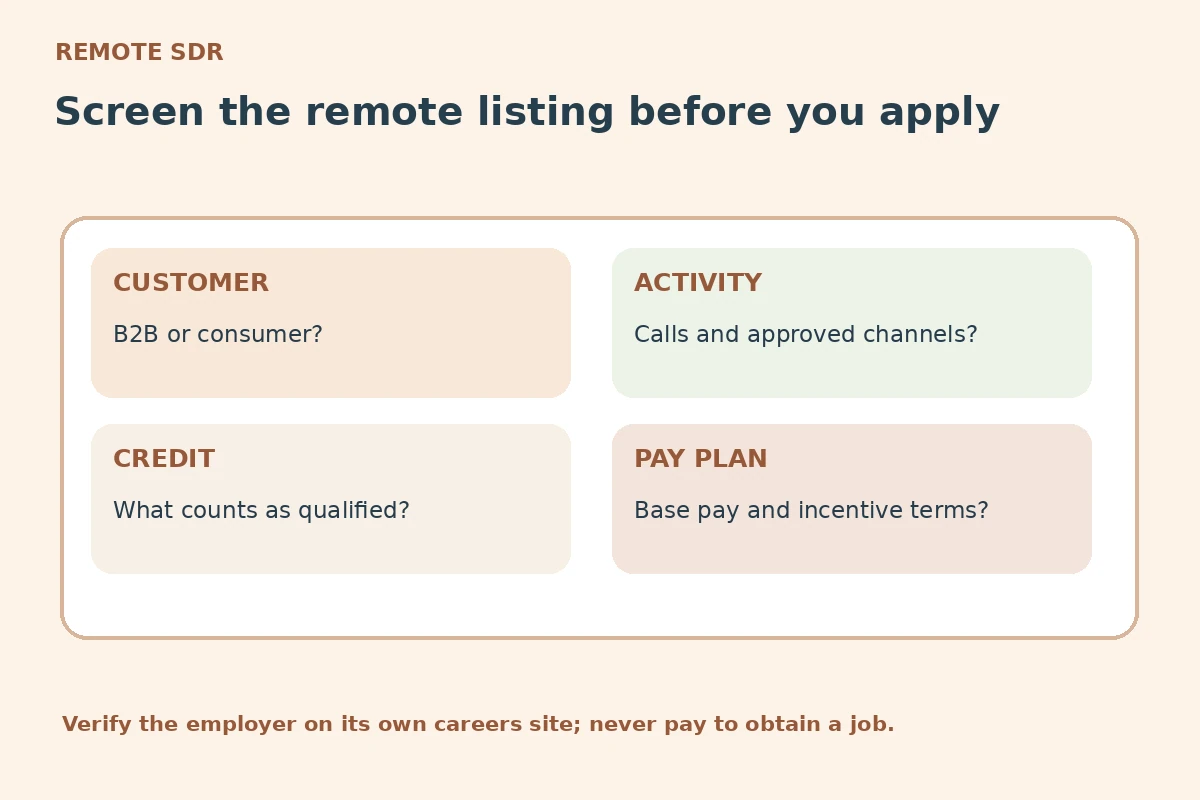
Search ‘remote sales development representative junior,’ ‘remote B2B SDR entry level,’ and ‘inside sales development remote.’ Note whether the customer is another business or a consumer, whether the product is software, services or physical goods, and whether outbound calls are expected. A role marketed as no-phone may still rely on phone-based discovery and live demos. Compare advertised territories, language expectations and shift overlap with the sales team. A remote listing may be restricted to certain states or time zones despite describing nationwide accounts.
Understand the lead-to-handoff sequence
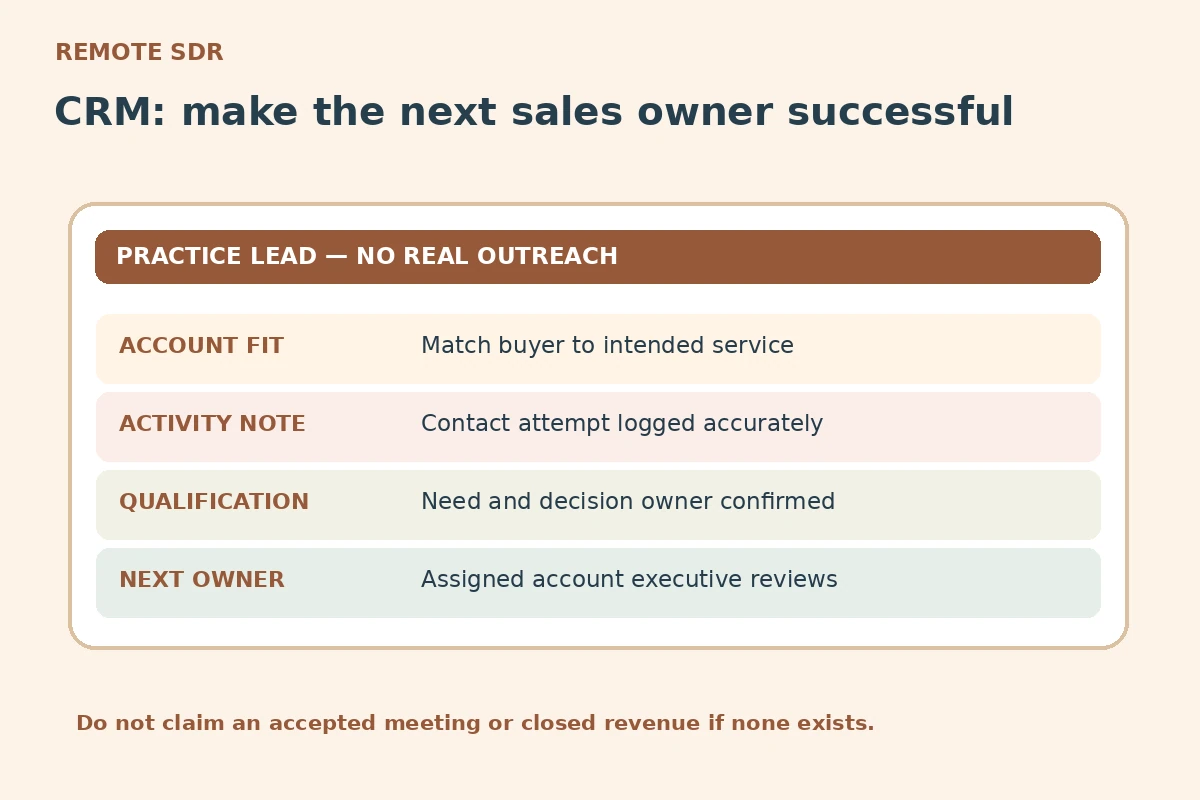
In a common SDR workflow, a representative researches an account, makes permitted outreach, records what happened and qualifies whether a conversation belongs with an account executive. Qualification might include a relevant business need, contact role and next meeting. The exact criteria are employer-defined. A junior SDR should not pretend that an unanswered email is a qualified opportunity or mark a sale closed to increase a metric. Ask what CRM statuses mean and who owns the handoff once a meeting is booked. Clear process matters when the team is distributed across locations.
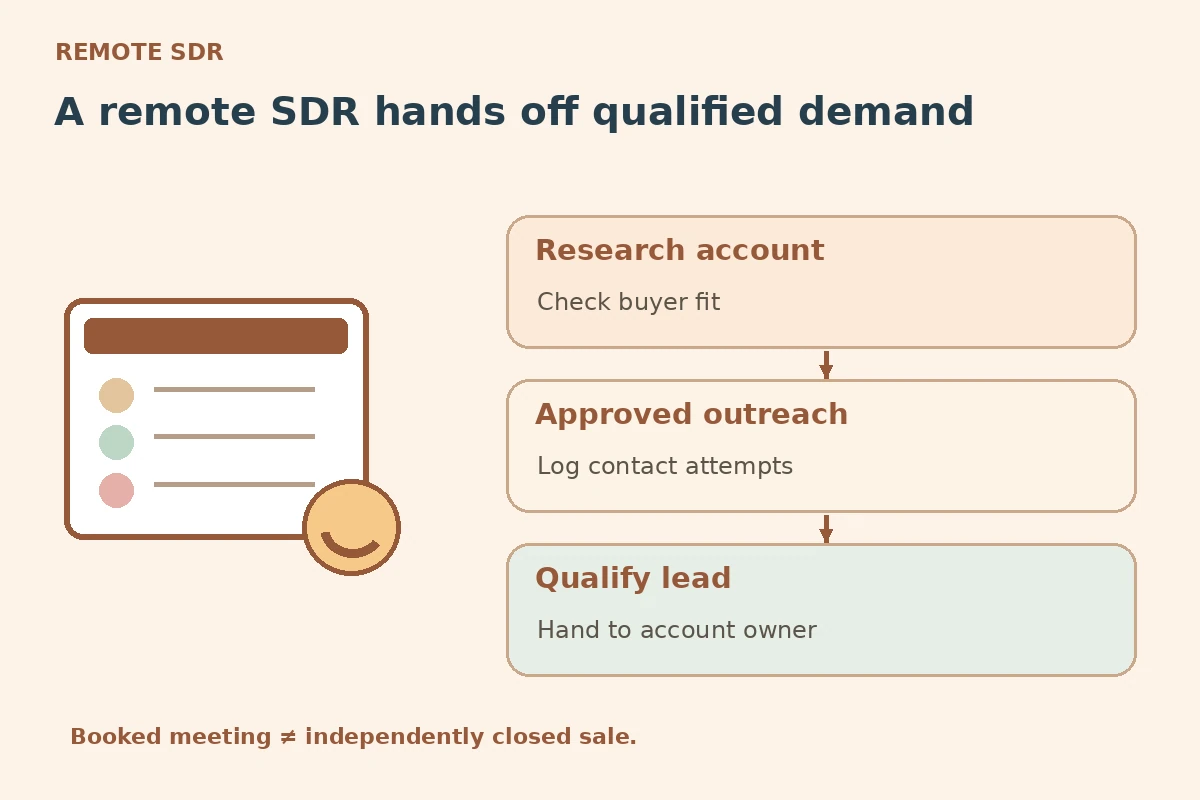
Present honest outreach practice instead of invented revenue
If you lack sales experience, prepare a hypothetical prospect research exercise using public business information and no unsolicited outreach. Show how you would identify a relevant role, write a concise value-focused email and record a respectful follow-up plan. Label the sample fictional and do not claim the recipients replied. If you have worked in retail, fundraising or customer service, accurately explain real customer conversations and recordkeeping without converting them into made-up B2B quota results. Avoid inventing meetings, conversion rates or closed revenue. Hiring managers can still evaluate your listening and organizational methods.
Ask about approved contact channels and data use
SDRs often use email, telephone, professional networks and customer relationship management systems. Ask which tools are authorized, how contacts are sourced, and what compliance policies govern outreach and opt-outs. Do not scrape personal information or send mass messages from your private account because a recruiter says it will build your pipeline. Discuss respectful communication and accurate preference records. Some industries add sector-specific privacy or communication rules; the employer should provide training and approved materials. A candidate’s job is to learn the workflow and avoid promising they can use any list freely.
Read compensation and quota terms in writing
An SDR offer may combine base pay and variable compensation, but the mechanics differ greatly. Ask whether metrics refer to calls, qualified meetings, accepted opportunities or revenue, and whether a manager reviews what counts. Confirm the written base-pay terms, commission eligibility, payment dates and any conditions for earning an incentive. Do not assume a high on-target earnings figure is guaranteed income. Compare realistic training time and account territory, not only the largest displayed number. If an employer refuses to explain how a beginner earns commissions, treat that as a decision-making concern.
| Requirement to check | What to record before applying |
|---|---|
| Job duties | Research account / Check buyer fit |
| Supervision | Qualify lead / Hand to account owner |
| Remote location | Employer-allowed states and working hours |
| Risk or permissions | No fake pipeline claims; Approved contact channels |
Check the remote schedule behind the quota
Remote SDR work often requires synchronous availability for customer calls, team coaching and meeting handoffs. Verify the time zone of target accounts, any required calling windows, weekend expectations and equipment support. Ask how new hires practice discovery calls and review messaging before contacting prospects. An employer that promises unlimited flexibility but requires daily live prospecting during another region’s hours may be a poor fit. Note whether the job uses approved calling systems or expects personal phone and email accounts. These details help you distinguish an operational sales position from a vague work-from-home advertisement.
Prepare one trustworthy discovery-call example
Practice asking a hypothetical business contact what problem they are trying to solve, which workflow is affected and whether another team member should join the next discussion. Do not lead with an invented product feature or guarantee savings the employer cannot verify. At the end, summarize the next step and record accurate CRM notes for the assigned salesperson. If you have actual customer service examples, describe how you clarified a request and handed it off, not that you won a large contract. The central skill is listening, qualification and accurate information transfer.
Verify the employer and reject task-scam patterns
Search for the opening on the company’s official career website and check that recruiter emails use a verified domain. The FTC warns that remote-work scams may ask candidates to pay for starter kits, deposit fake checks or complete paid ‘tasks’ that require personal deposits. A genuine SDR job should identify the product or service, target customer, manager and compensation terms. Do not pay to access a lead list or send money to release alleged commissions. If a listing advertises extraordinary earnings but omits the service being sold, investigate independently before sharing personal information.
Choose roles that provide measurable support and feedback
Maintain a shortlist with product category, buyer, territory, location eligibility, outreach channels, training, quota definition, compensation and the account-executive handoff. In interviews ask who reviews call quality, how contact data are protected, and how rejected meetings are handled. If you are entering the field, prioritize an employer with transparent coaching and a clear ramp-up process over a promise of effortless selling from home. A strong application explains careful prospect research, truthful communication and CRM follow-through rather than unsupported sales superlatives.
How We Research Remote Sales Development Rep Jobs
JobAsk reviewed the following occupational and government sources on November 17, 2026: O*NET describes service sales, prospect identification, customer contact and maintaining CRM-type account records. BLS explains business prospecting, communication, product explanation and negotiation by sales representatives; specific SDR duties differ. FTC warns that work-from-home scams seek upfront payments or personal information and recommends independent verification. We compared the described duties with typical job-search terminology and distinguished employer-controlled conditions from general occupational guidance. Neither these sources nor a public search result confirms that any particular vacancy remains open or that an employer hires in your state. Sample work records and interview responses here are explicitly hypothetical; use your own documented skills and follow the actual employer’s instructions. This page does not promise hiring, eligibility, compensation or legal clearance. We have not claimed any specific affiliate partnership. See the JobAsk affiliate disclosure for transparency.
Related Job Search Guides
Some organizations separate prospecting and qualification from account-executive closing; other roles combine duties. Verify the written job description.
Many require outbound calls or live conversations. Ask about approved channels, calling windows and time-zone coverage.
No. Variable compensation depends on written plan terms and actual eligible performance; read the base-pay and incentive details.
Some employers train newcomers. Present accurate customer communication, research and recordkeeping evidence instead of invented quota results.
Verify the opening directly, confirm recruiter contact details and reject requests to pay for leads, training or access to supposed earnings.