
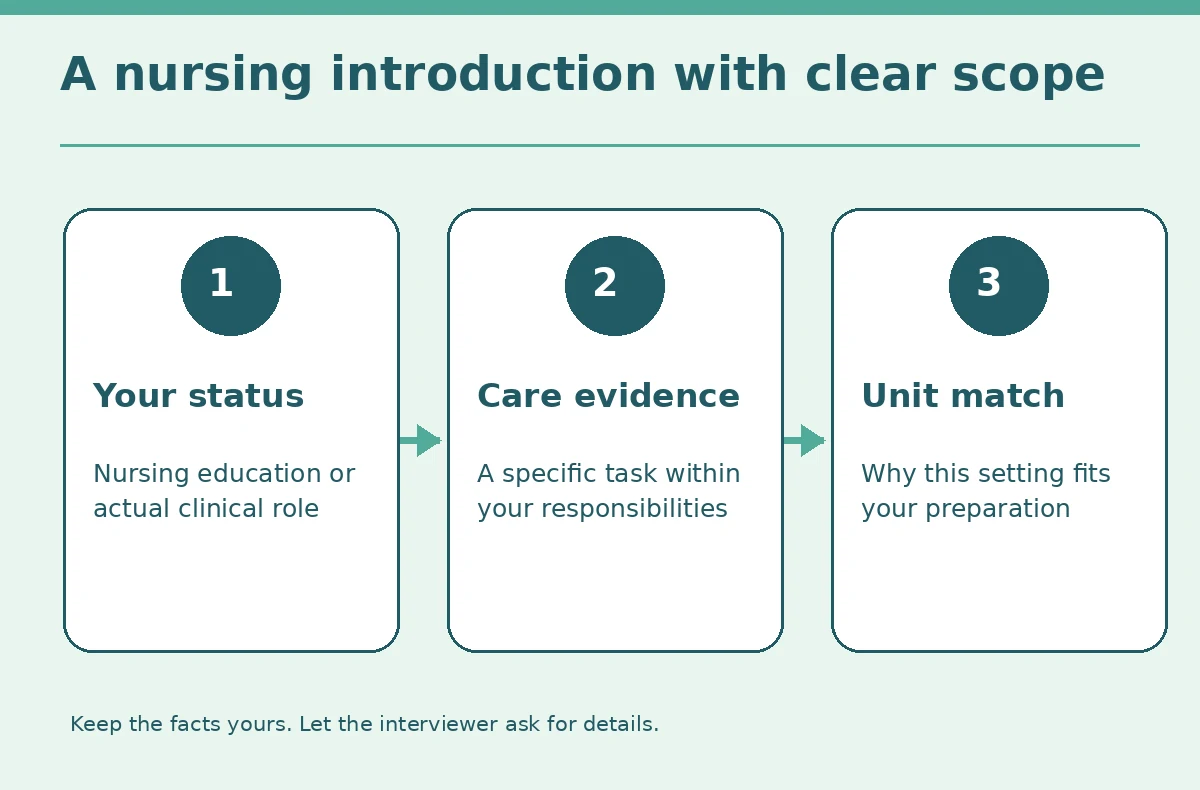
For “Tell Me About Yourself in a Nursing Interview” in a nursing interview, offer a concise clinical orientation: your actual education or nursing role, a relevant example of how you contribute to patient care, and why the unit’s work fits your preparation. A new graduate can discuss supervised clinical learning; an experienced nurse can describe real responsibilities. Neither should invent independent duties or patient outcomes.
The Bureau of Labor Statistics describes registered nursing work such as assessment, documentation, coordination and patient education. Penn Career Services recommends a focused professional introduction. Examples here are hypothetical and omit identifying patient details. Actual nursing scope, supervision and credentialing depend on applicable requirements and employer policy; this guide is not clinical or legal advice.
Start With the Correct Clinical Background
Begin by identifying whether you are a nursing student, recent graduate, licensed registered nurse or experienced nurse in a particular setting. State an area you genuinely practiced, such as patient education, documentation, discharge communication or coordinating with a care team. You do not need to list every rotation, job or credential in the opening. The employer needs enough context to interpret the evidence that follows. Our guide to nursing resume format goes into more detail.
Never say you independently performed a regulated activity if your role involved observation, simulation or supervised participation. If an academic placement allowed you to observe medication administration, observation is not the same as administering medication under your own authority. Precise phrasing protects professional credibility and gives the interviewer an accurate view of the support or orientation you may need.
Choose One Patient-Care Skill You Can Verify
A strong nursing example focuses on an action that illustrates safe practice: noticing a change, communicating a concern through an appropriate channel, documenting accurately within assigned duties, or explaining instructions under supervision. The BLS occupational profile describes how nurses assess conditions, record observations and work with other healthcare professionals. Choose a skill that actually belongs to your training and role rather than merely repeating a description of the profession.
For a student, a usable example might be preparing a careful handoff during a simulation or practicing communication in a clinical placement with permission. For an experienced RN, the example may involve coordination across shifts or a clearly described educational interaction. Do not report unverified recovery results, medical statistics or private patient stories. If you mention an outcome, use only an approved and factually supportable description.
Structure a New Graduate Nurse Introduction
A recent graduate may not have paid RN work to summarize. State your education and current licensure status accurately, then describe supervised experiences that introduced you to relevant care tasks. A good closing sentence explains what you hope to learn in the unit’s orientation or training environment. Do not imply that completion of a degree automatically establishes every credential required for a particular employer or state.
Hypothetical example: “I recently completed my nursing program and gained supervised experience with patient communication, basic documentation and team handoffs during placements. I learned the importance of asking for clarification when a situation changes. I am interested in this unit because I want to strengthen those habits through a structured orientation and contribute as my responsibilities develop.” Substitute your real training and status.
| Situation | Useful evidence | Honest boundary |
|---|---|---|
| Student clinical placement | Supervised observations, assigned tasks and learning | Name supervision; do not imply independent RN practice |
| New graduate RN | Actual education, licensure status and onboarding needs | Do not claim specialty competence without evidence |
| Experienced RN | Real setting, responsibilities and care-team communication | Keep patient details confidential |
| Changing specialties | Transferable clinical habits and known training gaps | Do not promise to perform unfamiliar procedures |
Structure an Experienced RN Introduction
An experienced nurse can use the same general shape while leading with the setting and kind of responsibility actually held. For example, a nurse who coordinated discharge instructions may emphasize patient education and interdisciplinary communication. Someone who worked on a busy medical-surgical team may choose a handoff example. Keep the description brief enough that the interviewer can ask which processes you used.

Hypothetical example: “I have worked as an RN in a hospital unit where patient assessment, documentation and clear shift communication were recurring parts of my practice. I pay close attention to communicating new concerns promptly through the care team. I am interested in this position because the advertised responsibilities emphasize coordinated patient care.” Avoid inventing patient counts or specialty qualifications.
Match the Introduction to the Care Setting
Different environments place different emphasis on the opening answer. An inpatient role may call for prioritization and handoff communication. An ambulatory role may foreground patient instruction and follow-up coordination. Community health work may involve education and connections with other services. Read the posting and use the specific duties it actually describes rather than a generic claim that you love helping people.
Do not infer the scope of practice from a unit name. A role can have responsibilities limited by law, employer policy, supervision and training. If an interviewer asks for experience outside your background, explain your current knowledge and what additional orientation or credential you would need. Never imply you can ignore safety steps simply to show confidence. For the fuller picture, see our registered nurse resume summary guide.
Show Respect for Privacy and Team Communication
Patient-centered examples should avoid identifying ages, diagnoses, dates or unusual details that could make a patient recognizable. Even a story with no name can expose private information. Discuss the general action—such as reporting a concern appropriately—without revealing protected or confidential information. If in doubt, choose a simulation or anonymized learning example your institution permits you to discuss.
Collaboration is also stronger when described at the correct level. “I shared my observations with my clinical instructor” is different from “I directed the treatment team.” Explain whom you notified, what you were responsible for, and how you understood escalation. This demonstrates professionalism without pretending to own medical decisions that belonged to someone else.
Use Evidence Rather Than Vague Caring Claims
Empathy and care are important, but “I am compassionate” alone is difficult for an interviewer to assess. Translate that statement into a behavior you can discuss: used understandable language, listened to a concern, checked comprehension where appropriate or took a question to a qualified colleague. The action should demonstrate respect, good judgment and proper boundaries. A sincere small example can be more useful than dramatic language.

Avoid made-up patient satisfaction scores or clinical outcomes, including claims that your communication saved a life. If you have genuine approved evidence, state its context and limit. If your example occurred during a skills lab, say so. OPM’s interview guidance explains the role of job-related behavior in assessment; an opening answer can preview that evidence without trying to answer an entire behavioral interview question.
Prepare for Scope and Safety Follow-Ups
After your opener, an interviewer may ask what you would do if a patient’s condition changed, how you documented observations, or how you communicated with a team member. Do not turn the opening into clinical instructions or claim you would perform tasks independently when they require qualified direction. State that you would follow role-appropriate procedures and seek supervision or escalation consistent with the setting.
Rehearse the terms you use. If you say you “led a handoff,” make sure you really facilitated it; otherwise say you participated. Keep a brief list of competencies you can support with examples from work, clinical placements or simulations. Your safest preparation method is to connect real experiences to the duties in the advertisement and discuss limitations plainly. Our guide “Tell Me About Yourself for an Internship” goes into more detail.
How We Research Interview Answers
We checked the public sources listed here on October 21, 2026: BLS; Penn Career Services; OPM. We compared this question-specific intent with prior JobAsk interview material and selected advice that can be tied to the target audience. The example answers and diagrams were independently written for this page. We do not have access to private employer selection criteria, and this content does not claim to predict hiring outcomes.
Disclosure and limits: All example candidates, projects and sample answers above are hypothetical; substitute only personal facts you can verify. No employer interview, placement statistic, guaranteed outcome, partner relationship or secret ATS rule is claimed. This guide contains no affiliate links. Read the JobAsk affiliate disclosure for sitewide policy. Employer requirements, training arrangements, and any professional scope restrictions must be verified for the specific vacancy.
More Interview Preparation Guides
- Questions to Ask in a Nursing Interview: Unit Support and Escalation
- Nursing Interview Strengths and Weaknesses: Safety, Examples, and Growth
- Questions to Ask About Company Culture: Get Specific Answers
- Tell Me About Yourself With No Experience: First Interview Answer
- Tell Me About Yourself for an Internship Interview: Coursework to Value
Yes. Clearly name it as a supervised clinical placement and describe what you personally observed or performed within its rules.
Use only a nonidentifying, appropriately permitted example; do not disclose patient information or rare identifying circumstances.
Usually select one or two directly related to the posting and leave other details for follow-up questions.
Explain applicable transferable skills, your actual qualifications and where you would need orientation or additional training.
Only when you have reliable, permitted evidence and can accurately explain your role and the measure. Never invent clinical results.