
Quick answer: Ask how the unit orients new nurses, handles handoffs, escalates concerns, and communicates scheduling expectations. These questions are about patient safety and role fit, not an attempt to obtain patient details or bypass local clinical protocols. Interview questions are a tool for judging the actual job, not a script that proves you will receive an offer.
Choose questions based on what is still unknown after the job description and the conversation. The examples below are hypothetical; employer responses, team structures, rules, and training arrangements vary. Avoid treating sample wording as a promise from any real employer.
Start With the Real Responsibilities of This Role
Registered nurses assess patient needs, document care, communicate with colleagues, and follow professional practice requirements. The O*NET nursing profile identifies those categories of work, but every unit has its own patient population, policies, orientation process, and escalation channels.
The important distinction is between an occupation profile and the actual work offered to you. Before the meeting, mark the responsibilities stated in the posting and write down what they do not explain: who owns a decision, how errors are corrected, which tools are used, and where a new employee seeks support. Bring the short list to the interview. If the interviewer already answers a question, acknowledge the answer and move to a more useful one.

Five Questions That Reveal How the Work Operates
1. “What does the orientation process look like for a nurse joining this unit?” Ask who supervises orientation, what competencies are checked, and when independent assignments are considered. Useful follow-up: “How is additional support requested if a skill needs more practice?” A useful response distinguishes structured learning from unsupervised trial and error.
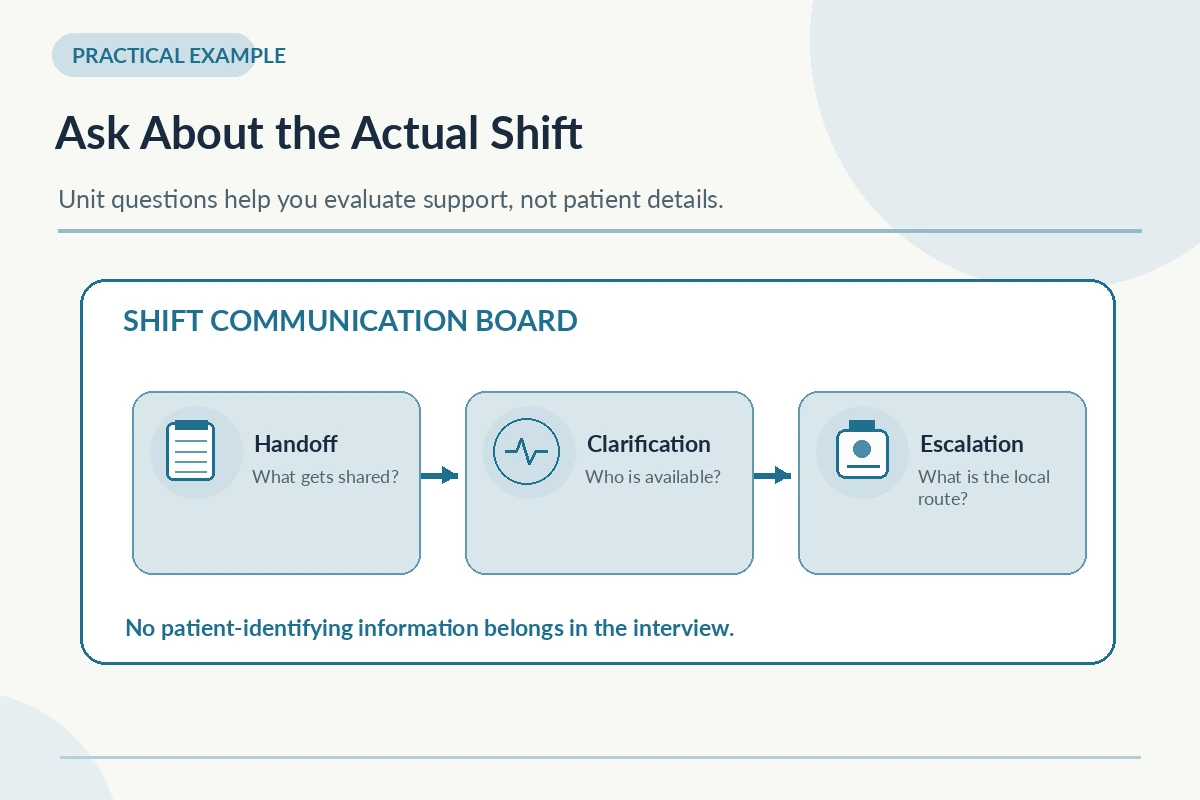
2. “How does the team share essential information at shift change?” The practical issue is whether incoming and outgoing staff have a clear handoff routine and a reliable way to clarify missing information. Useful follow-up: “Who should a new nurse contact when an important detail is unclear?” Listen for a clear communication path rather than a promise that handoffs are never difficult.
3. “How are patient safety concerns escalated during a busy shift?” Find out whether the unit can identify the appropriate charge nurse, supervisor, or clinical resource for concerns. Useful follow-up: “What is the process when the first contact is unavailable?” The answer should describe a local escalation route without requiring confidential cases.
4. “How are assignments and scheduling expectations explained to applicants?” Ask about standard shift patterns, orientation shifts, and any weekend or on-call obligations relevant to this specific posting. Useful follow-up: “At what stage are the actual schedule and staffing expectations confirmed?” Avoid treating a verbal generalization as a guaranteed schedule; request written terms when the offer arrives.
5. “How does the unit help newer staff develop after orientation?” Feedback, mentoring, and continuing education may shape both fit and safe practice. Useful follow-up: “Who reviews progress and helps identify learning priorities?” Look for named feedback channels and realistic expectations rather than a guaranteed promotion timeline.
Do not ask all five mechanically. The strongest question is the one that closes an information gap that matters to your decision. If the employer explains a process while answering an earlier question, move to the next unresolved issue rather than asking it again just because it is on your list.
Match Each Question to the Right Interviewer
A recruiter may know the position type and broad scheduling process. The nurse manager can usually explain orientation and assignment expectations. A staff nurse may describe daily teamwork and handoffs, but should not be expected to reveal private patient information. Frame questions about staffing around practical support and process; avoid presuming that one universal staffing ratio applies to every specialty or jurisdiction.
You can introduce a question by referencing something genuine from the posting or conversation: “You mentioned that this position will support the new workflow. Could you explain who handles the initial review?” This wording invites specific information while respecting the interviewer’s expertise. Do not pretend you researched an initiative unless you actually found it in a credible source.
Practice One Realistic Question and Follow-Up
Hypothetical exchange: Candidate: “If I encounter an unfamiliar situation during orientation, who is my point of contact?” Nurse manager: “Your preceptor, then the charge nurse when your preceptor is unavailable.” Follow-up: “How is that escalation route communicated to staff working different shifts?” This asks for safe clarity while respecting local protocols.
The hypothetical exchange shows the difference between merely listing questions and listening to the response. A strong follow-up uses an actual word from the answer—such as review, orientation, training, or escalation—and asks what that means in practice. If your interviewer cannot provide an answer, ask when and from whom you could obtain that information before deciding on an offer.
Check Risk, Authority, and Missing Information
Do not ask an interviewer to share real patient cases, protected records, or identifying shift incidents. If a response about supervision or escalation is incomplete, ask for clarification about the unit policy or who can explain it. The information available during an interview is not enough to certify that a facility meets every legal or clinical requirement; treat it as one part of your due diligence.
Keep a private decision note with three columns: what the employer stated, what remains unclear, and what document or person could confirm it. This protects you from turning a pleasant conversation into assumptions about duties, pay, training, or working conditions. It also helps you draft a concise follow-up if a serious question was not answerable during the interview.

Adjust the Shortlist for Your Experience Level
If you are a new graduate, prioritize preceptor structure, learning milestones, and the route for asking for help. If you have worked as an RN in another specialty, ask how experience transfers and what unit-specific competencies are evaluated. If this is a per-diem or float position, clarify orientation for each unit and what support is available during reassignment. An interview cannot replace review of the written position and organizational policies.
For a first conversation, prioritize role duties and the immediate support structure. For a later interview, ask about details that remain material to your decision, such as review processes, assignment boundaries, and the next stage. If time is short, choose two questions that lead to different information rather than two variations on the same concern.
Use the Answers to Decide Your Next Step
After the meeting, separate statements of fact from your interpretation. A thoughtful interviewer may be unable to speak for another department; that is different from proof that no process exists. Summarize any answer that affects your decision, note who supplied it, and identify one unresolved item. If necessary, send a short follow-up asking who can clarify the issue. Do not send a long questionnaire that repeats everything you discussed.
The CareerOneStop preparation guide suggests researching the organization and preparing questions related to the position. Harvard career services similarly recommends discussing challenges and expectations; Penn Career Services emphasizes tailoring questions to your interviewer. The goal is informed judgment, not a magic question guaranteed to impress.
How We Research These Interview Questions
This guide uses published interview preparation recommendations and role descriptions rather than invented employer policies. Its role-specific discussion is checked against the occupational profile, and its interview approach against the three university and federal career resources linked above. All scenarios are explicitly hypothetical. We do not have inside information about any particular employer’s practices, hiring results, or current job openings. For editorial and commercial transparency, read the JobAsk affiliate disclosure; this article does not endorse an affiliate product.
More Interview Preparation Guides
- Questions to Ask in a Healthcare Interview About Orientation and Patient Safety
- HR Interview Questions to Ask: Confidentiality, Hiring Process, and Scope
- Manager Interview Questions to Ask: Authority, Metrics, and Team Support
- First Job Interview Questions to Ask: Training, Tasks, and Support
- Tell Me About Yourself in a Nursing Interview: Clinical Evidence First
Yes. Ask how assignments and support are organized on the specific unit, while recognizing that staffing needs vary by shift and patient needs.
Yes, but also ask how readiness is assessed and what happens if more supervised practice is necessary.
No. A calm question about whom to contact for concerns shows interest in safe teamwork.
You may ask whether the organization offers one and follow its privacy and safety rules.
A recruiter or the formal offer process may be better for compensation terms; choose the right contact and clarify in writing.