
Behavioral interview questions ask what you did in a past situation, not whether you can repeat an ideal answer from the internet. The STAR approach—situation, task, action and result—can help organize a true account. This guide focuses on the wording, evidence and practice of behavioral prompts; JobAsk’s Job Interview Preparation and Common Interview Questions articles address broader interview preparation. All sample candidates and events here are hypothetical and must not be repeated as personal history.
Recognize what a behavioral prompt is asking
Prompts such as “Tell me about a time you handled a disagreement,” “Describe a mistake you learned from,” or “Give an example of initiative” invite a specific past event. By contrast, “What would you do if?” is often a hypothetical situational question that may need a different response. MIT and USC career centers describe behavioral interviewing as a way for employers to hear evidence from past actions. That does not imply every employer uses one scoring system or that a memorized story automatically demonstrates competence. For the fuller picture, see our guide “STAR Interview Method”.
Before answering, listen for the skill underneath the wording: collaboration, prioritization, judgment, ownership or resilience. A single true story may demonstrate several qualities, but it must still answer the particular question asked. Someone asked about teamwork should explain their part in working with others rather than offering only a technical solo achievement. Consider experiences from paid roles, study, volunteering or projects where you can identify real responsibilities. Do not invent an employer, coworker conflict or impressive result because it matches an online example.
Build a STAR answer around your own responsibility
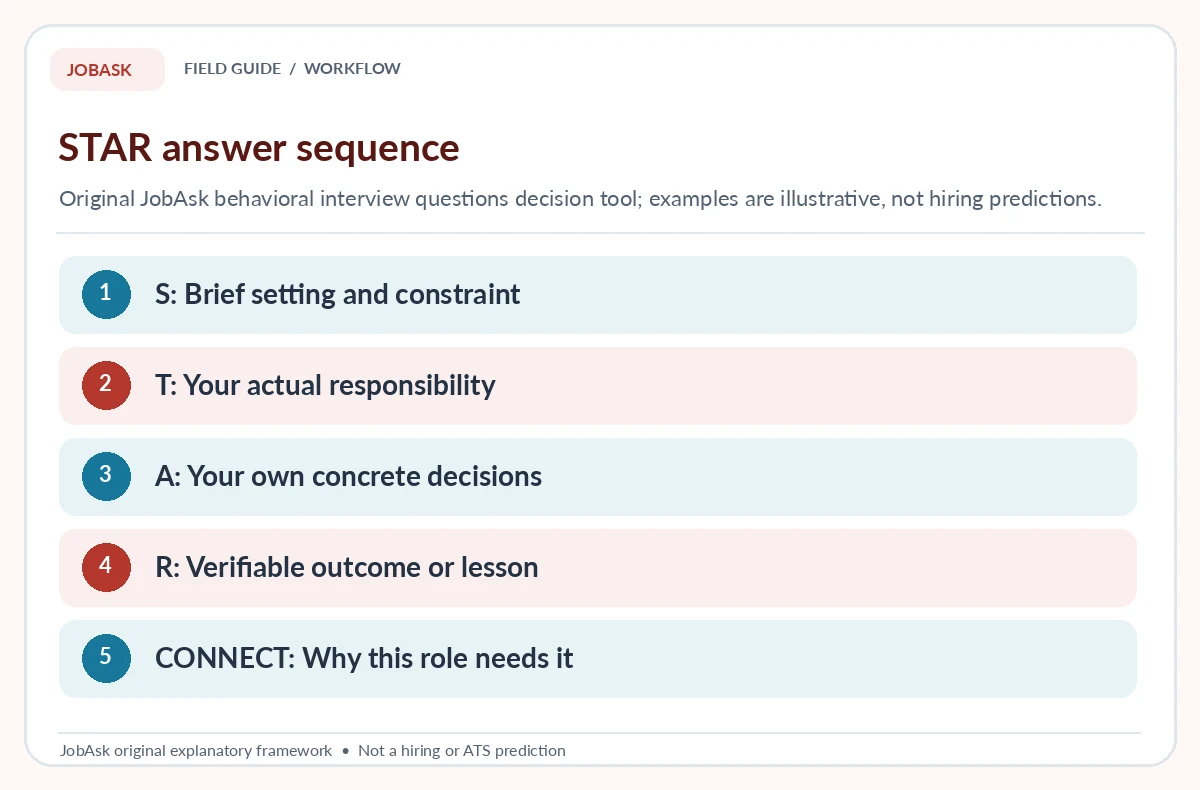
Situation supplies just enough context to understand the challenge; task explains your responsibility; action names the steps you personally took; result describes the actual outcome and, where appropriate, what you learned. UVA’s career center explicitly advises focusing on personal actions rather than describing a team only as “we.” The STAR labels are memory cues, not headings you must recite to the interviewer. Spend more words on what you decided and did than on the organizational history behind the situation.
Try writing four bullet notes rather than a polished speech. For each step, ask whether a former teammate could recognize the event and your role. If a result is still in progress, say so rather than inventing a finished success. If you made a mistake, acknowledge it and explain a genuine adjustment; do not force every setback into an implausible victory. A result may be a completed document, a clearer procedure or a lesson you can describe honestly. Precise numeric claims need the same verifiable basis as numbers on a resume.
Practice a fictional teamwork answer step by step
Completely hypothetical prompt: “Tell me about a time you worked with people who had different priorities.” Situation: an imaginary student group had overlapping project deadlines. Task: Jordan was responsible for coordinating a shared outline. Action: Jordan collected each person’s available time, proposed a sequence for editing sections and recorded decisions in a shared list. Result: the group completed an outline for review; no unsupported claim about its grade or impact is added. The account is fictional and should be replaced with a real collaboration if used for interview practice.
The answer becomes better when it distinguishes Jordan’s coordination from another person’s writing and explains why the chosen sequence helped the group proceed. It becomes worse if Jordan claims to have “led a cross-functional team to a record-breaking result” with no evidence. A suitable follow-up might ask what happened when someone missed a deadline. In practice, prepare an accurate answer to that question too. You do not need a flawless story; you do need enough detail to withstand sincere follow-up questions without a new invented plot.
Practice a fictional mistake and learning answer
Another wholly invented question: “Describe a mistake and what you changed afterward.” Imaginary volunteer Casey sent an outdated location note before a community event. Casey’s task was to coordinate information; after noticing the mismatch, Casey contacted the organizer, sent a corrected note through the agreed channel and began checking updates against a final reference list. The result is a documented correction and a changed checking habit; we do not claim nobody was inconvenienced or that the organization’s entire error rate fell. The story models accountability without heroics.
An honest mistake story should respect confidentiality and avoid blaming a coworker who is not present to respond. If the real event involved sensitive information, describe the process at an appropriate level without revealing private data. Explain what you learned only if you actually took an improvement step. Interviewers may ask what you would do differently today, which is an opportunity to reflect rather than declare complete mastery. USC career advice recommends including learning and behavior changes when discussing failures, making the reflection part of the answer useful. For the fuller picture, see our situational interview questions guide.
| Prompt theme | Useful genuine evidence | Check before telling |
|---|---|---|
| Teamwork | Your contribution to shared project | Give others proper credit |
| Mistake | Error, correction and learned process | Do not hide real limitations |
| Initiative | Task you spotted and owned | State your actual authority |
| Changing priorities | Specific choice between deadlines | Avoid invented urgent drama |
Match common behavioral themes to a story bank
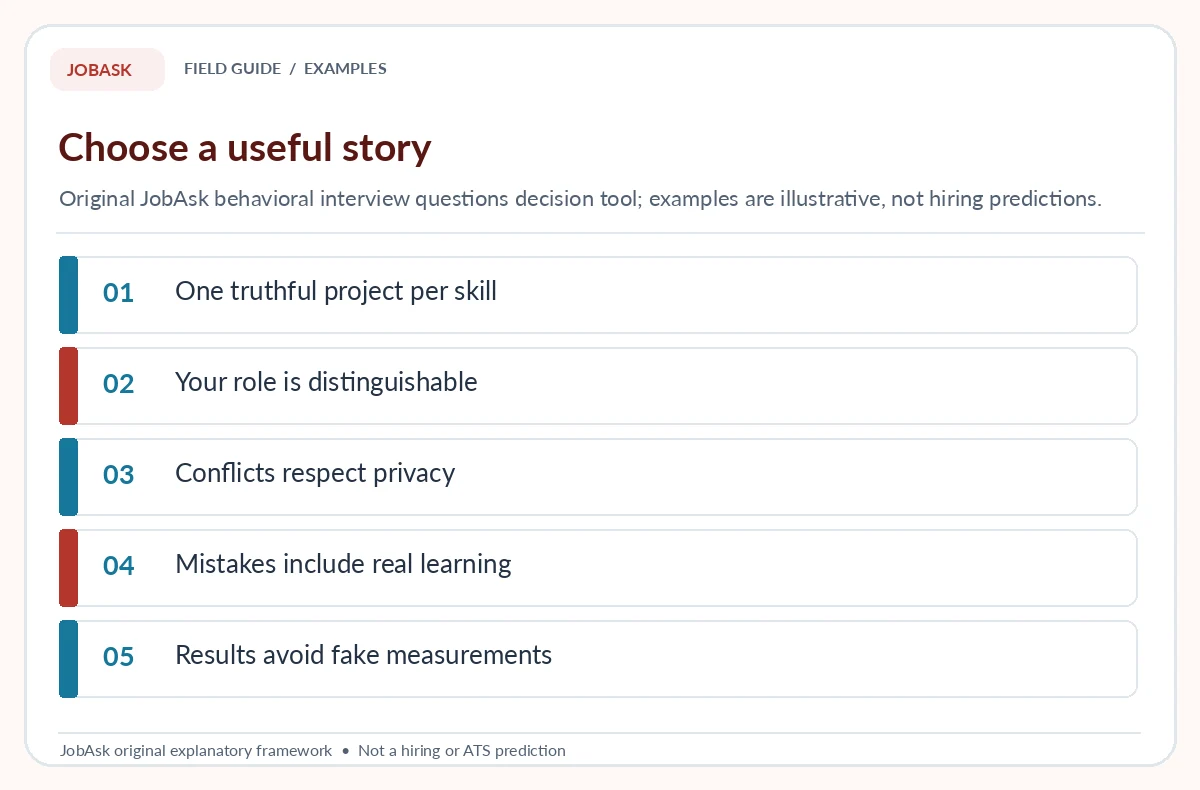
Prepare several distinct examples rather than the same episode for every prompt. For conflict, look for a time you listened and clarified an actual disagreement. For prioritization, recall a genuine decision about deadlines or dependencies. For initiative, use a specific task you noticed and addressed within your authority. For customer service, explain an interaction while protecting the customer’s identity. For learning, describe what you practiced and how you knew you were improving. Each example should have its own facts, not a rehearsed invented persona.
Use a simple bank with columns for prompt, skill, event, your action, observable outcome and limits. This does not require a paid interview-coaching product. A student may draw from teamwork in a class, while an experienced worker may have several work projects; both should identify the same basic evidence. If your experience does not include the exact circumstance, state that and discuss the nearest genuine example when appropriate. Pretending that an unrelated event is identical can mislead the interviewer about your capabilities. Our guide “Interview Strengths and Weaknesses” goes into more detail.
Adapt length and context without changing the facts
A spoken answer should have enough context to be understandable but not bury the action. Practice telling the same event concisely and then preparing the details a follow-up might request: who made the decision, what you had authority to change, and what you could actually observe afterward. Listen for unclear pronouns and overuse of “we.” Do not turn the practice rubric into a numerical prediction of whether you will be hired. The aim is to improve your explanation of experiences already true for you.
Behavioral prompts can touch on conflict, criticism or mistakes; keep other people’s private information out of your account. A truthful answer does not require naming a colleague, exposing an internal customer record or making allegations you cannot substantiate. If you are asked about a situation outside your experience, acknowledge the limit and explain a closely related actual example if one is relevant. An invented scenario can be useful for learning STAR but must be clearly labeled as imagined rather than presented as something you lived.
Use a repeatable rehearsal and evidence audit
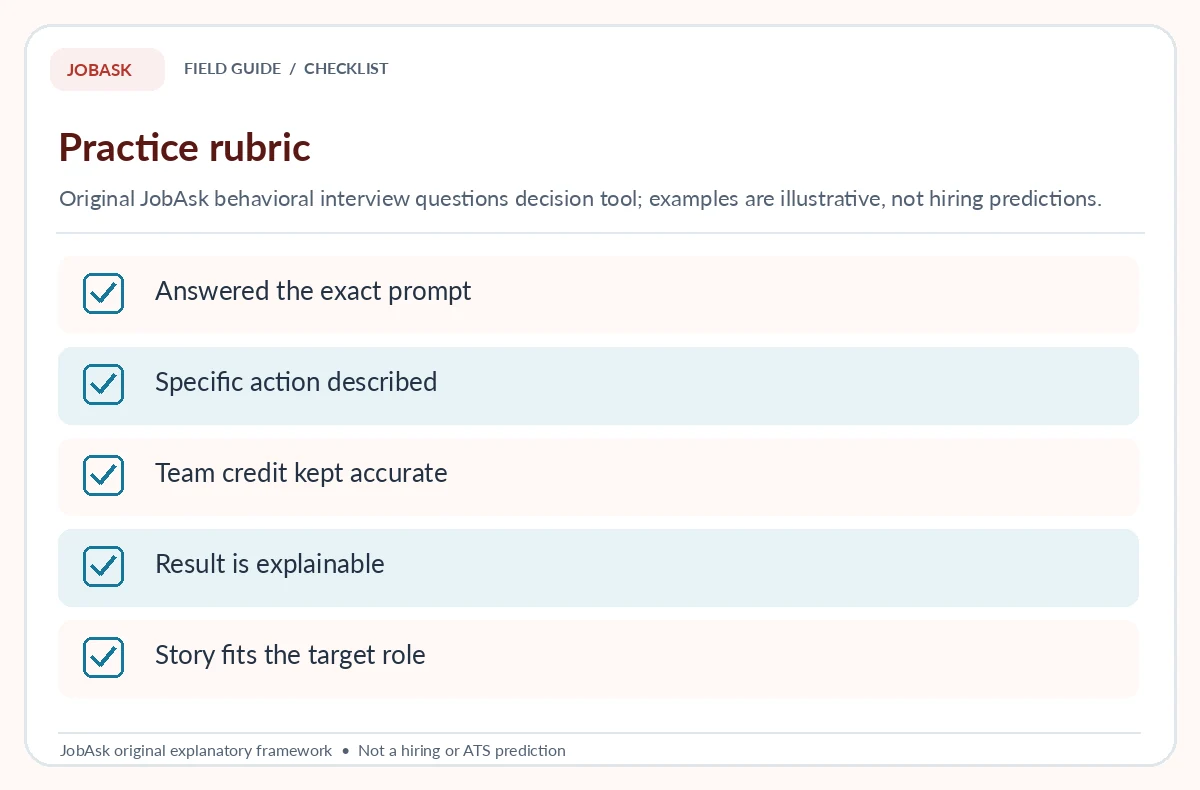
Ask a partner to read an unfamiliar behavioral prompt and listen to your response. Afterward, check five items: Did the example answer the question? Was your specific action clear? Did you give appropriate credit to other people? Was the result true and proportionate? Did the event connect to the role? Choose one weak point and rewrite only that part. A listener who says “I cannot tell what you actually did” has given more useful feedback than a speculative hireability score. Our guide “STAR Interview Answer Preparation” covers how to build real stories that fit the question.
Keep short notes after actual interviews about which prompts challenged you and which examples need more clarity. Avoid recording confidential employer questions when prohibited. Revisit the job description and improve story selection rather than expanding each anecdote into a speech. Career-center STAR guides are frameworks, not proof that a particular recruiter will ask these questions. No single formula guarantees an offer; a defensible, relevant story simply helps someone understand your past conduct and what you might bring to a new setting.
How We Research and Limits of This Guide
We reviewed MIT, University of Virginia and USC career-service STAR materials to distinguish behavioral questions from generalized interview practice. The two story scenarios, follow-up checks, theme map and evidence audit are original hypothetical exercises, not research observations or interview transcripts. We compared this intent to JobAsk’s Job Interview Preparation, Tell Me About Yourself and Common Interview Questions draft scopes. We did not review an employer’s internal scoring, any live interviews or authenticated WordPress content.
Sources reviewed October 19, 2026: MIT career center outlines STAR for questions asking about specific past behaviors. University of Virginia identifies situation, task, action and result, including volunteering and projects. USC career services recommends choosing relevant accomplishments and practicing STAR explanations.
Affiliate disclosure: The learning links go to public university career resources and are not promoted as affiliate-approved interview products. Read the JobAsk affiliate disclosure for the site-wide policy.
More Interview Preparation Guides
- Attention to Detail Interview Questions: Explain Checks and Error Prevention
- Internship Interview Questions You Can Answer With School Projects
- Panel Interview Questions: How to Answer a Room of Interviewers
- Customer Service Interview Questions: Answer With Care and Evidence
- Tell Me About Yourself in an Interview: Build an Honest, Focused Answer
It asks for a concrete example of how you acted in a real previous situation, often introduced by “Tell me about a time.”
No. Relevant school, volunteer or project experience can work when you label it accurately and explain your personal role.
Describe the real result and, if appropriate, what you learned or changed. Avoid falsely claiming success.
Short evidence notes and rehearsal are usually more adaptable than memorizing a script that may not match the question.
No. It is an organizing framework; the outcome depends on the specific role, employer, candidate and hiring process.