
When interviewers ask how you demonstrate attention to detail, they are looking for an observable checking habit, not a claim that you never make mistakes. Choose an occasion where you compared information, spotted a mismatch, verified its importance, and handled it within your role. A strong answer identifies the source you checked and what happened before the work was released or passed to another person.
Recognize the Behavioral Questions Behind Accuracy
You might hear “Tell me about a time you caught an error,” “How do you check work before submitting it?” or “Describe a detail that changed the outcome of a task.” These questions evaluate more than eyesight or memory. They ask whether you have a repeatable method to avoid preventable errors. The OPM competency definition for attention to detail emphasizes thorough and conscientious work, not perfection.
Choose an example matched to the role. A candidate for scheduling support might discuss a date mismatch in a calendar invitation; a warehouse applicant might describe checking item labels against a picking list; an administrative applicant might discuss comparing two approved records. Do not use a story involving unauthorized access to medical, financial or personal records. Interviewers need to understand the process, not see private data.
Define the Source of Truth Before the Check
Explain which information you were permitted to rely on: an approved order, current schedule, signed form, specification, or assignment brief. Without a source of truth, “I double-checked everything” says little. Identify whether you were comparing a filename, date, quantity, customer instruction, or other material detail. Then describe how you knew which version was current, rather than assuming the newer-looking file was automatically approved.
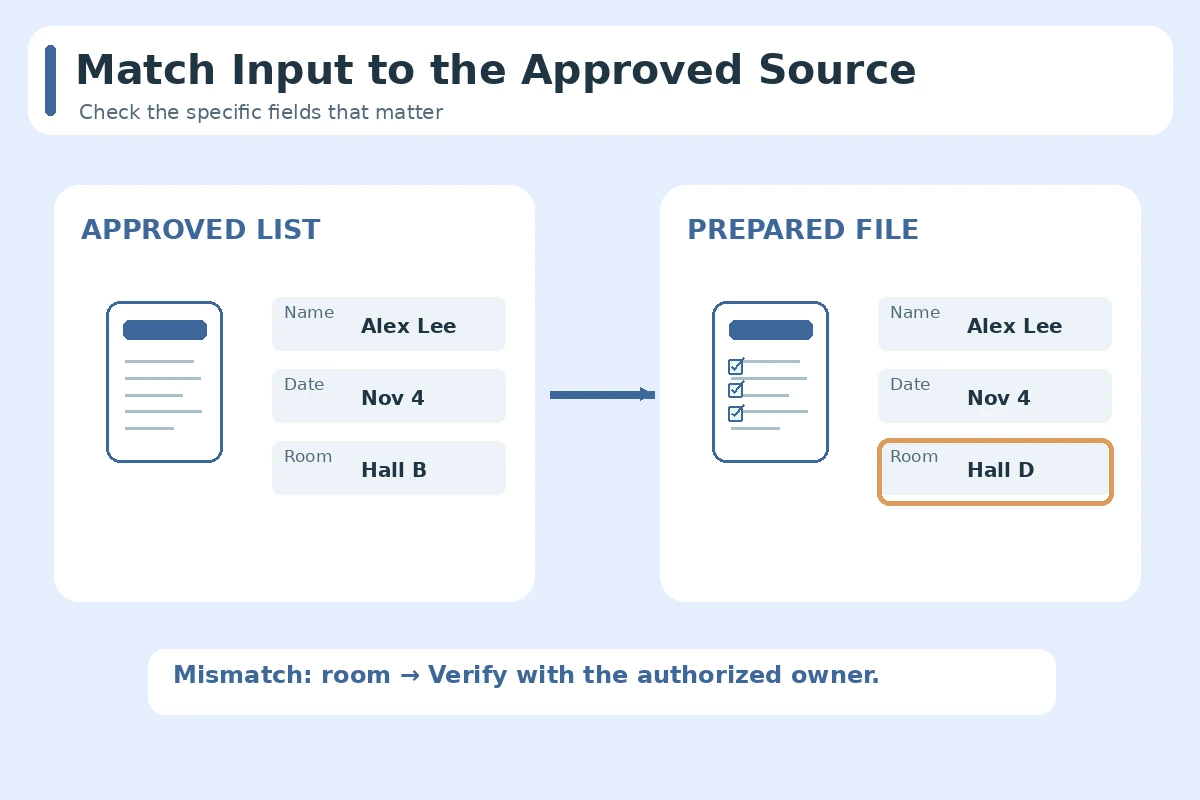
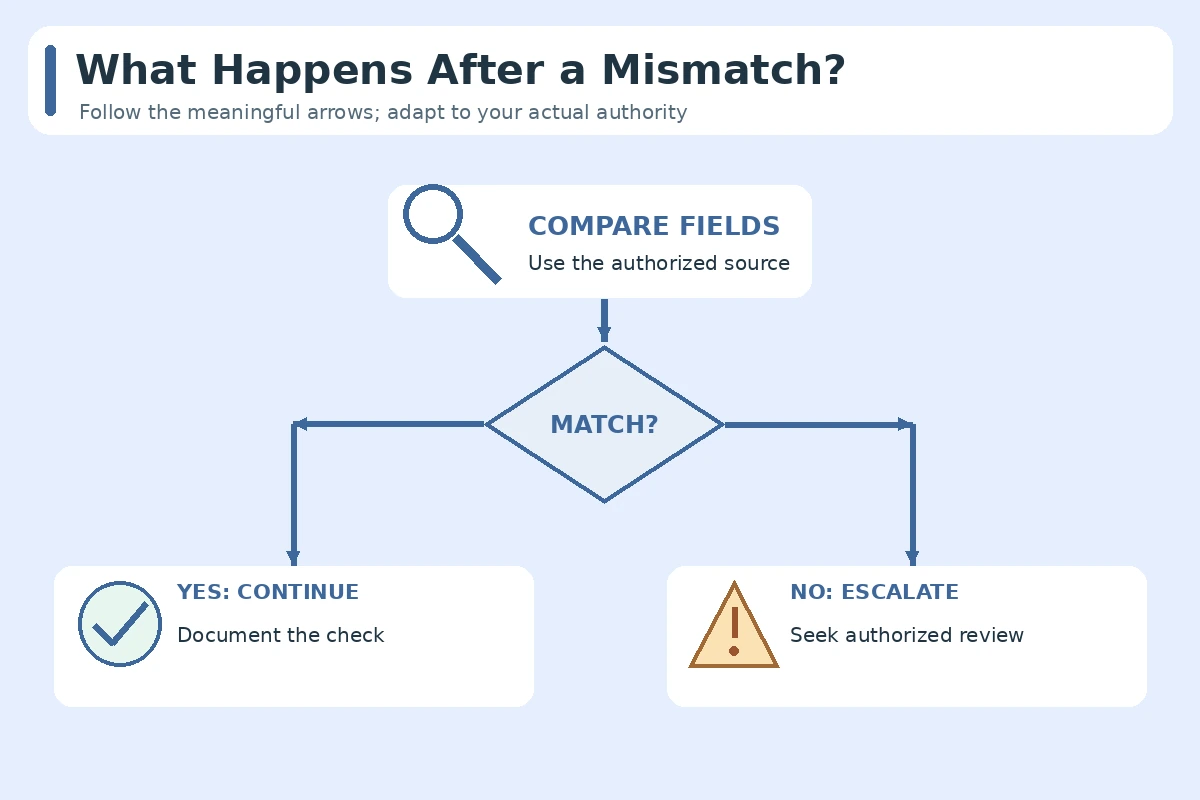
A useful four-stage map is input → compare → exception → disposition. Disposition means either making an authorized correction or flagging the issue to the person allowed to decide. Keep this distinction explicit. Discovering a discrepancy does not grant authority to alter an invoice, disclose a record, change a medication order, or overrule a safety step. Sometimes the responsible result is to pause and ask rather than speed ahead.
Use a Specific Checking Method in Your Answer
People check different work in different ways. Explain the method you actually used: matching order details against a printed list, confirming the dates on two approved forms, reviewing spreadsheet filters for hidden rows, or asking a colleague to verify an ambiguous instruction. Describe the error or risk the check was designed to catch. Checking three relevant fields can be stronger evidence than claiming you reviewed an entire system.
The OPM interview guidance encourages concrete action and result details. You can use that logic to tell the story in this sequence: what had to be accurate, what was your role, how did you test it, what happened after the finding. Do not turn a routine check into an invented financial saving or accuracy rate. The outcome may simply be a corrected draft, clear record, or responsible escalation.
Review an Illustrative Detail-Oriented Answer
Hypothetical answer: “I was helping prepare name badges for a community workshop. My task was to match the approved attendee list to the print file. I compared first and last names line by line and noticed two badges carried the same name even though the list showed two different people. I flagged the mismatch to the event coordinator, who checked the latest signup record and approved the correction. We printed the corrected badges before registration began.”
Notice the limits. The candidate did not decide which participant record was valid; the coordinator confirmed it. The example shows a check, a discrepancy, an authorized resolution and a clear output. Avoid adding a fabricated attendance number or saying no mistakes ever occurred. For your own response, find an equally plain example with a check that can be described without showing sensitive data.

Explain Error Detection Without Claiming Perfection
A weak response says, “I am a perfectionist and always notice everything.” That tells the interviewer nothing about your method and implies an unrealistic standard. A more useful statement is: “Before sending the schedule, I compared the meeting time and location with the approved booking record and asked for confirmation when the room differed.” The specific action can be discussed and tested in a follow-up.
If you found an error after submission, describe what you did next. Did you promptly notify the relevant person, preserve the original document for comparison, and help correct the file through the approved process? Those are stronger signals of integrity than hiding the mistake. However, do not use an incident in which someone else’s private error becomes an entertaining anecdote. Focus on your response and process.
Tailor Verification Examples Across Work Settings
For inventory work, identify the picking or labeling fields that are actually checked. For customer support, think of confirming a requested address or service date using permitted records. For coursework, you might describe catching a mislabeled graph axis before a presentation. For office administration, compare the stated meeting time with the appointment calendar. Pick one setting where the checking action was genuinely yours.
The NACE critical-thinking competency includes understanding situations and interpreting information accurately. A detail-focused answer can show this skill while keeping the story anchored in a task. Do not imply that spreadsheet knowledge alone proves quality control experience or that checking a practice dataset grants authority over production records. Label the experience as school, volunteer, or paid work.
Prepare for Follow-Up Questions About Quality
After your story, expect questions such as “Why did that field matter?”, “What happened to the discrepancy?” or “How would you prevent a repeat?” Have honest answers based on your actual responsibility. If you made an error in the initial pass, you can acknowledge the limitation and explain the added check without describing yourself as infallible.
Before the interview, practice saying what you could independently correct and when you needed approval. This makes a quality-check story credible across regulated and unregulated jobs alike. Summarize the benefit in ordinary words, such as “The corrected list was ready before the team printed it,” rather than invented scores. The goal is transparent process, not flawless self-promotion.
How We Research Interview Questions and Examples
We compare the competency definitions and interview design guidance from the U.S. Office of Personnel Management with NACE career-readiness frameworks and use plain-language, role-limited hypothetical examples. We reviewed the available public topic index and live search results on October 27, 2026. Public results do not reveal unpublished WordPress content or guarantee that a slug is free. This is AI-assisted editorial work, not an independent human interview study or promise of hiring success.
Source: U.S. Office of Personnel Management. Defines attention to detail as thorough, conscientious work.
Source: U.S. Office of Personnel Management. Recommends concrete situation, action and result examples.
Source: NACE. Describes information evaluation and critical thinking in career readiness.
Every sample answer is hypothetical. Use only a situation that truly happened to you, respect confidentiality and the limits of your authority, and avoid invented performance numbers. We do not imply endorsement or affiliate relationships. Read the JobAsk affiliate disclosure.
More Interview Preparation Guides
- Behavioral Interview Questions: Answer With Real Stories and STAR
- Accountability Behavioral Interview Questions: Show Ownership and Follow-Through
- Leadership Behavioral Interview Questions: Show Influence and Real Scope
- Ambiguity Behavioral Interview Questions: Clarify Uncertain Instructions
- Situational Interview Questions: Explain What You Would Do
A real instance of checking an approved source against an output, finding a mismatch and completing an authorized correction or escalation.
Yes. Describe the original instructions, your personal checking method and the actual outcome.
No. Describe preventive checks and a responsible response when errors occur.
No. If changes require approval or special authority, explain how you escalated the discrepancy.
No. A verified task and honest result are more useful than an invented performance metric.