
If an interviewer asks “Tell me about yourself” and you have no paid work experience, introduce where you are now, describe one real activity that demonstrates a useful skill, and explain why you want this particular position. A class project, volunteering, a school club, family responsibility, or independently completed work can supply an example when it actually involved the skill. You do not need to apologize for being new to paid employment.
A strong answer is a short professional introduction, not a biography. You should never turn a classroom assignment into a supposed employer project or claim you were paid when you were not. The examples in this article are hypothetical, so replace every detail with your own verified experience before speaking.
Start With Your Current Stage, Not an Apology
Begin with a clear sentence about your education, current training, or recent activity and connect it to the kind of work you are seeking. “I’m finishing a business certificate and am interested in customer-facing work” provides more context than “I have never had a job.” The employer already knows your listed experience; your job is to identify what you can contribute honestly. Our guide “Tell Me About Yourself in an Internal Interview” adds more detail on this.
If you are out of school, you can start with an accurate present focus such as learning a tool, helping with an organized community task, or preparing for entry-level work. Avoid presenting informal learning as a degree or credential. The opener should tell the listener what you are doing now and why the subject is relevant to the opening rather than listing unrelated personal history.

Find One Real Source of Evidence Outside Paid Work
Make a list of specific tasks you have actually done: scheduled club volunteers, answered questions for new students, checked a spreadsheet for missing entries, or prepared materials for a neighborhood event. From that list, select the one that most closely matches the position. Yale Office of Career Strategy suggests using academic projects and involvement to explain relevant background even before a long employment history.
Be precise about ownership. Helping distribute materials is not “managed operations”; entering numbers into a template is not “led financial analysis.” Explain what you personally did, who you worked with, and how you checked the work. If a school example is confidential or involves another person’s private information, describe the process in general terms without sharing identifiable details.
Convert a Classroom Task Into a Short Skills Example
Suppose the vacancy mentions organization and clear communication. A hypothetical statement might be: “In a class group assignment, I coordinated meeting times and kept our shared task list current.” This is evidence of coordination, not proof of professional management. Follow it with a sentence that ties the action to organizing information or responding to other people on the job.
Choose a concrete example over adjectives such as hardworking or passionate. The reader cannot verify a personality label, but you can discuss the steps behind an activity. Prepare one backup example in case the interviewer asks a follow-up question about teamwork, mistakes, or deadlines. The purpose is to open an honest conversation, not to impress with a rehearsed success story.
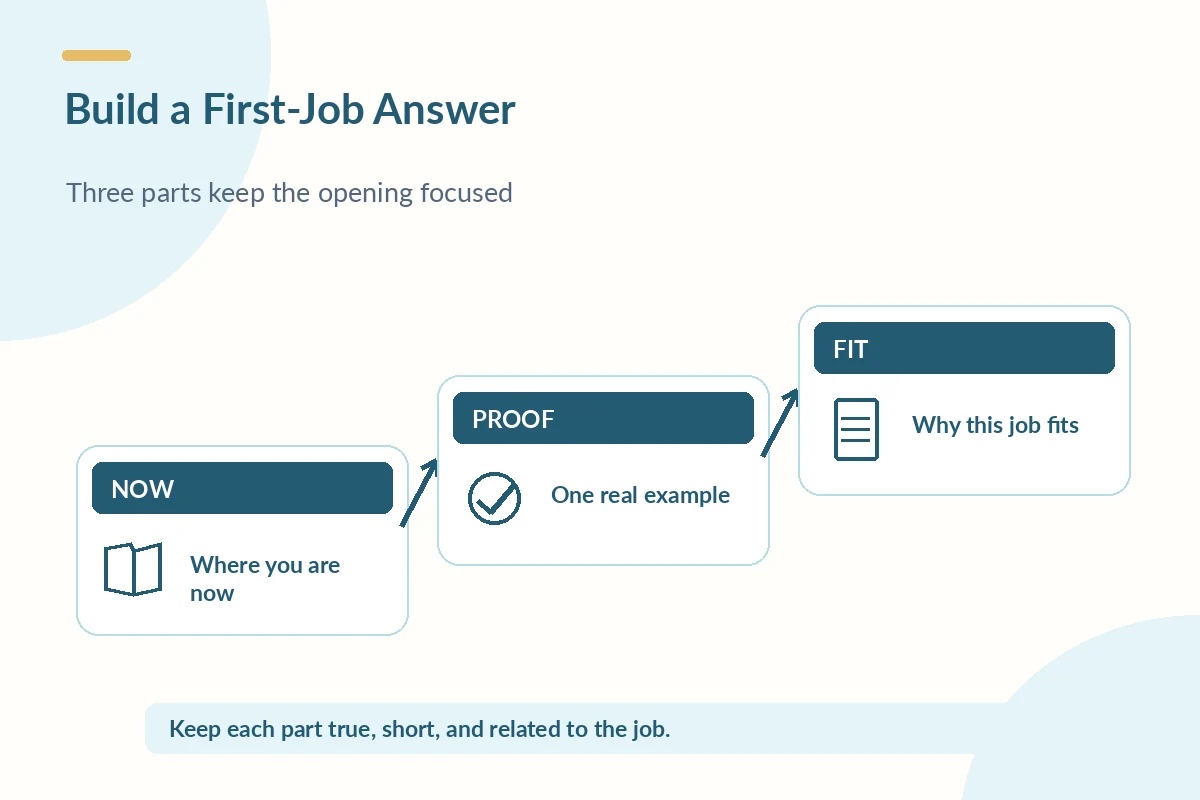
Build a Present, Evidence, Next-Step Introduction
A useful three-part route is present situation, relevant action, and reason for applying. UW–Madison Career Center presents a present–past–future framework, while Mississippi State Career Center emphasizes connecting background to the role. Use these as planning aids rather than treating any one order as compulsory. Your answer may begin with a past example if that tells the story more naturally.
Hypothetical answer: “I’m currently completing a community college program and looking for my first customer service role. In a volunteer registration project, I helped organize sign-in information and answered visitor questions. I enjoyed making instructions clearer and would like to bring that care to a team serving customers.” This is a sample structure only; do not claim those activities unless they occurred.
Adapt One Answer to Different Entry-Level Vacancies
For retail, emphasize any truthful experience helping people find information or handling a group task responsibly. For office assistance, select a recordkeeping, scheduling, or communication example. For basic technical support, mention a real troubleshooting project and how you explained the fix. Different applications should not receive an identical generic paragraph when the jobs demand different abilities.
Write two job requirements on paper and choose one matching example for each. Then narrow your answer to the stronger of the two so it stays conversational. The question is not a request for a full inventory of your academic life. If there is no believable example of a skill the employer requires, say what you are learning instead of implying you already perform it professionally.
Practice for Clarity Without Memorizing Every Word
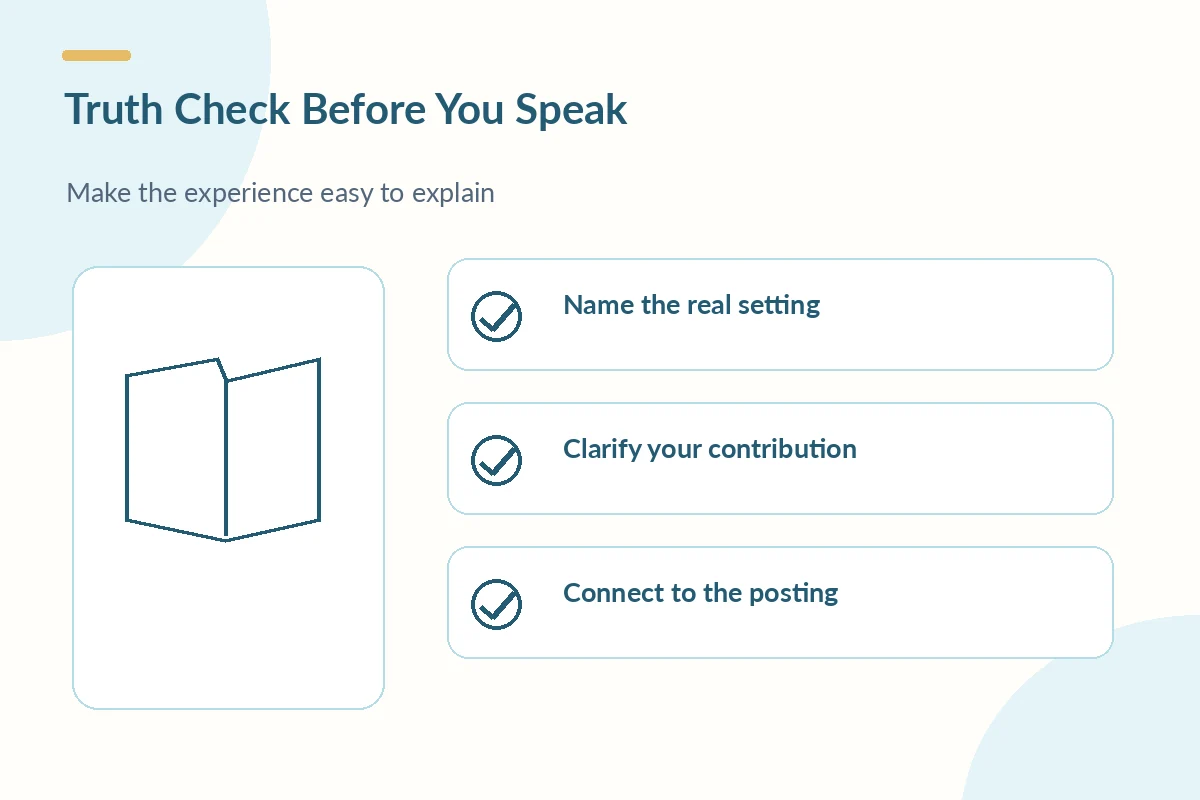
Say your response aloud and listen for three things: a clear present identity, a specific example, and a reason for this application. Career services sources recommend concise and relevant answers, but durations vary by context; treat roughly a minute as a practice target, not a rule imposed by every interviewer. End naturally and let the interviewer ask for details.
Practice with different opening phrases rather than repeating an exact memorized paragraph. A friend can ask “What did you actually do?” after your example; you should be able to answer without inventing extra detail. If you freeze, return to your three notes rather than starting your entire life story again. Pauses are normal and better than unsupported claims.
Use a Last Check Before Your First Interview
Confirm the school, program, dates, and activity names you plan to mention against your actual records. Reread the job posting and identify which requirement your example supports. Remove claims that might misrepresent a group project as an individual outcome or describe a personal project as a professional certification. A calm, accurate answer makes the follow-up discussion easier.
Keep your response separate from a longer behavioral story: “Tell Me About Yourself in an Interview” is an overview, while “Tell me about a time” usually asks for a specific incident. Prepare those examples too, but do not attempt to squeeze every situation, task, action, and result into the opening. Let the interview develop through follow-up questions.
How We Research Interview Guidance and Examples
We compared the scenario with publicly accessible university career guidance and, where needed, occupation-specific information, reviewed on October 22, 2026: Yale Career Strategy, Texas A&M Career Center, Mississippi State Career Center, University career center. These resources support general interviewing practices and occupational duties, not the alleged effectiveness of a particular script or any sample person’s qualifications. All answer samples are hypothetical.
This is general U.S. career guidance, not a promise of an interview or employment. We do not recommend affiliate products here. See the affiliate disclosure.
More Interview Preparation Guides
- Tell Me About Mentoring Someone: Show the Teaching Steps and Feedback
- Tell Me About Showing Initiative: Improve a Process Within Your Role
- Tell Me About Critical Feedback: An Interview Answer With Proof
- Tell Me About Yourself for Customer Service: A Calm, Evidence-Based Answer
- Tell Me About Yourself in a Phone Interview: A Clear First Answer
Mention your current education or activity, one genuine relevant school, community, or personal project, and why the role interests you.
Yes, if it truly happened. Identify it as volunteer experience and accurately describe your own responsibilities.
Not automatically. Use it as an academic example without mislabeling it as a job or employer assignment.
Aim for a concise spoken introduction and adapt to the interviewer; practice around a minute rather than treating a strict timer as universal.
You can acknowledge being new to paid work when relevant, but lead with real skills and activities instead of an apology.