
Quick answer: For “Tell me about a time you showed initiative,” pick an example where you noticed a practical problem and took a useful first step without being asked for that exact step. Show what you observed, what you could do independently, when you needed permission, how you tested the idea, and what happened. Initiative is not a license to change policy, spend money or access restricted information.
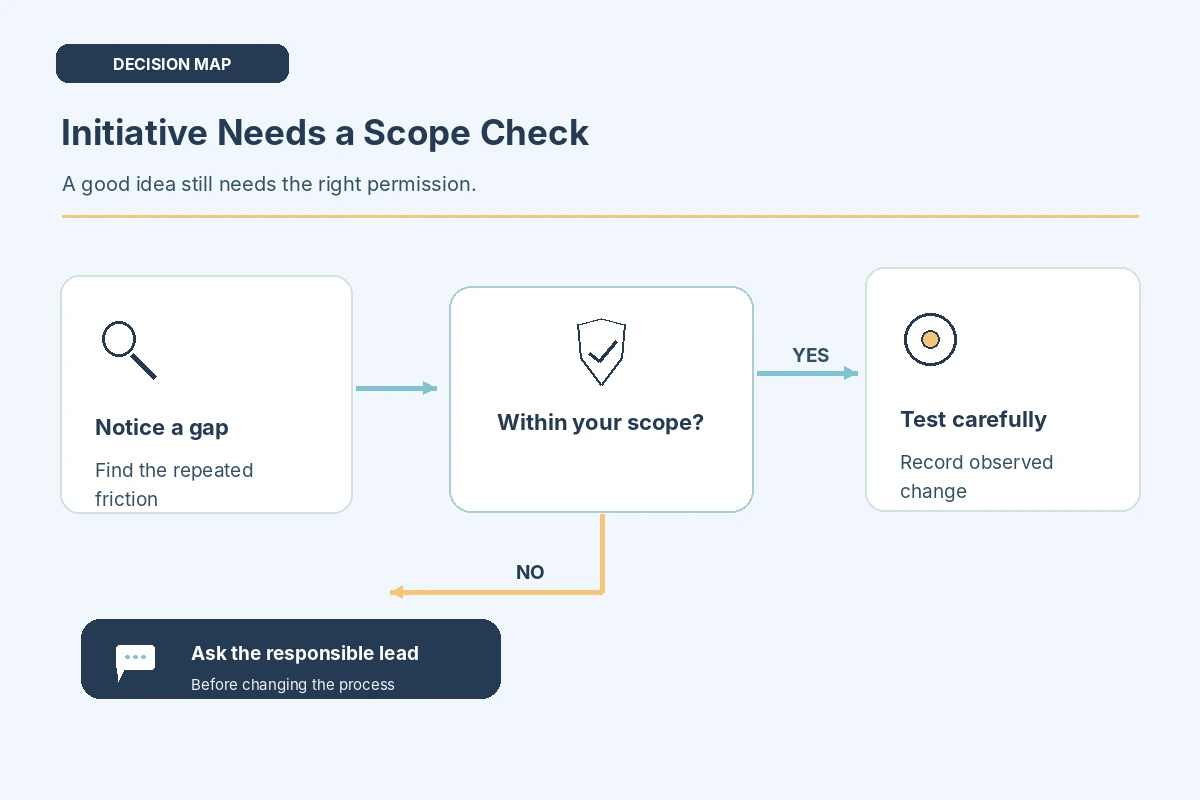
This is different from the general accountability question. Accountability often means delivering an assigned task; initiative is recognizing a missing step or opportunity and acting proactively within your scope. A modest improvement to a shared checklist can be more credible than an unverified claim that you transformed an entire department. The key is the origin of your idea and the safe path from observation to improvement.
Find an Improvement You Identified Yourself
Look for a small repeated friction point: volunteers could not tell which event requests had been confirmed, a class team confused current and old document versions, or a service desk regularly had to ask twice for an order reference. Explain when you observed the pattern and what evidence made you think it was worth addressing. Do not describe an improvement suggested entirely by your supervisor as if you originated it.
Your story should involve a specific behavior you chose, not a personality claim. “I am always proactive” is unverifiable. “I drafted an additional confirmation field after noticing three requests missing a reference” is more useful if those details are true. If you did not count cases, say “several requests” rather than creating a statistic. Keep sensitive records anonymized.
Check Whether You Have Permission to Act
Before altering a team workflow, ask whether the change affects customers, official records, privacy, safety or other teams. You may be free to organize your own notes, but not to change a production report’s calculation or a customer communication rule. In your interview story, identify who reviewed the proposed change and the limit of your authority. Approval is often part of the initiative, not evidence that you lacked confidence.
If your improvement was rejected, that does not erase the initiative. Show that you prepared a reasoned suggestion, accepted the decision, and used the feedback. Avoid saying that you “implemented a new system” when you drafted a sample or conducted a pilot. Interviewers should be able to tell precisely what changed and who authorized the change.
Run a Small Test and Record What You Saw
A modest test can establish whether an idea helps before a wider rollout. Perhaps you tried a clearer file naming convention in your own working folder, asked a coordinator to review a simplified intake checklist, or compared a sample of records before proposing a template. Describe what you measured or checked. It might have been an easier handoff or fewer clarification questions during one event; avoid turning that into a guaranteed improvement everywhere.
NACE’s critical thinking and professionalism competencies involve anticipating needs, analyzing information and acting responsibly. Connect one of these behaviors to the actual test. It is fine to say the pilot showed a flaw that caused you to revise the idea. Initiative includes learning from a first attempt, not just announcing a successful change.
Write a Hypothetical Initiative Answer
Hypothetical answer: “While helping a campus club schedule volunteer shifts, I noticed some confirmations were buried in a long message thread. I drafted a simple status column in a separate copy of our schedule and showed it to the coordinator. After they approved using it for one event, I updated only the assigned shifts and asked volunteers to confirm their entries. The coordinator could then review confirmed and pending slots in one place. We kept the column for the next event.”
This sample is hypothetical. Do not claim that you built a system or saved staff hours unless you actually did so and have evidence. If a volunteer lead came up with the status column, acknowledge that your contribution was testing or maintaining it. A real classroom, hobby or volunteer example can work when clearly labeled; do not disguise it as paid experience.

Show an Outcome That Fits the Test
Possible outcomes include an approved draft, one successful trial, fewer clarification requests you observed, or a clearly documented reason the team declined the change. State what can be checked. “We could see which entries still needed confirmation” describes a feature, not necessarily a measured productivity gain. Separate what the tool made possible from what actually happened in the session.
If other colleagues adopted your suggestion later, say how you learned that. Do not assert a department-wide rollout based on a single meeting. If the idea required permissions and the team chose not to proceed, describe the review decision and your learning. Interviewers may prefer sound judgment over a dramatic but implausible victory claim.
Avoid Initiative Stories That Signal Risk
Do not use a story about bypassing approval to satisfy a customer, working with protected records outside an authorized system, or operating machinery without training. “I went ahead even though the rule said not to” may show disregard for safety rather than initiative. When an immediate hazard is involved, the appropriate initiative may be to stop, report and follow the site procedure instead of improvising a repair.
Do not imply that the employer expected endless unpaid hours. Initiative can mean clarifying a problem early, preparing an option or simplifying an authorized process while respecting workload and boundaries. If you volunteered additional time, explain what was agreed and avoid presenting overwork as a universal professional requirement.

Practice the Proposal-to-Approval Route
Draw three columns: opportunity, authorized action, observable outcome. Under the first, write how you noticed the need. Under the second, list your proposal, permission and test. Under the third, record what changed or remained pending. Practice saying the story with emphasis on what you actually did. Omit elaborate background if it takes attention away from the sequence.
Penn Career Services specifically includes initiative among behavioral prompts and recommends a specific role, contribution and outcome. Use that advice to make the story verifiable. Prepare to answer why you chose the change, what alternative you considered, and whose permission you sought. An interviewer can usually recognize whether the actions align with the person’s actual responsibilities.
How We Research These Interview Answers
We used the University of Washington STAR explanation, Harvard FAS behavioral interview guidance and CareerOneStop’s interview question distinctions. Where relevant, we also compared the topic with role and competency guidance. These sources support interview structure and professional conduct; they do not verify the hypothetical stories or guarantee a hiring outcome.
All sample situations here are explicitly hypothetical and are not evidence of any reader’s real experience. Rewrite a practice answer using your own actual role, authorizations, timeline, contributions and observable outcomes; do not disclose confidential names or records. This is general career information rather than employer-specific policy. See our affiliate disclosure for disclosures and relationships.
More Interview Preparation Guides
- Tell Me About Mentoring Someone: Show the Teaching Steps and Feedback
- Solved a Difficult Problem Interview Answer: Show Your Decisions
- STAR Interview Answer Preparation: Build Real Stories That Fit the Question
- Conflict With a Coworker Interview Answer: Show a Fair Resolution
- Tell Me About a Mistake at Work: Explain the Fix and Prevention Check
Yes. A tested, approved improvement with a clear contribution is often more credible than an unsupported transformation claim.
Credit their idea and explain your own initiative in developing, testing or documenting it.
No. Initiative is proactive, useful judgment; excessive hours are not required to prove it.
Explain the review, feedback and responsible response without inventing implementation.
Only within your actual authority. Describe required permission, particularly for sensitive records, safety or customer commitments.