
A strong CNA resume skills section does not try to sound like a nurse’s license. It tells a reader which nursing assistant tasks you have actually performed, which credential is current, and how you communicated with the supervising care team. Lead with the duties stated in the vacancy, then use experience bullets to support them. Skills without an example or training basis are weaker than a smaller, verifiable list.
The Bureau of Labor Statistics profile for nursing assistants identifies activities of daily living, transfers, vital signs, and reporting patient concerns as common work, typically under the supervision of licensed nurses. It also explains that credential requirements differ by state. Those occupation-level descriptions do not establish your own authorization; consult your registry, training records, employer procedures, and the particular posting before naming a clinical skill.
Separate Credentials From Everyday Care Tasks
Start with the credential name exactly as issued, the issuing state or registry when appropriate, and its current status. Do not write “certified” when you have only completed a class or have an exam pending. If a position requests a specific credential or registry listing, verify how the employer wants that information displayed. Place accurate credentials in a clear qualifications or certifications section; put routine care competencies in a separate skills list.
Describe actual care tasks precisely. Depending on training and employer assignments, useful terms may include assistance with bathing and dressing, safe positioning, meal support, and communicating observations. Do not use “medication administration” or invasive procedures as default CNA resume skills. Some functions depend on additional authorization, setting, and state rules. If you only observed a task during clinical training, label that experience accordingly rather than claiming independent performance.

Build a Patient Care Evidence Matrix
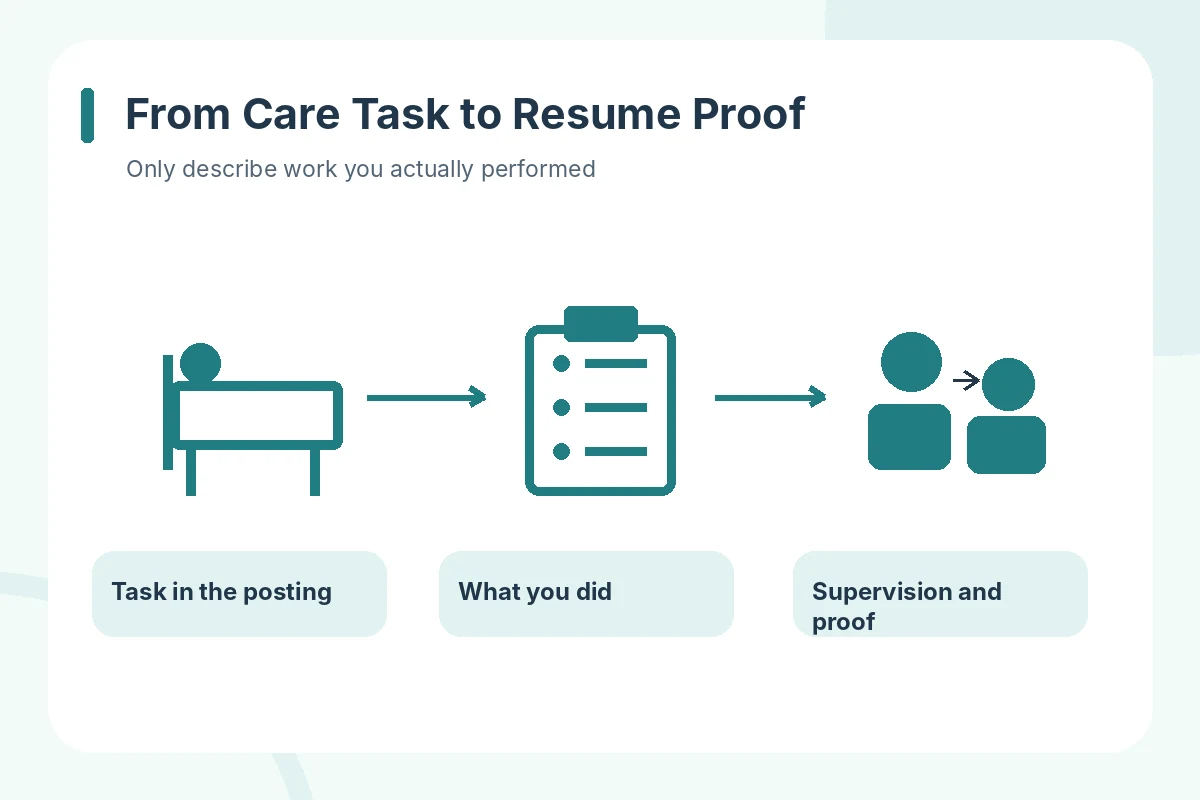
Use three columns in your notes: duty named by the employer, your verifiable example, and the boundary or supervision involved. A posting about resident mobility might connect to a real example of following an approved transfer plan and alerting a nurse to changes. A posting emphasizing communication might connect to recording observations and relaying concerns promptly.
If you have no paid CNA experience, supervised clinical rotations can still be relevant when described accurately. State that the work occurred during clinical training, avoid naming patients, and do not overstate caseloads or clinical decision authority. A hypothetical example of wording is “Supported daily-living activities during supervised clinical training and promptly reported resident concerns to the assigned nurse.” Use that sentence only if every action reflects your real experience.
Turn Supervised Work Into Specific Bullets
The University of Pennsylvania resume guidance favors specific descriptions of what you did over unsupported adjectives. Replace “compassionate team player” with a real action: assisting a resident according to the care plan, providing a clear handoff, or maintaining organized supplies. Include a result only if you can establish it; patients’ individual outcomes should never be invented to embellish a resume.
A hypothetical applicant who helped set up mobility aids might write “Prepared approved mobility equipment for supervised resident transfers and confirmed readiness with nursing staff.” A different applicant who has never performed transfers should not borrow that line. Avoid percentages, patient counts, satisfaction scores, and shift volume unless your own permitted records can verify them without revealing protected details. A modest, accurate action often communicates more than an impressive-sounding claim.
Place Skills in the Right Resume Sections
Use the top third of the document for current credentials and the most relevant care capabilities, but let the experience section carry the proof. The skills area can list short terms such as “daily-living assistance,” “observation reporting,” and “care-team handoffs” where these accurately reflect training. Detailed examples belong beneath the facility, rotation, or volunteer setting in which the work actually occurred. Avoid duplicate phrases repeated unchanged in summary, skills, and bullets.
Write dates and settings clearly. A student clinical placement is not equivalent to salaried employment; a volunteer role is not automatically clinical practice. If you are newly trained, show education and appropriate supervised experience without suggesting independent nursing judgment. If you have several related roles, prioritize the experiences closest to the employer’s care setting while preserving chronological accuracy and the exact license or certification terminology.
Screen High-Risk Skill Claims Before Applying
A skills phrase becomes risky when it implies authorization you do not have. Review claims about medication assistance, wound treatment, equipment operation, documentation access, and patient transfers against current training, local rules, and employer instructions. The BLS description is a useful occupational overview, not permission to practice. If you have only learned about a procedure in a course, say so or leave it off a work-ready skills list.
Patient privacy also matters in resume examples. Do not include names, diagnosis combinations, room identifiers, photographs, or details that could identify someone who received care. Describe a class of tasks instead of an identifiable case. For an interview, prepare a de-identified account of how you followed instructions or escalated a concern. The point is to show responsible conduct, not to impress with sensitive clinical information.

Finish With a CNA-Specific Skills Audit
Read the vacancy once for task requirements, then reread your resume line by line. Mark every clinical term as credentialed, performed with supervision, learned only, or unsupported. Keep only truthful entries in sections that imply proficiency. Check that your registry status, dates, and credential name are consistent. Have a qualified person explain unclear scope questions rather than guessing from a generic online skills list.
Before submission, confirm that each high-priority duty has a related example or honest training reference. If the vacancy lists a skill you lack, consider whether you could acquire it through approved instruction, but do not claim it in advance. This audit helps you present a credible profile and ask better interview questions; it cannot guarantee screening results, certification eligibility, or a job offer.
How We Research Resume Skill Claims
This guide uses career-center advice on resume descriptions and professional occupation or competency descriptions as a factual starting point. The decision framework and hypothetical examples are editorial teaching aids, not evidence of a real candidate’s history. We do not guarantee an interview, claim an ATS outcome, or invent credentials or results. Sources reviewed on 2026-10-23: BLS nursing assistant profile, University of Pennsylvania career guidance, UC Berkeley career guidance. Relationships with affiliate partners have not been assumed; read our affiliate disclosure.
Related Guides
- CNA Interview Questions: Patient Care, Reporting, and Safety
- Medical Assistant Resume Summary: Confirm Credentials and Patient-Care Scope
- Data Entry Resume Skills: Prove Accuracy, Tools, and Record Handling
- Computer Skills for a Resume: Show the Tools, Tasks, and Proof
- Childcare Skills for a Resume: Supervision, Routines, and Verified Training
Show any current state-required credential prominently, using the exact issued title. Requirements and registry formats vary by state and employer.
Yes, if identified as supervised educational experience rather than independent paid work. Describe actual tasks and dates accurately.
Only if you received appropriate training and genuinely performed the task within your permitted role. Follow the posting and applicable requirements.
Use de-identified descriptions of your actions. Do not share patient-identifying details or protected records.
Do not claim proficiency. Note relevant foundational training when accurate and ask about approved training or eligibility requirements.