
Childcare Skills for a Resume belong on your resume only when they match the position and describe work you can genuinely demonstrate. This guide shows how to choose specific tasks, assign yourself accurate responsibility, and write supporting examples without fabricated outcomes. Start with the actual job description and a short inventory of authentic experience.
The practical route is SUPERVISE → SUPPORT → REPORT. These are decision prompts, not proof that an applicant is certified, will pass an automated screening system, or will receive an interview. The examples are hypothetical unless explicitly described as official-source statements.
Match Childcare Skills to the Age Group and Setting
Childcare work varies across centers, after-school programs, community activities, and family settings. The age of the children, supervision arrangement, available staff, and required training affect what a worker may do. Do not treat babysitting, classroom assistance, and licensed childcare-center responsibilities as identical. Start by recording where you helped, the ages you supported in general terms, your assigned duties, and who supervised or approved your actions.
The BLS childcare worker profile lists supervision, meals, hygiene, activity organization, and routines among common tasks. It also notes that credential and training expectations vary by state and employer. Use that professional scope to check a vacancy, not to claim you meet a license requirement automatically. State your actual role clearly before adding broader care terminology.
Describe Supervision Without Making Safety Guarantees
A resume can describe monitoring an assigned activity area, following attendance procedures, guiding children between scheduled activities, or reporting an issue to the responsible teacher. Those tasks demonstrate attention and communication. However, they do not prove that no injury could occur or that you were the legally designated lead caregiver. Do not claim sole supervision if you worked alongside a teacher or guardian.
A hypothetical volunteer bullet might read, “Assisted program staff with attendance checks and supervised group transitions under staff direction.” This is an illustration, not a documented applicant history. Remove any term that exceeds your actual responsibilities. When describing a safety issue, emphasize following established procedures and notifying the authorized person rather than improvising universal emergency instructions.

Use Daily Routines as Evidence of Organization
Childcare roles often rely on predictable transitions among activities, meals, rest, and cleanup. Support can include setting up materials, preparing a play area, helping maintain routines, or keeping simple activity records according to program policy. A valuable bullet identifies the part you handled and the context, not a claim that your personal routine improved developmental outcomes. The latter would require evidence beyond a standard resume.
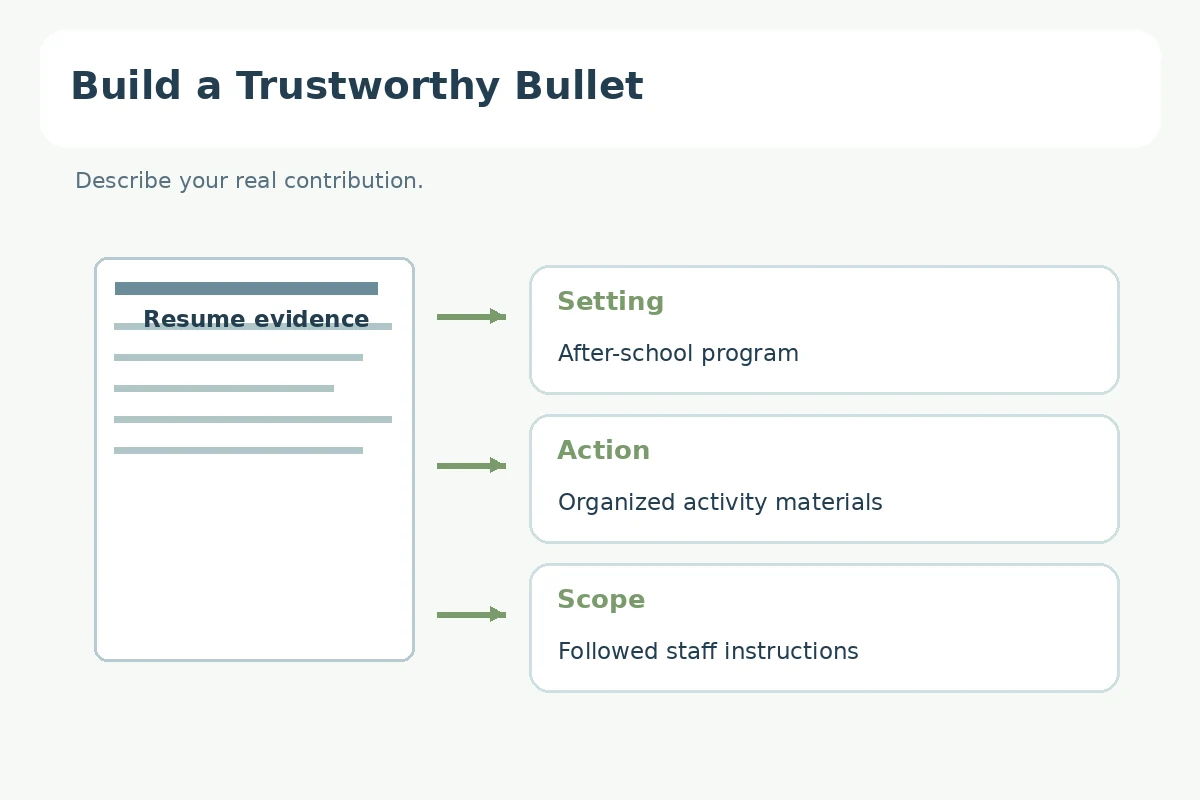
For example, “Prepared age-appropriate activity materials and reset shared spaces for the next group” is useful when accurate. If you only followed a provided lesson plan, do not say you designed the curriculum. If a staff member approved the routine, leave that responsibility with the staff member. Keep your task description grounded in the practical workflow the prospective employer needs.
Show Family Communication Without Violating Privacy
Communicating with parents or guardians may involve sharing basic schedule information, directing questions to staff, or reporting routine observations within a program’s rules. It does not automatically mean making decisions about a child’s health, behavior plan, or eligibility. If you used a parent communication system, identify whether you entered updates, reviewed messages, or simply passed notes to another caregiver.
Avoid naming children, describing diagnoses, or publishing identifiable family stories in portfolio samples. A generalized resume line can say that you relayed approved daily activity updates to families, if that was genuinely your assignment. When a concern required judgment outside your role, reporting it through established channels is a credible skill. Do not imply you gave clinical advice or made decisions reserved for guardians, teachers, or licensed professionals.

Verify CPR, First Aid, and Childcare Credentials
Training terminology matters. A course attended is not always equivalent to an active certificate, and a pending credential is not the same as one awarded. BLS explains that states and employers can require different childcare training, background checks, and credentials, and some require CPR or first aid certification. Do not announce that a single national rule applies to every applicant.
Check the exact issuer, credential name, completion date, renewal date, and applicable setting. If a credential has expired, update the status before applying. If you are enrolled in training, say “training in progress” only if accurate. Never invent completion, licensure, or background-check clearance. Some hiring processes will verify these claims and may set stricter standards than a general occupational profile describes.
Translate Babysitting and Volunteer Work Accurately
Informal caregiving and volunteer activities may support a childcare resume, but context is essential. Name the setting as “family babysitting,” “community volunteer,” or “school activity assistant,” as appropriate. State the responsibilities and the level of supervision without creating a fictional center or employer. Experience arranging games with a relative does not establish that you administered a school program or supervised a classroom independently.
UC Davis resume guidance recognizes projects and activities as potential evidence when described clearly. A genuine example could identify routine planning, age-appropriate engagement, simple recordkeeping, and communication with guardians. Avoid estimating a paid duration when the work was occasional. A small, truthful description is more useful than a dramatic invented achievement or a numerical developmental claim.
Review Every Childcare Claim for Responsibility and Trust
Read the finished resume looking for responsibilities that require approval: led curriculum, administered medication, evaluated a child, trained staff, or maintained official records. Use those verbs only when accurate and within the relevant role. Replace inflated claims with assisted, prepared, monitored, communicated, or reported where those better describe the work. The exact language should fit the employer’s vacancy and local requirements.
Finally, inspect evidence of dates, credentials, and role names. Remove private details about children and families and avoid photographs from childcare settings unless sharing is explicitly authorized. A clear resume combines task evidence with caution about training and permission. It cannot guarantee compliance with a particular state’s hiring requirements or that a prospective employer will offer an interview.
How We Research Skills and Their Limits
For this guide, we compared resume-writing standards and relevant professional task descriptions: professional source 1, professional source 2, professional source 3, professional source 4. Source descriptions support specific features or professional duties, not the success of hypothetical resume wording. No employer has confirmed a hiring outcome or a particular ATS result for any example here. Check the current job posting, local requirements, and documentation before applying.
Examples marked hypothetical are teaching examples, not accounts of real hires. There are no confirmed affiliate relationships for any named products or organizations in this article. See the affiliate disclosure and replace every illustrative detail with facts from your own experience. Local structural checks are separate from independent human editing.
More Resume and Cover Letter Guides
- Research Skills on a Resume: Show Methods, Sources, and Your Contribution
- Hospitality Skills for a Resume: Guest Service, Handoffs, and Accuracy
- Microsoft Office Skills on a Resume: Name the Apps and Prove Your Work
- Project Management Skills on a Resume: Show Scope, Milestones, and Risks
- Skills for a Resume: Choose Relevant Abilities You Can Prove
Yes, when labeled accurately with genuine responsibilities and dates or frequency.
Describe only the training actually completed; do not call an expired or unearned credential current.
No. Avoid identifiable information and protect family and child privacy.
No. State and employer rules vary; verify the requirements for the particular role.
Identify the tasks you supported and make clear when oversight or approvals belonged to the lead teacher.