
After your first job, update your resume by recording the real employer, job title, dates, responsibilities, tools and work products you can explain. Keep any school projects or volunteering that are still useful, but move your new employment evidence higher when it better matches the roles you want next. You do not have to turn ordinary entry-level tasks into leadership claims or fictional financial results.
This is a shift from potential demonstrated in training to work actually performed. CareerOneStop’s work-experience guide recommends making relevant duties and accomplishments easy to find. Its education guidance explains why section order can change with career stage. You will learn how to document your scope, distinguish learning from ownership and keep an accurate application version history.
Capture Your First Job’s Verified Facts
Before editing, record your true start and end dates or current status, official or widely understood role title, employer name and location where applicable. List the routine duties you performed, systems you personally used, handoffs you handled, training completed and decisions that required supervisor review. Your employment documents and personal notes can help you verify dates; do not guess months to look more experienced.
If you had a temporary assignment or multiple distinct positions with one employer, reflect the actual arrangement rather than inventing a promotion. Do not copy a coworker’s duties into your record because both of you worked on the same team. Note what you were authorized to do and where your responsibility stopped. These distinctions produce interview-ready evidence rather than impressive-sounding but fragile statements.
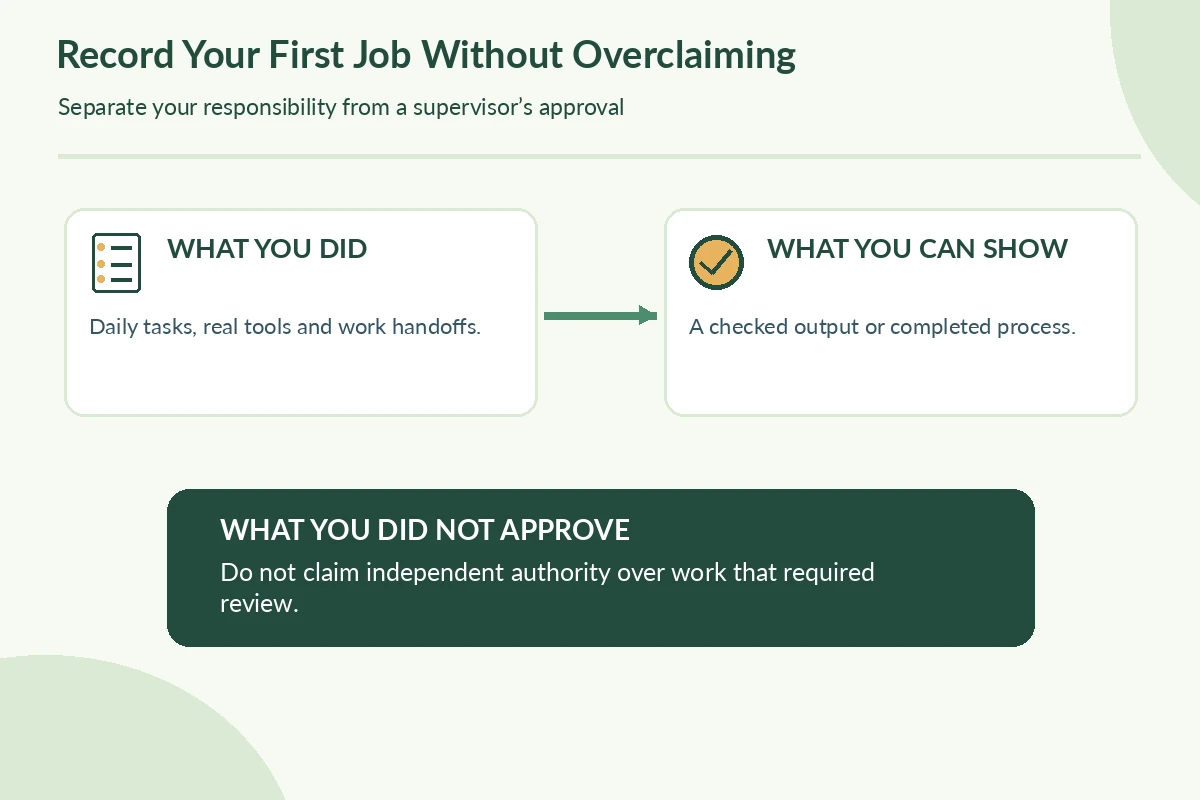
Separate Routine Duties From Useful Evidence
An employer wants to understand how your work relates to the new role. A description such as “worked with customers” may be accurate but vague. Ask what kinds of requests you handled, which records you checked, how you followed up and what you passed to a supervisor. When a task had a tangible output, describe that output. You can be specific about the process even without a dramatic metric.
Hypothetical example: “Checked customer order details against a daily list and referred discrepancies to the shift lead before completing records.” This scenario is fictional and must not be copied unless true. Notice that it describes escalation, not unauthorized approval. If your work involved teamwork, describe your part and avoid claiming the entire store’s service improvement or an invented error reduction.
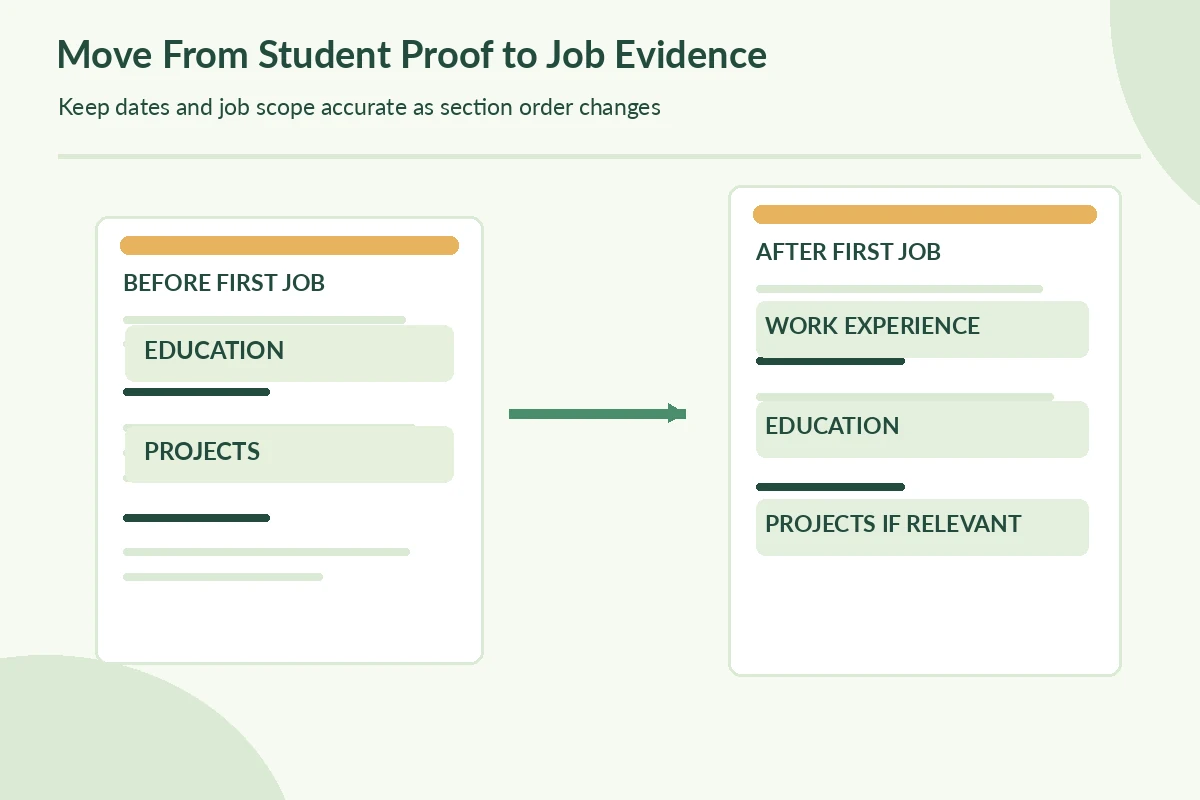
Decide Which Student Sections Still Belong
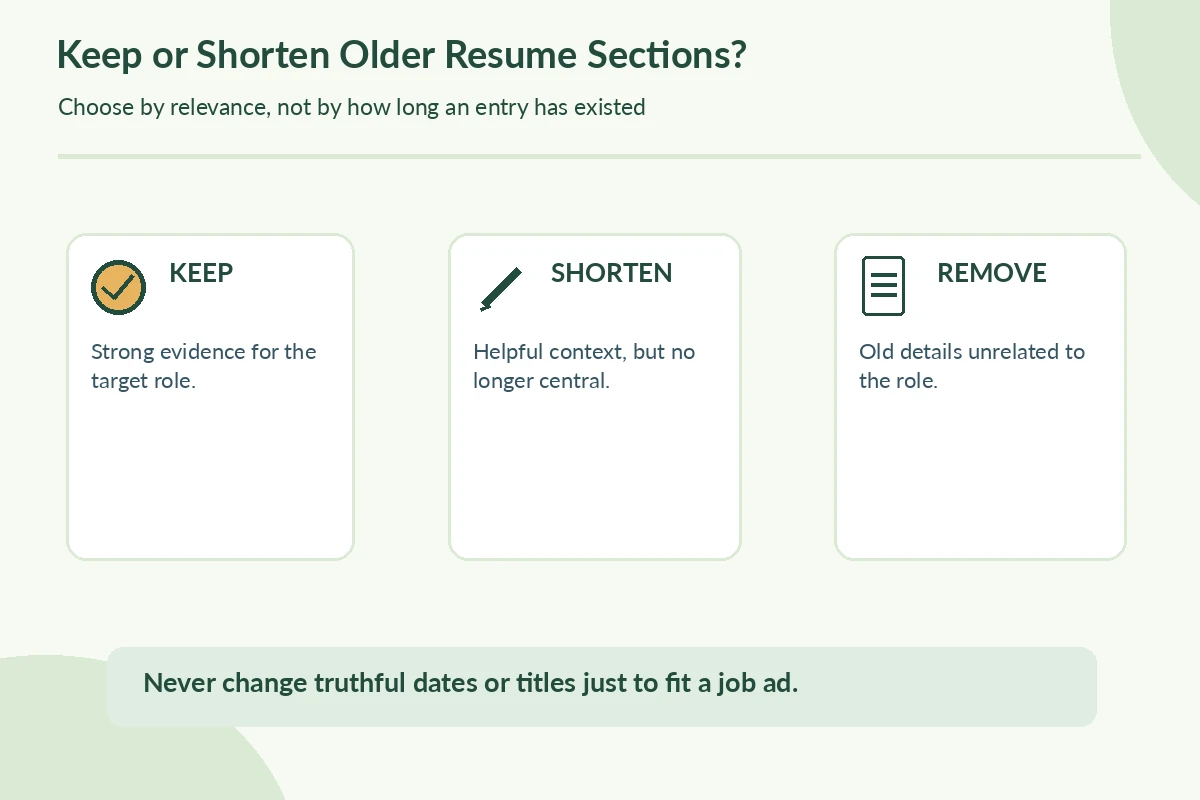
A new employment section may replace a less-relevant school club description, but education and strong projects can still matter. For technical roles, a genuine class project may demonstrate software the first job did not use. For customer-facing work, a recent service job may be more relevant than an unrelated coursework list. Keep information that clarifies current qualifications; shorten old entries that now consume disproportionate space.
Use CareerOneStop’s guidance on education placement to judge whether education should remain near the top or move after employment. Do not delete a credential because you started working, and do not leave an obsolete “student seeking first opportunity” statement when the resume now includes real employment. Make the change explicit and consistent throughout the document.
Update the Headline and Skills Carefully
If you used the title “Student” or “Aspiring Professional” in a headline, consider replacing it with a factual focus that fits the position you seek. A summary may name relevant responsibilities and tools, but it should not inflate your seniority after a short initial job. For example, experience updating calendars does not establish executive operations leadership, and simply using a POS terminal does not prove accounting expertise.
Check the Skills section against what you can demonstrate today. Remove courses or software you no longer remember well enough to use. Add systems you personally used at work, including your actual level of familiarity when necessary. CareerOneStop’s top-of-resume guidance recommends relevant rather than indiscriminate skills. Avoid fabricated certifications or unsupported “expert” ratings added only to match a posting.
Rewrite Bullets for the New Target Role
Keep a master list of verified first-job evidence, then select bullets that match a particular vacancy. For an administrative role, an accurate appointment scheduling example may matter more than stocking shelves. For a logistics role, the same first job may offer relevant receiving and handoff evidence. Tailoring means prioritizing what you genuinely did, not changing your official dates or claiming a different employer.
Use an action → process → checked output pattern. An entry such as “prepared end-of-day handoff notes for the next shift” can be persuasive when real, even without a numeric result. Do not imply independent authority over policies, payroll or personnel decisions if you only submitted information for review. Preserve a consistent timeline across resume versions and any required online applications.
Handle Short Tenure and Employment Changes Honestly
If your first role ended after a brief period, you can still describe meaningful, verified work. Avoid adding months you did not work or concealing a contract status when asked directly about it. You do not have to write an essay about why a job ended inside every bullet; keep the resume focused on qualifications. Details about departure can be discussed honestly when an employer requests them.
When your work history includes part-time, seasonal or internship appointments, labels should reflect the real arrangement if it prevents confusion. Maintain a private record of accurate employment details even if your targeted resume emphasizes only recent, relevant roles. Do not use a resume edit to create a version of events that would contradict employer records or your own application answers.
Audit the Finished Resume Against Your History
Check whether your first job now has the correct dates, consistent tense, tools you actually used and outcomes that are not overclaimed. Confirm that credentials, education status and contact links are up to date. Compare the result with the original student resume: does the newer version show growth in verifiable responsibility, or merely new adjectives? An accurate new bullet often demonstrates more than an embellished headline.
Save an editable master and a copy of each submitted version. Review appearance using CareerOneStop’s formatting advice: a clear section order and simple spacing help a reader find your real work. Before applying again, read each new posting, verify its requirements and remove details that no longer strengthen the application. Your first job does not need an extraordinary story to count as useful evidence.
How We Research and Verify Resume Advice
We examined official career guidance and cross-checked it with another professional or official reference as available on October 26, 2026. This page supplies an original task-focused method rather than an employer survey or documented candidate result. Employer instructions, job duties and individual documentation must take precedence over generalized examples.
This article is educational, not a guarantee of interviews, hiring, software screening results or legal rights. Every example and invented situation is explicitly hypothetical and must be replaced by verified personal facts. We do not claim affiliate arrangements or employer partnerships. Read the affiliate disclosure before acting on any recommendation.
More Resume and Cover Letter Guides
- Resume Checklist Before You Apply: Accuracy, Relevance and File Checks
- College Student Resume Layout: Order Education, Projects, and Work
- Student Resume Objective for a First Job: Use School and Project Evidence
- Resume Work Experience Section: Show Roles, Dates, Duties and Scope
- Resume Sections: Choose What to Include and What to Move Up
Record verified responsibilities as they develop, and revise the submission version when you are pursuing another role.
Not automatically. Keep projects that still provide stronger relevant evidence than some employment details.
Yes, if useful and accurately dated. Describe the real work without exaggerating tenure or responsibilities.
No. Specific actions, tools and work outputs are valuable without fabricated metrics.
No. Represent your actual responsibilities and authority rather than inferring seniority from simply having worked.