
A barista resume should show the practical service work you can perform: taking and confirming orders, preparing drinks according to training, processing payments if authorized, cleaning the work area, and communicating with coworkers. The strongest skill list is not a collection of coffee adjectives. It reflects what you have actually done, whether at a café, in another customer-facing role, or during legitimate training.
Select Skills From the Actual Café Workflow
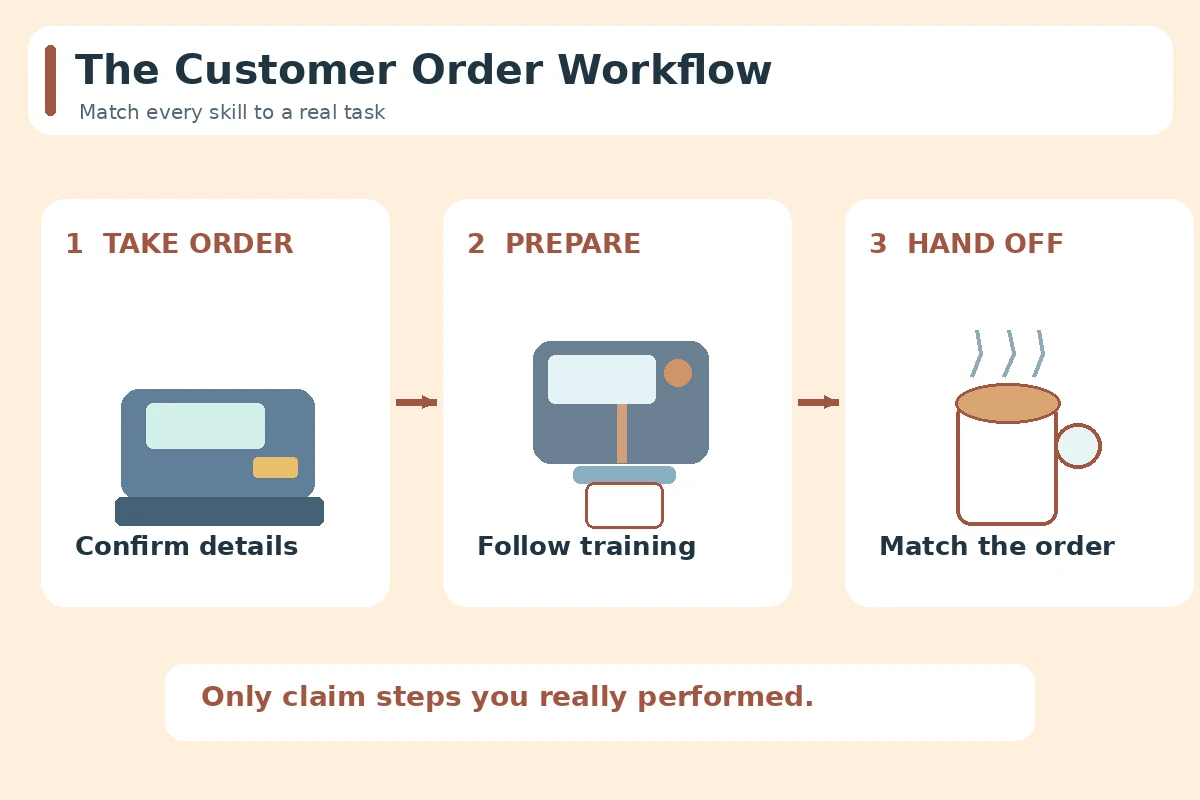
Most cafés combine order taking, beverage preparation, payment processing, restocking, and cleaning. The O*NET barista occupation profile includes preparing hot and cold beverages, handling customer payments, explaining menu items, and sanitizing work areas among reported tasks. Not every café assigns every task to every worker. Read the job posting to see whether it calls for register work, drink preparation, opening routines, or a combination. Match each requirement only to activities you can substantiate.
A good starting list could include “Order confirmation,” “POS checkout,” “Beverage preparation,” and “Station cleaning,” but those labels belong on your resume only if true. New applicants can use transferable skills from retail, school events, or food-service support. If you have never operated a café espresso machine, do not claim espresso calibration as a skill. You can still highlight customer communication and careful task follow-through and state that you are ready to learn the employer’s procedures.
Show Order Accuracy and Customer Communication
Order taking includes listening, repeating important details, routing the order to the correct station, and clarifying changes when necessary. If you performed that work, explain your part. A hypothetical experienced worker might write: “Confirmed customized beverage orders at the counter and relayed changes to the preparation station.” The wording is specific without inventing a service score or sales percentage. If your prior experience involved retail checkout rather than drinks, call it retail experience.
Customer service also includes explaining a menu within the training you received and handling requests you are authorized to resolve. For complaints or allergy questions, the safest response may be to consult a manager or approved ingredient information rather than guessing. The BLS food and beverage serving profile describes taking orders, serving items, handling payments, and cleaning service areas. Use it to understand task categories, not as permission to claim you personally performed every activity.
Name POS and Payment Skills Precisely
“POS” means point-of-sale tools, but systems and permissions differ. If you accepted payments and issued receipts on a specific register, name the process and, where useful, the software you truly used. Processing a sale is different from managing refunds, balancing deposits, or approving adjustments. An entry-level worker who learned one checkout system should not claim “all POS platforms” or unrestricted cash management. Write down the exact tasks you handled while preparing your resume.
A hypothetical truthful bullet for someone with prior retail experience is: “Processed customer payments at the register and recorded exceptions for supervisor review.” Do not insert a made-up drawer total or claim perfect accuracy over an invented number of transactions. If you completed an actual shift close, say which reconciliation or cleaning duties were yours and who signed off. Accurate boundaries help an employer understand what training you need on a new café system.
Explain Drink Preparation and Station Standards
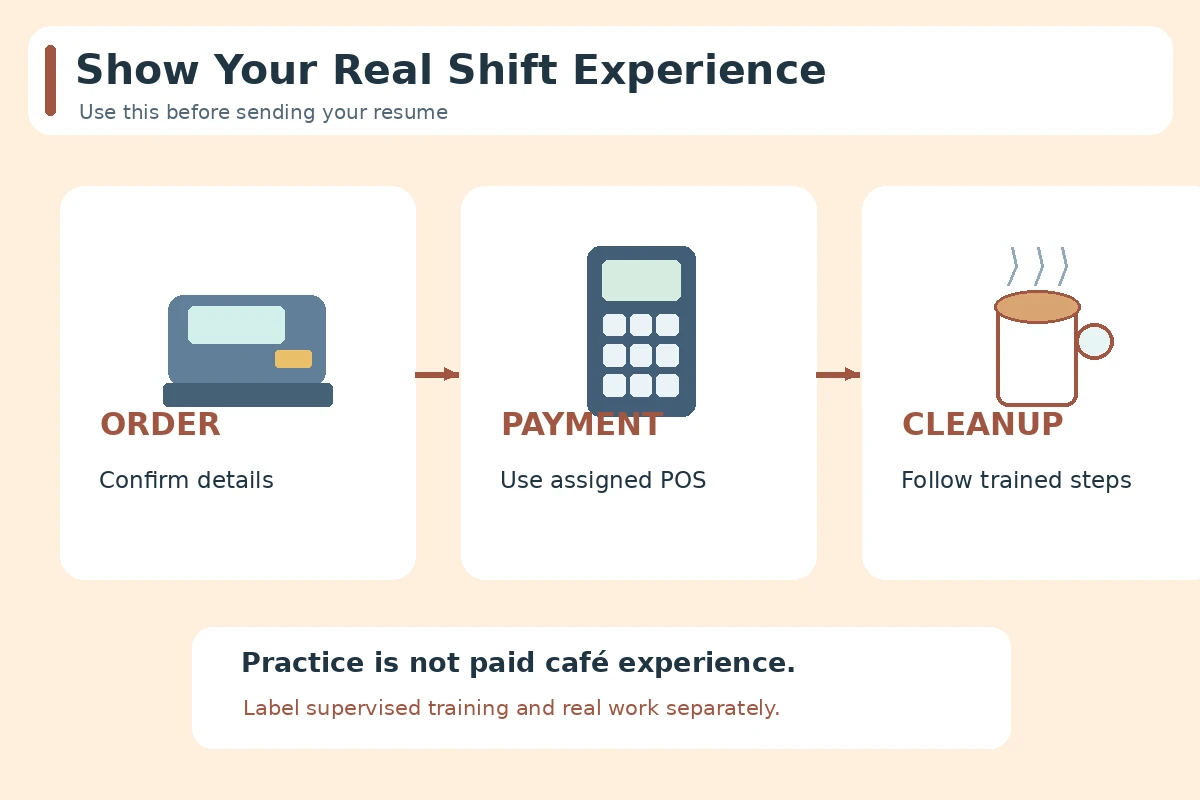
Specificity makes café skills more useful. An experienced barista might identify espresso drink preparation, milk steaming, recipe consistency, or restocking. Only list equipment procedures you have practiced under the appropriate training. If you have limited exposure, distinguish supervised practice from regular independent service. Food safety and cleaning instructions are not interchangeable across employers; follow the actual site procedures and applicable rules rather than inventing universal temperatures or chemical mixtures.
O*NET identifies cleaning or sanitizing equipment and service areas as a barista task. A credible bullet could be “Completed assigned station wipe-down and restocking checks using the café’s cleaning checklist,” assuming it is true. That statement does not claim food safety certification or chemical handling authority. If you possess a required local food-handler credential, list the precise current credential and jurisdiction. Do not label a short informal tutorial as a certification.

Turn Transferable Experience Into Barista Evidence
No café experience does not mean no relevant skill. A volunteer who served refreshments at a community event may have greeted guests, followed a simple distribution checklist, or cleaned shared tables. A shop assistant may have handled customer questions and checkout. Describe where the experience occurred, not as a paid barista job. A hypothetical example is: “Organized the refreshment table, checked supply levels, and reported shortages to the event organizer.” It supports work habits without implying espresso-machine operation.
Identify the job requirements you already meet and the training you still need. For a new worker, honest readiness could mean availability for assigned shifts, experience learning procedures, and respectful communication when a request is unclear. Availability should be stated only when it is accurate. Do not say “works under pressure” unless you can describe a real high-volume situation and how you managed it safely. The goal is to offer evidence, not to fabricate the appearance of café seniority.
Edit Your Barista Skills Before Sending the Resume
Choose a compact relevant Skills line, then use experience bullets to demonstrate your strongest claims. An experienced applicant could list “Order accuracy; POS payments; espresso preparation; station cleaning; stock rotation” if those were actual tasks. A newcomer might list “Customer service; retail checkout; order confirmation; supply restocking,” with truthful work history. Review the posting for required credentials, scheduling, and equipment experience, and verify those rather than assuming every café trains the same way.
Finally, read the resume for misleading verbs. “Managed café operations” is not equivalent to making drinks or restocking shelves. “Certified barista” may suggest a formal credential that you do not have. If a metric appears, confirm it belongs to your actual work and can be shared. Keep customer details private, use simple readable headings as recommended by CareerOneStop, and check the exported document before submitting. Clear descriptions of real service tasks are more convincing than inflated claims.
How We Research Resume Skills and Examples
We use public U.S. occupational descriptions, career-service guidance and documented competency frameworks to distinguish typical duties from individual qualifications. Links were checked on October 27, 2026. All sample resume sentences here are hypothetical writing examples, not claims about real applicants or JobAsk clients. Our review of public search results and the supplied local topic index does not reveal private WordPress drafts or establish availability of a slug in the database.
Source: O*NET. O*NET barista tasks covering beverage preparation, payments, sanitation and service.
Source: BLS. BLS description of food and beverage service tasks and entry requirements.
Source: CareerOneStop. CareerOneStop guidance on readable resume section headings.
These editorial references are informational, not a claim of endorsement or a commercial partnership. See the JobAsk affiliate disclosure. Skill examples must be adapted only to work you actually performed; no particular resume layout guarantees hiring or automated screening results.
More Resume and Cover Letter Guides
- Barista Resume Summary: Describe Order Accuracy and Shift Teamwork
- Barista Cover Letter: Highlight Service, Orders, and Teamwork
- Retail Resume Skills: Show Register, Stock, and Service Evidence
- Data Entry Resume Skills: Prove Accuracy, Tools, and Record Handling
- 911 Dispatcher Resume Skills: Prove Call Accuracy, Radio Work, and Records
Order confirmation, customer communication, POS use, drink preparation, cleaning and stocking can be relevant when the applicant truly performed them.
Yes, some roles provide training. Highlight transferable customer-service tasks while accurately describing the experience setting.
Not as hands-on ability. State completed training or actual supervised practice accurately.
Requirements vary by role and location. Check the posting and applicable local rules rather than assuming one national standard.
Name the register, payment and review tasks you truly handled; skip unverified volumes or perfect-accuracy claims.