
Before accepting transcription work from home, identify the audio type, accuracy rules, pay unit, real editing time, and confidentiality requirements. General recorded transcription, medical documentation, and live captioning have different training and work conditions; a short audio file is not necessarily a short assignment.
The decision framework below uses official occupational descriptions and consumer-protection guidance. Any scenarios described as hypothetical are instructional, not verified job listings, placement claims, or promises of earnings.
Identify Which Kind of Transcription Is Offered
“Transcription from home” can mean typing prerecorded interviews, editing a speech-recognition draft, medical documentation, or realtime captioning. These tasks are not interchangeable. The BLS medical transcriptionist profile describes knowledge of medical terms and checking dictated reports for accuracy. Its court reporter and simultaneous captioner profile addresses realtime work that often needs different training and, in some legal settings, a credential.
Before applying, locate three facts: what audio or live content you will process, who checks the final text, and the accuracy standard. A general recorded-interview role may require careful speaker labels and formatting. A medical role adds technical terms and confidential health records. A realtime captioning task requires capturing content as it is spoken rather than correcting a recording later. Do not present one skill or credential as automatically qualifying you for all three.

Check Audio Quality and Assignment Instructions
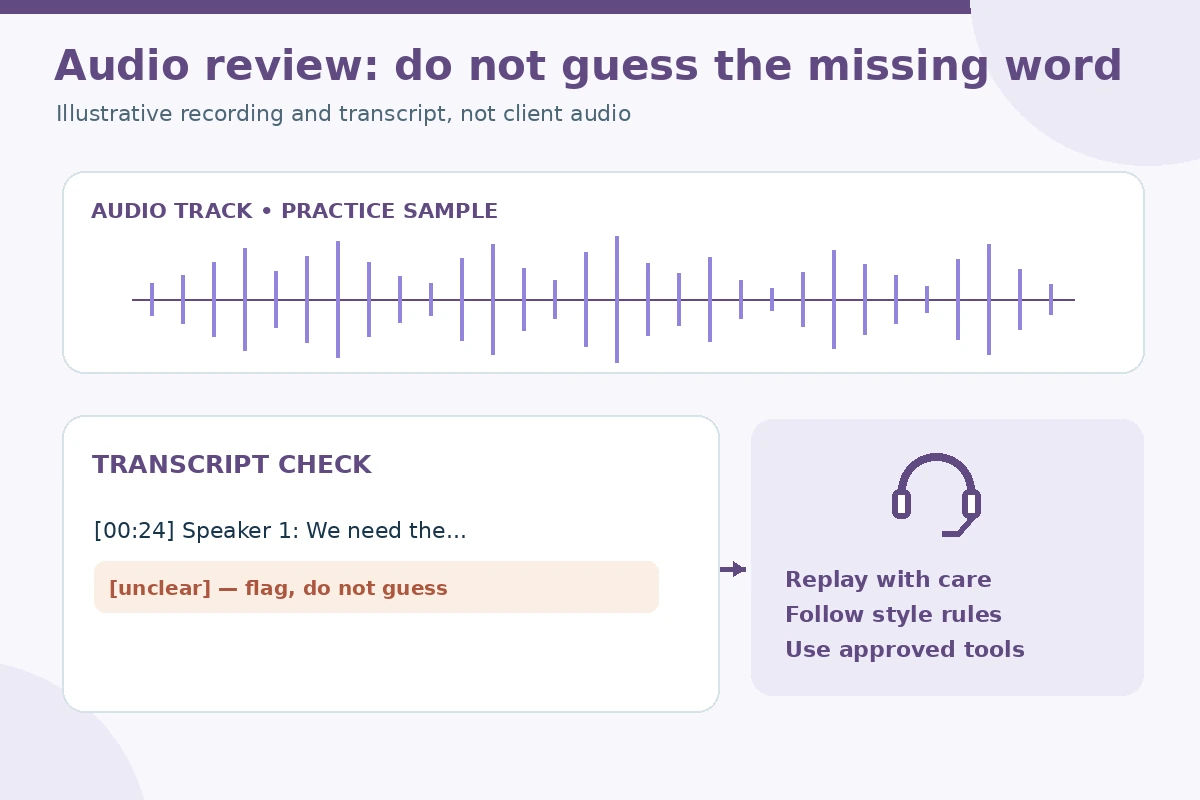
Practice with audio you are authorized to use. Listen for background noise, accents, overlapping speakers, specialized vocabulary, and unclear names. Identify whether the project needs verbatim speech, a cleaned-up transcript, timestamps, or speaker IDs. Unclear words should be flagged according to the client’s instructions rather than guessed confidently. A candidate who pauses to confirm the meaning is often showing more judgment than one who claims perfect accuracy without evidence.
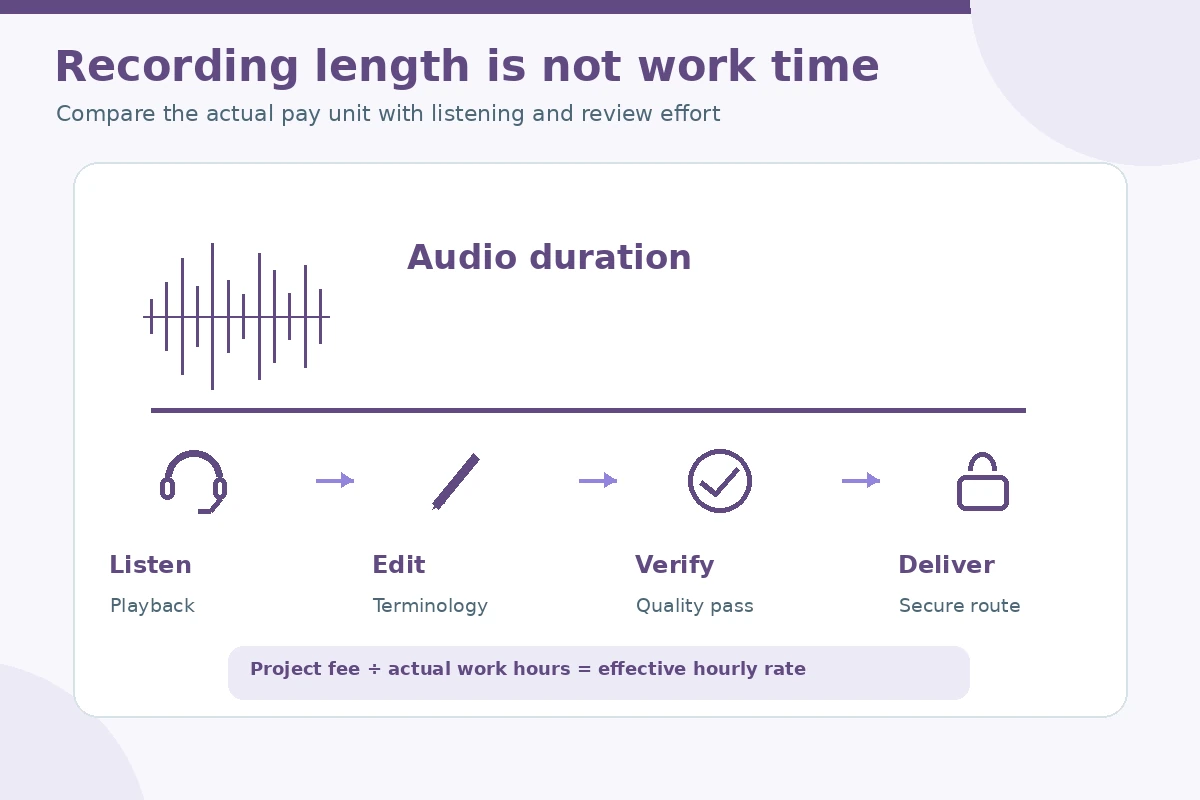
An assignment can look short in audio duration yet require extensive listening, rewinding, research, formatting, and quality review. Ask whether speaker verification, review of auto-generated text, or corrections after client feedback are part of the work. Know who approves changes to sensitive content. Do not use unapproved public AI or transcription services to process confidential recordings, even if automated results appear convenient.
Translate the Pay Unit Into Real Work
Listings may state pay per audio minute, recorded hour, page, assignment, or worker hour. Those units are not equivalent. For a hypothetical project paying a flat amount for a 20-minute recording, the worker may spend substantially more than 20 minutes listening and editing. To compare terms, divide the stated project payment by the actual total time you reasonably expect to spend, including allowed corrections. This is an estimate, not an earnings guarantee.
Ask whether training, rejected segments, mandatory revisions, or platform fees change the amount you receive. Keep a small worksheet for sample projects: audio duration, transcript style, expected edit time, deadline, and pay basis. If a listing says “$X per hour of audio,” do not assume that means $X for every hour you work. Avoid drawing conclusions from unusually easy test clips; difficult real-world audio may change the workload.
Separate Medical Transcription From General Typing
Medical transcription can involve anatomy, abbreviations, drug names, and the format of clinical reports. BLS notes that medical transcriptionists commonly need postsecondary preparation and may edit speech-recognition drafts. The risk of changing a clinical meaning is greater than a cosmetic typo in an ordinary meeting note. Do not present proficiency with general typing as proof of medical-documentation competence.
If the posting requests medical knowledge, list specific relevant courses or experience you can verify. Ask how uncertainty is marked and escalated to qualified healthcare staff. Do not fill in missing clinical facts from memory. In an application sample, use a clearly fictional training recording and do not invent patient details or imply authority to correct clinical decisions. An honest boundary is especially important in records that other professionals rely on.
Plan a Secure At-Home Workflow
Before downloading any material, confirm whether the employer permits a personal device, how files are received and returned, and what happens to local copies afterward. Workspaces, sharing, and retention rules depend on client or employer instructions. A short standard process is: accept authorized files, check required format, transcribe, proofread against the recording, record uncertainty, submit through the approved channel, and follow the retention rule.
Live captioning adds separate equipment and scheduling considerations. Some captioning work can be remote, according to BLS, but the deadlines may be instantaneous and the skill demands specialized. Do not casually combine captioning, subtitles, court reporting, and ordinary transcription under one “easy online typing” category. Search using the specific skill and assignment type instead of a vague promise of earning money from audio.
Verify the Client and Avoid Transcription Scams
The FTC says work-from-home advertisements may be used to collect payments or personal data. Independently verify the business and contract route. Ask for a sample of the actual task type, the compensation unit, any quality review, and who owns the material. Do not pay a recruiting fee to unlock a supposedly guaranteed stream of audio jobs. A job that has no verifiable entity or payment terms is not made trustworthy by a professional-looking test form.
Be wary of offers that require purchasing equipment through an unfamiliar third party after a check is sent. A legitimate business should provide a coherent route for onboarding and a real contact. Never send sensitive identity documents to an anonymous messaging account. If a freelance platform is involved, read its public terms and how disputes are handled; a marketplace profile alone does not verify a client’s actual assignment.
Prepare One Sample for the Actual Job Type
Choose a short, authorized audio recording whose subject matches your experience. Create a transcript with consistent capitalization, speaker labels, and a visible system for inaudible sections. Explain which style guide you followed and what you would ask if a source name could not be verified. Do not claim a sample is client work when it is a personal exercise; label it “hypothetical practice transcript” if that is what it is.
Before applying, review required software, confidentiality terms, audio format, workload windows, location restrictions, training requirements, and the pay unit. If one of these is missing, ask rather than infer. The goal is not to accept every audio task; it is to find work compatible with your actual skills, time, privacy obligations, and acceptable compensation.
How We Research These Remote Work Choices
We checked BLS, BLS, FTC on October 27, 2026 to distinguish occupational duties, qualifications, remote-work limitations, and job-scam warnings. The illustrations are original explanatory diagrams; sample tasks are hypothetical, not actual employer policies or reported client outcomes. Requirements may change, so verify the current job listing and the organization’s official instructions.
JobAsk does not claim an employer affiliation, an available vacancy, or a guaranteed hiring result from this information. If you follow commercial links elsewhere on the site, read our affiliate disclosure; no paid referral or affiliate relationship is asserted in this guide.
Related Job Search Guides
- Bilingual Work-From-Home Jobs: Compare Interpretation and Translation Roles
- Work-From-Home Chat Support Jobs: Verify Text Duties and Shift Requirements
- Overnight Work-From-Home Jobs: Compare Shifts and Coverage Rules
- Part-Time Work From Home: Check Hours, Tasks, and Job Legitimacy
- Work-From-Home Data Annotation Jobs: Verify Real Tasks and Quality Rules
No. One audio hour can require more than one worker hour; calculate your expected total editing time.
No. Realtime captioning has distinct speed, training, and possible credential demands.
Medical work often calls for terminology and specialized preparation; check the listing before applying.
Only if the organization explicitly authorizes that workflow and it meets its data-handling rules.
Use an authorized, clearly labeled practice sample and describe your listening and review steps.