
A resume headline is a short role-focused line below your contact details. It can name your current professional identity or describe the role you are pursuing, but it must not pretend you already hold a job or credential that you do not. For most applicants, a clear title plus one relevant, verified strength works better than a pile of adjectives.
The sample descriptions in this guide are hypothetical unless explicitly labeled as source examples. Do not copy a claimed outcome, date, title, or credential that does not describe you.
Place the Headline Where It Helps the Reader
A headline is not your name, your file name, or a list of keywords. Put it beneath your contact details and above any optional summary so a recruiter can quickly see the professional direction. The CareerOneStop resume guide illustrates a short job-title headline and distinguishes it from a longer summary. If the line causes your contact details to wrap or pushes more persuasive experience onto another page, simplify it.
Compare two openings for the same hypothetical applicant. “Customer Service Representative” tells the reader a role; “Customer Service Representative | Order Records and Complaint Follow-Up” indicates what the candidate can substantiate. Neither states a success rate or invents management responsibility. When your experience already shows the position clearly, a headline is optional, not a required space to fill.

Distinguish a Current Title From a Target Role
If you are currently an administrative assistant applying for another administrative assistant role, that title is easy to substantiate. If you are a student targeting a project coordinator role, “Project Coordinator” alone might imply a professional status you have not yet earned. Instead write “Project Coordinator Candidate | Scheduling Project Experience,” provided the projects are real. Your resume summary can then explain which project, your actual contribution, and its relevance.
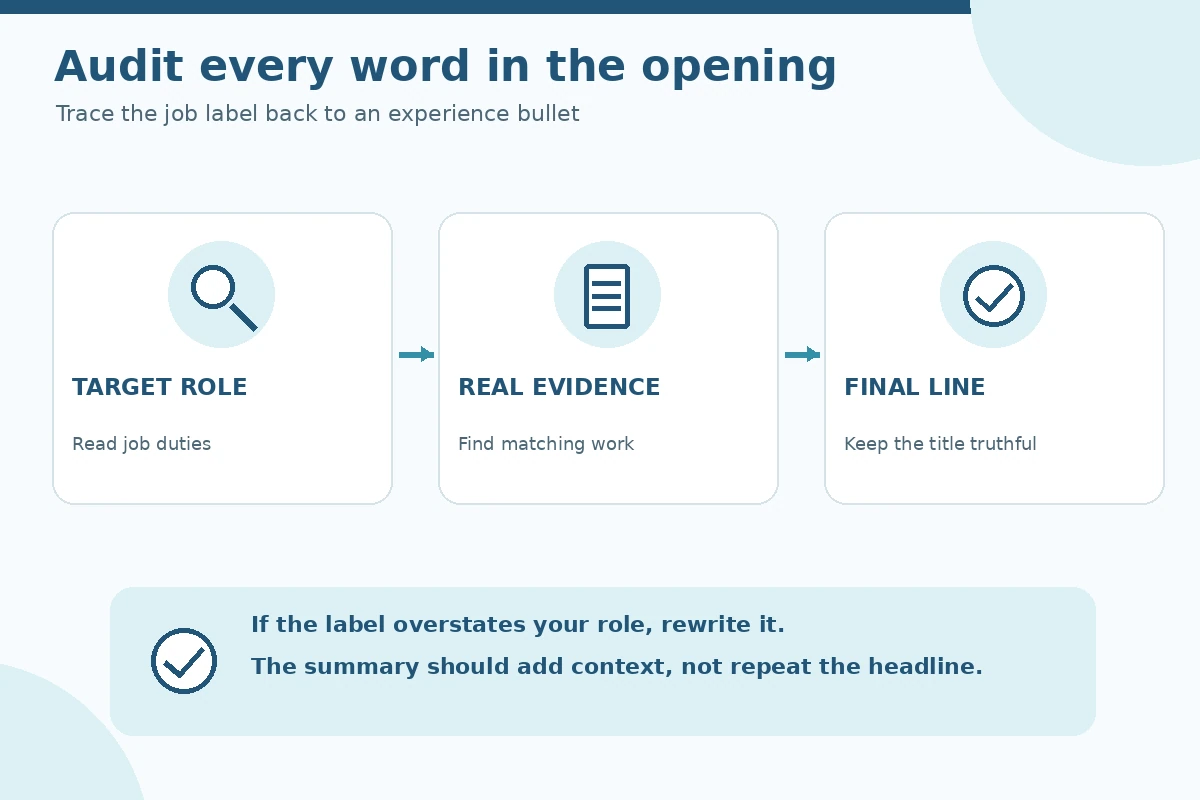
Try a three-column worksheet: target job wording, your actual background, and documentary evidence. Keep the headline only if all three connect. Job postings often contain titles such as senior analyst or certified specialist; borrowing them verbatim does not make you one. A targeted label such as “Seeking Entry-Level Logistics Roles” can be clearer, though some applicants may omit the headline and lead directly with Education or Experience.
Write Evidence-Bearing Lines for Experienced Applicants
An experienced candidate may combine a role with a specialty that appears elsewhere on the page: “Accounts Payable Clerk | Invoice Matching and Vendor Records.” Another hypothetical candidate might use “Retail Shift Lead | Cash Reconciliation and Stock Handoffs.” These are labels for abilities, not numbers, and they should be used only if supported by actual work. If the credential is essential, the CareerOneStop example supports using a legitimate designation near the name.
Avoid slogans such as “World-Class Dynamic Leader” and claims like “Top 1% Revenue Driver” unless independently supported and job-relevant. The headline should reduce the reader’s effort, not invite a credibility investigation. Two distinct strengths are generally easier to grasp than seven skills strung together. Read the line without the rest of the resume: does it identify what you do and where your proof will be found?

Build a First-Job or Career-Change Alternative
A first-time applicant has genuine evidence from coursework, volunteering, supervised training, or projects. A hypothetical line could read “Entry-Level Lab Support Candidate | Sample Logging Project,” if the project actually involved sample logs. A career changer might write “Operations Support Candidate | Scheduling and Data Cleanup,” while leaving a truthful earlier job title in the Experience section. Neither example turns school work into paid employment.
The University of Michigan career center emphasizes relevant experiences and concrete skills. Use that principle to select a headline you can illustrate in the first few bullets. If you cannot show the claimed skill with a project, task, course, or other evidence, remove the claim. A modest truthful line is preferable to a glamorous title that conflicts with the dates and roles beneath it.
Choose Between a Headline, Summary, and Objective
A headline answers “Which professional focus should I notice?” A summary explains two or three qualifications with context. An objective primarily clarifies what kind of opportunity you seek. You do not need all three. A recent graduate may lead with Education, and an experienced candidate may choose a headline plus Work Experience. The sequence depends on the most valuable, verified information for that specific application.
For a hypothetical inventory assistant, the headline “Inventory Assistant | Cycle Counts and Receiving Records” says enough if the bullets immediately demonstrate those tasks. Adding a summary that repeats “inventory assistant, inventory records, receiving records” makes the top third redundant. Instead reserve the space for a credential, actual experience, or relevant skills that the first line does not explain.
Match a Posting Without Copying Its Entire Title
Read the posting for its core duties, not marketing adjectives. A company might advertise a “Customer Experience Ninja” but describe returns processing, case documentation and order inquiries. Use recognizable language such as “Customer Service Representative | Case Documentation.” The objective is a human-readable bridge from the employer’s requirement to your actual experience. It is not a trick for an applicant tracking system.
Do not include a city, employer name, salary expectation, or personal identity details in a headline unless directly pertinent and safe to share. CareerOneStop treats contact information separately. Keep acronyms familiar to your audience, and spell out less-known labels elsewhere. A line that is concise and accurate on screen should remain understandable after export to PDF.
Perform a Ten-Second Headline Audit
Read the line aloud, then point to a specific place elsewhere in the resume that proves each part. Ask whether the title is held, targeted, or credentialed; whether those statuses are clear; whether the line adds information not already in your name; and whether it fits without spilling onto another line. Remove anything you cannot substantiate.
Have someone unfamiliar with your background read the top portion and say what job they think you are applying for. If they guess a different role, revise the noun before revising the adjectives. The headline passes the practical test when it directs attention to the correct experience without promising more than that experience can support.
How We Research These Resume Recommendations
We examined the relevant resume guidance from CareerOneStop, University of Michigan, Princeton on October 27, 2026, and cross-checked the distinction between required qualifications and optional resume details. These institutions give career advice, not rules imposed by every U.S. employer. The original diagrams explain decisions; fictional examples are labeled hypothetical rather than represented as candidate outcomes.
JobAsk does not guarantee an interview, hiring outcome, employer endorsement, or software-screening result. For information about potential commercial relationships elsewhere on the website, read the affiliate disclosure. This article does not claim any paid referral.
More Resume and Cover Letter Guides
- Resume Objective: When to Use One and Write a Job-Specific Statement
- Online Degree on a Resume: Use the Awarding School and Official Title
- Executive Resume Layout: Show Leadership Scope Without Hype
- Leadership Skills on a Resume Without a Manager Title: Show Scope Honestly
- Work-From-Home Resume: Show Remote-Ready Skills with Real Proof
No. A headline is optional; use it only when it helps the reader recognize a relevant role or specialization.
Yes if you frame it as a target or candidate label when you have not held that title, rather than implying employment you lack.
Usually a brief title or short tagline; prioritize clarity and fit over hitting a fixed word count.
No. A headline is one short identifying line; a summary provides more context about relevant qualifications.
Only for actual credentials or designations you hold and may accurately use.