
Quick answer: A 911 dispatcher cover letter without prior dispatch work should show a narrow, honest match: clear listening, accurate notes, calm communication, and willingness to complete the agency’s required testing and training. Do not imply that a school or customer-service example qualifies you to dispatch emergency units. Use a real incident where you gathered facts carefully, state the result you can verify, and refer to the particular agency’s posting.
Read the Agency Posting Before Choosing Your Example
Scan the announcement for caller information, incident location, accurate entry, shift work, background screening, typing assessments, or training steps. These requirements differ across agencies, so do not write a universal promise that every center hires people with no prior dispatch experience. Copy only the requirements shown in the vacancy into a private checklist. For each one, record either a truthful example, an actual credential, or “not yet demonstrated.” The letter should emphasize a short list of credible matches rather than restating the entire vacancy.
Make Listening and Record Accuracy Concrete
The BLS occupational profile describes the need to gather location and situation details and keep records. An applicant who has handled nonemergency customer calls might describe repeating back an address, verifying a callback number, recording a corrected time, and handing an unresolved question to a supervisor. State the setting exactly. “I documented customer requests and checked spelling against the original messages” is defensible if true; “I handled emergency incidents” is not unless that actually happened.

Use a Short Sample Letter as a Writing Model
Hypothetical cover letter: “Dear Hiring Team, I am applying for the Public Safety Telecommunicator Trainee opening listed by your department. In my volunteer scheduling role, I listened to requests, confirmed contact details, and kept an updated shift log that the coordinator could check. When a request was unclear, I asked for the missing information rather than guessing. I have not worked in emergency dispatch, and I would welcome the required assessments, supervised instruction, and shift expectations identified in your posting. I would value the chance to discuss how my careful records and communication habits could support the trainee role. Sincerely, Applicant.” This is not a real candidate account; replace every statement.
Keep Training and Emergency Authority Separate
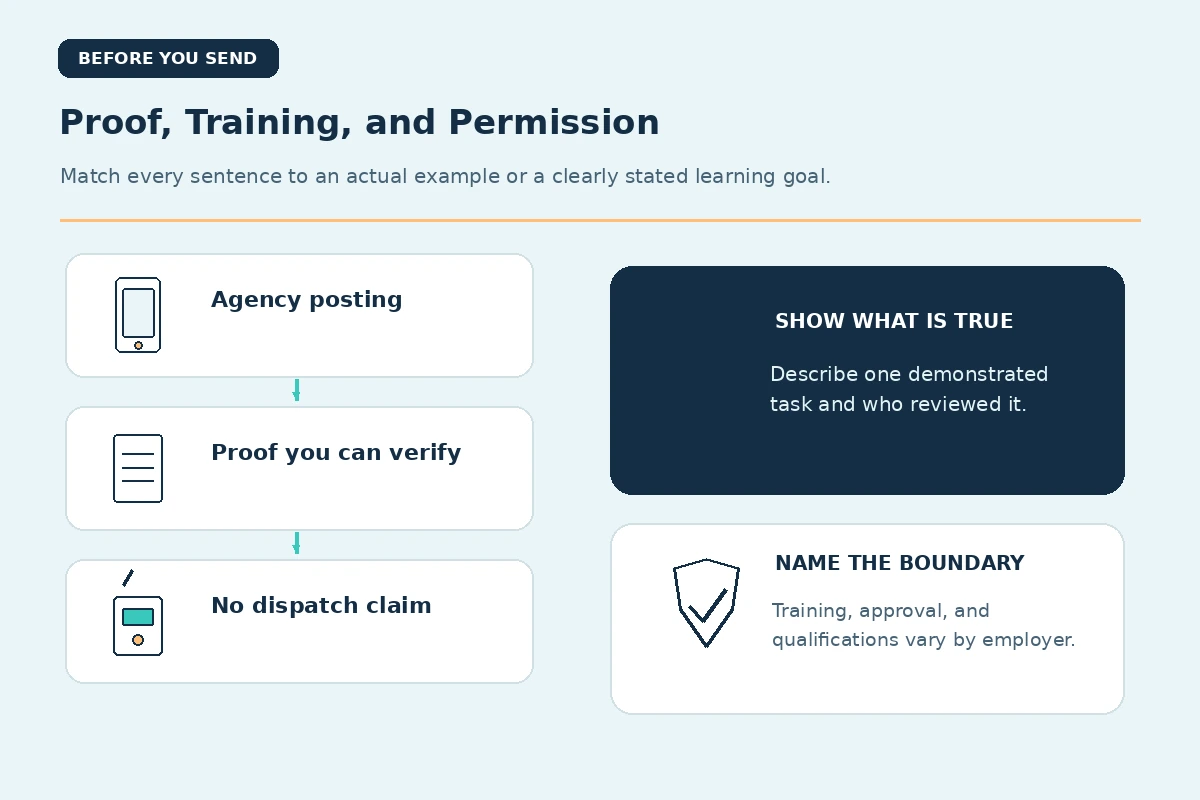
A dispatch trainee may need a lengthy employer-designed training program, testing, and supervised practice. Do not say that customer service, first aid coursework, a mock call, or a classroom exercise makes you an authorized dispatcher. If you have taken relevant training, write the exact course name and completion status only when verifiable. If the posting requires certification or a particular clearance, do not imply that writing a strong letter waives it. The O*NET occupation profile is useful for understanding the communication context, not replacing the agency’s hiring instructions.

Explain Availability Without Promising Unlimited Hours
If the vacancy lists nights, weekends, holidays, or rotating shifts, mention specific availability you can actually honor. A responsible sentence might read, “I reviewed the rotating-shift requirement and can discuss my availability for the listed schedule.” Do not claim 24/7 availability if transportation, school, caregiving, or another commitment makes that false. The cover letter does not need your personal reason for each limitation. It needs an accurate response to an actual posting requirement and a willingness to clarify it with the hiring team.
Replace Generic Calmness With Observable Behavior
“I work well under pressure” is a weak statement on its own. A better example explains which facts you collected, whether you asked a clarifying question, and how you passed an issue to the correct person. In a hypothetical community-event sign-in problem, a volunteer might have checked the original registration message and informed the lead when the guest list did not match. That is evidence of orderly communication, not evidence of emergency judgment. Keep the distinction visible. A reviewable record is more persuasive than invented praise such as “everyone knew I was unshakable.”
Inspect the Final Message for Safety and Privacy
Remove names, medical information, addresses from real incidents, confidential schedules, and agency records you cannot share. Check the job title, agency name, required document format, and whether the employer wants a cover letter in a portal or a separate attachment. A one-page letter is often sufficient if the posting does not specify otherwise. Use direct language about your trainee status, the example you can substantiate, and your next steps. A spell-check cannot verify whether a sentence improperly claims dispatch authority; review every action verb yourself.
Use a Four-Column Evidence Check Before Sending
On paper write “Posting requirement,” “Actual setting,” “My action,” and “Limit.” For precise information capture, the columns might show “accurate details,” “volunteer intake,” “checked contact numbers,” and “not an emergency call center.” A row with no real example should not turn into an invented claim. You may instead indicate readiness to learn if the employer permits on-the-job training. This exercise also prepares you for an interview question asking what you personally did, who reviewed the records, and what happened afterward.
Practice the Readback Without Claiming Emergency Training
A helpful practice exercise is to compare a short fictional request with a clean note: who called, where the event occurred, what detail was uncertain, and who should receive the unresolved question. This is a writing exercise for attention to detail, not a simulated emergency dispatch credential. In your real letter, mention a comparable review habit only if you truly used it at school, in volunteer service, or at work. Distinguish asking for clarification from deciding how first responders should act. You can prepare an interview explanation showing what you checked and whom you told; never fabricate a live emergency.
How We Research These Cover Letter Examples
This guide uses the U.S. Department of Labor-sponsored CareerOneStop advice on writing cover letters to check when a letter is useful and why it should connect real skills to the advertised job. It also compares the role with official occupational descriptions and the relevant professional task or safety guidance. Those sources provide context, not an assurance that a specific employer offers training or waives credentials. Confirm the actual job posting before applying.
All sample letters and scenarios in this article are explicitly hypothetical. They must be rewritten from the reader’s own education, volunteer activities, employment and permissions; never copy invented results or confidential records. We have no verified hiring outcome or automated screening guarantee to report. For information about site relationships and recommendations, read our affiliate disclosure. This guide contains no affiliate product recommendation.
More Resume and Cover Letter Guides
- 911 Dispatcher Resume Objective: Show Calm Communication and Trainable Skills
- Cashier Cover Letter With No Experience: Prove Service and Payment Readiness
- 911 Dispatcher Resume Skills: Prove Call Accuracy, Radio Work, and Records
- Cover Letter With No Experience: Honest Examples That Show Potential
- Library Assistant Cover Letter With No Experience: Show Service and Accuracy
Some trainee positions provide structured training, but individual agencies set screening, testing, and certification requirements; check the specific posting.
Yes, if you actually verified information or handled difficult conversations. Identify it as retail work, not emergency response.
Only if you can truthfully support that claim; ordinary calm communication does not establish emergency dispatch competence.
No. A genuine nonemergency example about listening, record accuracy, and appropriate escalation may be safer and more credible.
Keep a reusable structure, but change the verified requirements, agency name, evidence, and training references for each posting.