
Quick answer: For a one-month resignation notice, write the full date you submit notice and the exact intended final employment date. Say directly that you are resigning, then offer a realistic transition plan without guaranteeing every task will finish. Check your employment terms: “one month” may be calculated differently from “four weeks,” and neither phrase creates a universal U.S. notice requirement. Use the sample and calendar below as planning tools.
Clarify What One Month Actually Means
A calendar month and four seven-day weeks are not always the same period. An employer may define a notice period in a contract, policy, or applicable agreement. Before choosing an end date, check the document that governs your position and ask HR how it counts notice if there is any uncertainty. Do not assume the answer is always exactly 30 days or four Mondays.
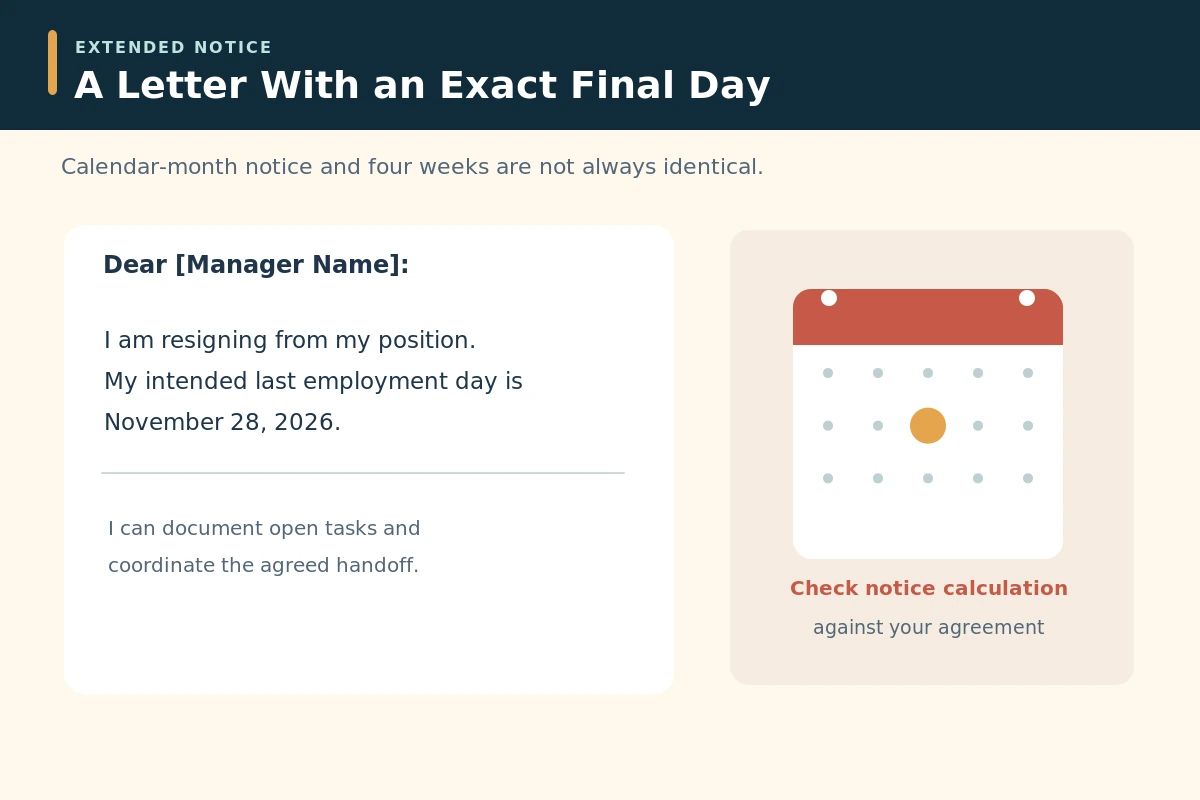
For instance, a hypothetical letter written October 28 could propose November 28 as the final employment date if that fits the applicable terms, but the actual schedule needs verification. State both dates explicitly. The Texas Workforce Commission’s guidance highlights the role of definite dates in descriptions of advance resignation notice; its examples are Texas-specific, not a national definition of “one month.”
Write the Notice Without Unnecessary Detail
Hypothetical sample: “Dear [Manager Name]: I am resigning from my position as [Job Title]. I am providing one month of notice, with my intended final day of employment being [Month Day, Year], subject to the terms that apply to my role. During this period, I can document current assignments and coordinate a practical handoff of responsibilities. Thank you for the opportunity to work with the team. Sincerely, [Your Name].”
Use plain language in your own voice. The statement about one month is optional if the contract already specifies the length and the date is clear. Do not claim all projects will be completed, your replacement will be ready, or your notice has been accepted on specific terms when the organization has not confirmed them. Keep new-employer details private unless you choose to share them.
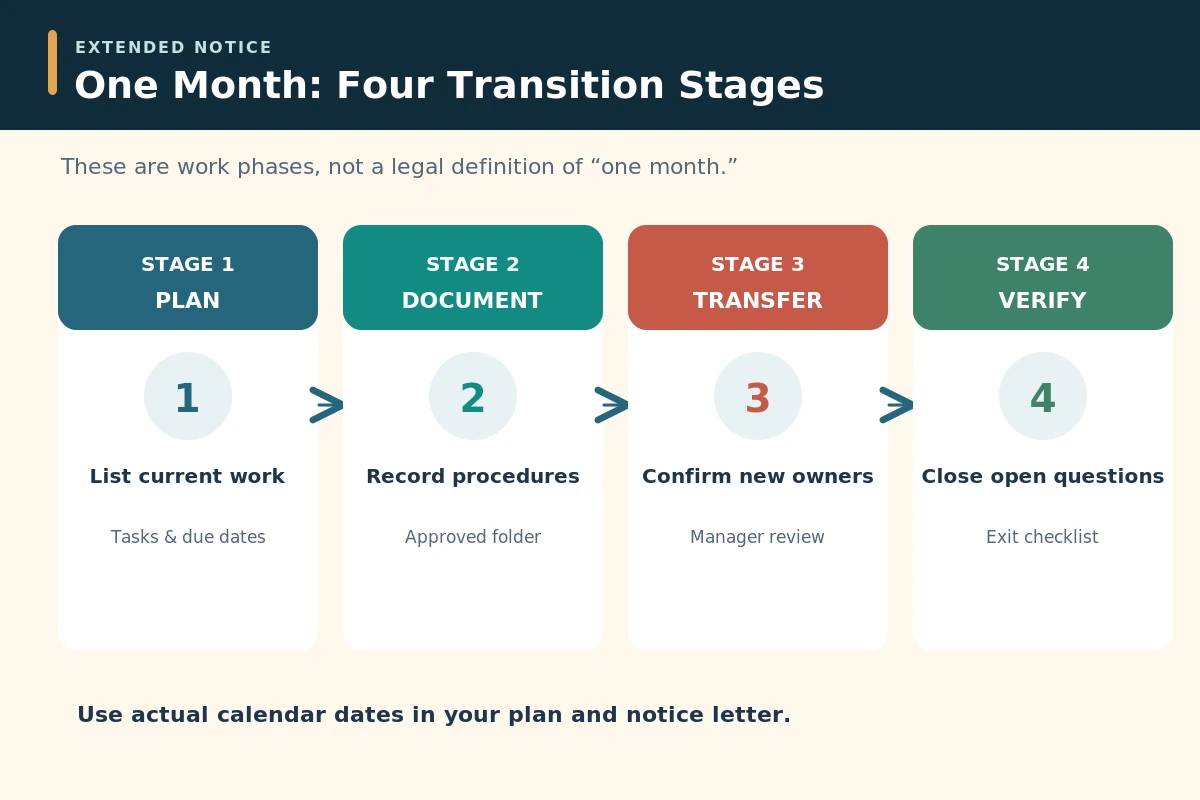
Create a Four-Stage Transition Calendar
Use four stages as a planning model, not a literal definition of a month. In the first stage, audit work and list deadlines. In the second, document recurring procedures and flag risks. In the third, walk through tasks with an authorized owner. In the final stage, verify handoffs, return property and clarify remaining open items. Use actual calendar dates instead of vague labels when the plan is implemented.
For example, an operations coordinator might identify weekly vendor reports, monthly reconciliation and open customer escalations. The handoff should note what was completed, where approved documents live and which decisions need supervisor review. Never invent a new owner or assume that someone will take control of a system simply because their name appears in your personal checklist.
Match the Timeline to Actual Work Cycles
One month of notice can overlap a payroll run, reporting cycle, school calendar or customer project milestone. Identify which deadlines fall before your proposed final day and which fall after. A month-long schedule is useful only if those dependencies are visible. Ask your manager which tasks should be finished, transferred, paused, or canceled rather than attempting to do everything.
For tasks that require licensed authority, financial approval or restricted access, document the handoff boundary without claiming you can delegate that authority yourself. For recurring work, record the next due date, authorized owner, quality check and location of process instructions. A practical schedule might allocate multiple reviews to a high-risk process instead of equal time to every low-value item.
Use a Decision Point for a Proposed End Date
If HR confirms the intended final employment date, align the formal resignation letter, workforce schedule and transition plan. If the date is still under review, label it proposed in shared planning notes. If a contract specifies a different notice method, follow the required channel and seek local advice when needed. Do not quietly count the period from an earlier informal conversation if written delivery is required.
A longer notice period can also be shortened by employer scheduling decisions. The Texas Workforce Commission discusses work-separation situations in which advance notice and employer response interact. Outcomes depend on state rules and the facts. If the employer proposes a different end date, ask for written clarification about whether that is a last-shift change, a separation change, or something else.
Use a Task Ownership Table Not a Promise
A workable handoff table has five columns: task, current status, next deadline, proposed owner, and approval needed. Mark the owner “to be assigned” until a supervisor decides. Include source-document locations within approved business systems instead of attaching sensitive files to the resignation letter. Keep customer information, passwords, employee records and internal financial data out of personal accounts.
Schedule check-ins that the manager actually agrees to. A 15-minute status review may be more useful than a polished transition document nobody knows where to find. If there are outstanding questions, write “awaiting manager decision” rather than signaling completion. The goal is continuity through authorized people and information, not an unrealistic promise of a seamless departure.

Plan Final Pay and Benefits Questions
Ask payroll how worked hours, any approved time off, and the last pay period will be processed under your state and employer rules. The U.S. Department of Labor states that federal law does not generally require immediate delivery of the final paycheck, while state law may be more specific. Do not assume your longer notice determines the exact paycheck date.
Confirm the end date of health coverage through your plan. The DOL COBRA FAQ outlines potential continuation rights for people covered by qualifying plans after job loss, with eligibility and election rules. A one-month letter cannot guarantee coverage. Also ask about equipment, access, unused leave policies and the return of company property rather than waiting for the final week.
Recheck Everything Before the Last Week
Before the final week, review the resignation date, current schedule, handoff owners, unfinished deliverables and who will answer questions after departure. You should not commit to ongoing support from a personal address unless there is a separately approved arrangement. Shut down unauthorized access routes and return property according to the employer’s actual instructions.
Keep a dated copy of the notice and any relevant response in an authorized manner. If a public or internal farewell message is appropriate, coordinate its timing with management. The strongest one-month notice is not the most emotional or elaborate letter: it is the one whose dates are clear, scope is realistic, and next owners know where work stands.
How We Research and Check Resignation Guidance
We reviewed the specific official U.S. employment and education authorities linked below on October 28, 2026, and compared their stated scopes with the hypothetical communication examples. General letter-design and handoff steps are editorial workflow recommendations, not claims that federal law dictates a resignation template. State rules, contracts, employer policies and school district procedures may alter a real decision. We do not know or verify your personal employment arrangement. Our affiliate disclosure explains site relationships; none of the links below is presented as a paid placement.
Primary sources: Texas Workforce Commission (Texas Workforce Commission describes advance notice and cautions that an effective voluntary departure date should be definite.). U.S. Department of Labor (DOL explains federal versus state final-pay timing after work ends.). U.S. Department of Labor (DOL outlines potential coverage continuation and eligibility after group-plan job separation.).
Explore Related Career Guides
- Request Early Release From a Notice Period Without Assuming Approval
- One-Week Notice Resignation Letter: Confirm the Date and Prioritize Handoff
- Short Notice Resignation Letter With a Realistic Handover Plan
- How to Give Two Weeks Notice: Conversation, Date, and Letter
- Immediate Resignation Letter: What to Say When You Cannot Give Notice
Not necessarily. A calendar month and 28 days can differ. Read the applicable contract or policy and use a full calendar date in the notice.
There is no universal one-month notice rule for every U.S. worker. Applicable employment agreements, occupation-specific rules and state law may matter.
You can adapt the wording, but confirm whether “30 days” is the term your actual agreement uses, then enter the correct end date rather than relying on the phrase alone.
Only promise activities within your control. Offer a documented handoff or approved walkthrough; the employer decides who receives responsibility and what access they receive.
Ask for written clarification of the formal end date, schedule, pay and benefits. Work-separation effects depend on applicable rules and the facts, not on a template.