
If you must leave a job right away, an notice effective immediately should plainly state that you are resigning, identify the effective date, and give an accurate way to coordinate urgent handover items. You do not have to turn a brief notice into a personal explanation. Before sending, check your own employment agreement, workplace process, and whether a short extension or time away would meet your actual need.
An immediate letter is a communication tool, not a guarantee that all contractual, benefit, or workplace consequences disappear. UNLV career guidance emphasizes dated, courteous notices, while the University of Wyoming career resource offers an immediate-notice example. Neither template decides what your employer must do in your circumstances.
Decide Whether You Really Need to Leave Today
Start by identifying the precise problem your notice must solve. Do you need your last working day to be today? Can you complete one additional scheduled shift, or is there a short, agreed transition that would protect a critical obligation? If you are unable to work because of an urgent matter, asking about leave or schedule options may be appropriate before choosing resignation. Do not use the phrase “effective immediately” merely because you want a conversation to end quickly.
If the decision is final and urgent, make the message unambiguous. Write down the date in full rather than using “as soon as possible,” and distinguish the last date you will work from the date on which an employer might later complete offboarding. A manager can use a specific date to understand staffing needs. Where a contract or collective-bargaining arrangement applies, seek appropriate advice instead of relying on a generic online template.
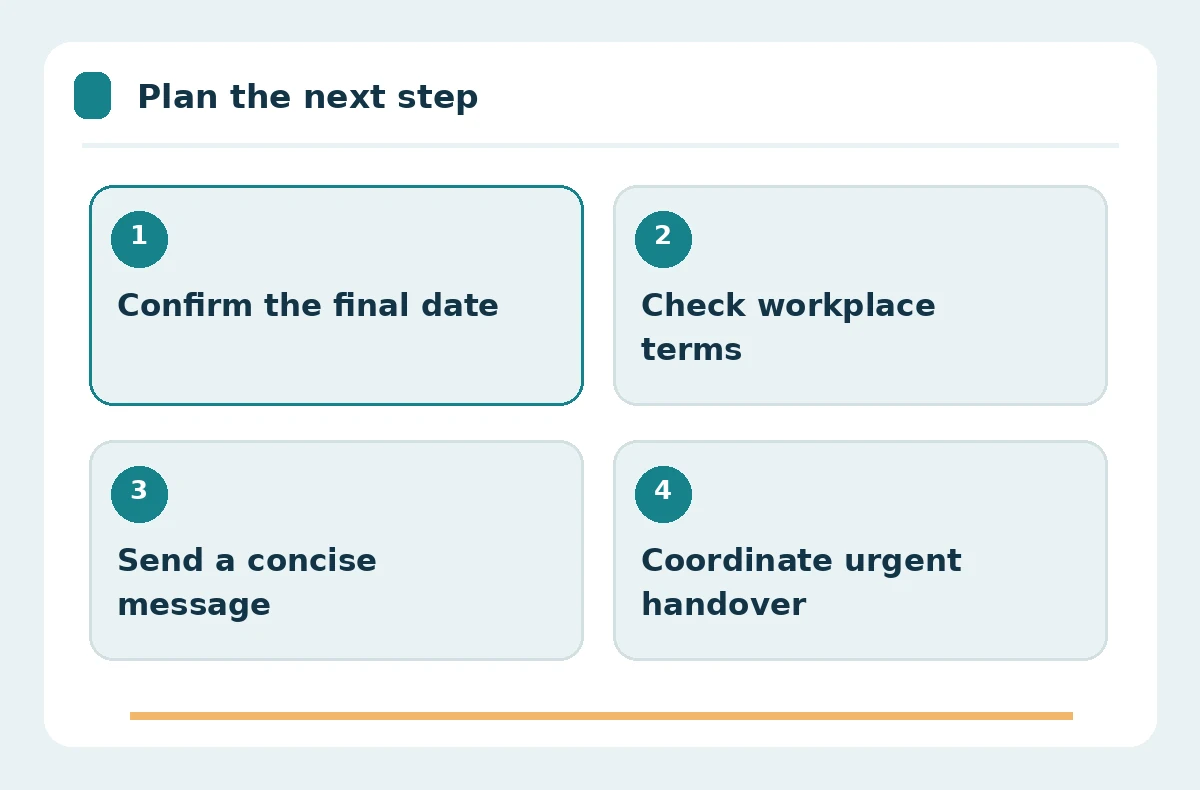
Use a Short Letter With Four Essential Details
The letter needs four pieces: who you are, the role you are leaving, the effective date, and a civil closing. A concise optional sentence can acknowledge that the notice is shorter than expected. If you can genuinely identify urgent records or return company property through an approved process, note that you will coordinate those items. This is not the place to promise unrestricted help after your employment ends.
A subject such as “Resignation Effective [Month Day, Year]” gives a clear record for email. Address your normal manager, and copy an HR contact only if the organization’s published process calls for it. Keep sensitive documents out of the message and use employer-approved channels. For confidentiality, do not forward proprietary client records to a personal account as part of the transition. For the fuller picture, see our guide “Resignation Letter for Personal Reasons Without Oversharing”.
Adapt This Hypothetical Immediate Notice Example
Hypothetical example — not a real employee or a statement about a particular employer: “Subject: Resignation Effective [Date]. Dear [Manager], I am resigning from my [Role] position at [Company], effective [Date]. Due to urgent personal circumstances, I cannot work a further notice period. I recognize that this is short notice. Please let me know the approved steps to return company property and identify any urgent work items I should document. Thank you for the opportunity to work with the team. Sincerely, [Name].” Our guide “Resignation Letter Due to Relocation” goes deeper into dates and handover example.
Edit the example so every claim remains true. If you can work until tomorrow rather than today, change the date and remove “cannot work a further notice period.” If it is safer to keep the cause private, “due to circumstances requiring my immediate attention” is enough for a courteous explanation. Avoid an invented medical reason or a promise to train someone when you will not be available to do it.

Check the Difference Between Notice and Permission
Notice, a request, and a confirmed arrangement are not the same thing. “I am resigning effective today” communicates an action you intend to take. “Could we agree on an earlier final day?” asks for a change to an existing schedule. “We agreed on [date]” should only be written after the date is genuinely confirmed. This distinction matters when you are replying to a manager who asks you to stay through a planned handover.
Review the employment documents you actually have, applicable workplace policies, and any specific benefit or repayment terms that might be affected by the timing. Rules vary across jurisdictions, agreements, and organizations; an internet article cannot settle them. If there is a safety, discrimination, or legal concern, consider appropriate official or professional help rather than negotiating solely through a generic letter.
| Your situation | Most useful next step |
|---|---|
| Leave cannot wait | State the exact effective date; keep the reason brief. |
| Shorter notice might work | Ask for a specific earlier date; do not assume agreement. |
| Workplace rules are unclear | Review your written terms and contact HR or appropriate advice. |
| Handover is incomplete | List pending tasks and approved record locations honestly. |
Handle Open Work Without Sharing Private Information
A brief handover is useful even when a full transition is impossible. List urgent tasks, what is still incomplete, and where authorized staff can find the required records. Give the manager enough context to reassign the work, but do not publish passwords, confidential personnel details, customer data, or personal notes in an email chain. Use the employer’s approved systems to transfer access and equipment.
Distinguish between an action you completed and an action you proposed. “I added the current project status to the approved board” should only be written if you did so. “The project status still needs to be added” is a more honest alternative if you did not. Confirm the appropriate return address and who should receive company devices rather than assuming any coworker can accept them.
Review the Practical Consequences Before Sending
Read the message once for date accuracy and once for tone. Verify the recipient, subject, effective date, and any attached documents. Make a private record of the letter itself without copying confidential business materials. Consider the impact on a future reference, scheduled shifts, unused leave, benefits, or a contract term, but do not assume one universal outcome. Ask payroll or HR about the process if details are unclear.
If there is still time to discuss your final day, propose a concrete alternative rather than making a vague offer to “help however possible.” A realistic alternative might be a short written status summary delivered through the normal workspace. You may choose to send the letter even if the employer does not agree with your preferred timing; this guide cannot determine the consequences for any specific case.

Send the Notice and Confirm the Next Step
Send through a channel you actually use for employment communication. If possible, have a direct conversation first, but do not invent confirmation when you have received no reply. Follow up by asking whom to contact about property, access, timesheets, and any final documentation. Keep a note of what you sent and when, and avoid spreading a departure announcement to the whole team before your manager has the information.
Your message should remain short; complex facts belong in a separate, appropriate conversation. You are seeking a clear employment record, not writing a detailed defense of a personal decision. If someone requests sensitive explanations, decide what is appropriate to share and seek reliable advice when an employment obligation is disputed.
How We Research This Resignation Situation
The letter wording, decision table, and diagrams are original editorial examples, not actual employee correspondence. We used these sources for the specific points indicated: source guidance; source guidance; University HR. Source guidance is not a substitute for your own agreement or workplace policy.
This article provides general US career communication guidance, not individual legal, financial, tax, or HR advice. Employers, states, contracts, collective-bargaining terms, and plan documents differ. JobAsk does not claim paid placement, sponsorship, or an approved affiliate relationship in this guide; see the JobAsk affiliate disclosure. All sample letters are explicitly hypothetical and must be edited to reflect real circumstances.
Explore Related Career Guides
- Resignation Text Message to Your Boss: Say It Clearly and Confirm in Writing
- Resignation Letter for a New Opportunity: Keep It Brief and Specific
- Nurse Resignation Letter: State Your Last Shift and Protect Patient Handoffs
- One-Week Notice Resignation Letter: Confirm the Date and Prioritize Handoff
- Teacher Resignation Letter: Check Contract Terms and Protect Student Handoffs
The structure is similar, but the effective date is immediate and the letter may briefly acknowledge that a normal transition is not possible.
You can often keep a courteous personal explanation broad. Review any particular workplace or legal reporting obligations rather than assuming that every case is identical.
Do not make conflicting statements. If you are requesting a change to an agreed date, label it as a request and document any actual agreement.
No. Use approved work systems for handover materials, and never send credentials or confidential information to personal email.
No. Those are separate issues that depend on the relevant rules, agreements, and plan documents; request accurate information from the responsible contact.