
A one-week notice resignation letter should tell your manager, in the first few lines, that you are leaving and state your exact last working day. Keep the explanation brief, confirm how the employer wants formal notice delivered, and focus any offer to help on tasks you can realistically finish or transfer within seven calendar days. The goal is an accurate record and a workable transition—not a promise that every assignment will be complete.
Unlike a generic two-week notice template, a seven-day departure requires active prioritization. UNLV Career Services recommends a clear resignation date and polite acknowledgment; Indeed’s one-week notice guide discusses notice expectations as contextual, not a single rule. Review any agreement, workplace policy or professional obligation before choosing the date; this article is not legal advice.
Check Whether a One-Week Timeline Is Workable
Before writing, distinguish the date you plan to send your notice from your final day of work. A week can contain nonworking days, scheduled time off, shift changes or closure days. Do not assume that “one week from Friday” will be understood identically by payroll, your manager and your coworkers. Use an explicit calendar date, with month, day and year; if shifts extend past midnight, ask how your employer records the final shift.
A short notice is not a universal entitlement or a universal breach. Different employers have different policies, and some employees have contracts, collective agreements or regulated duties. Review the conditions that actually apply to you and seek appropriate professional guidance for a disputed obligation. Where the deadline is negotiable, discuss a different last day before making promises to a new employer or booking an irreversible commitment.

Write the Letter in Four Necessary Sentences
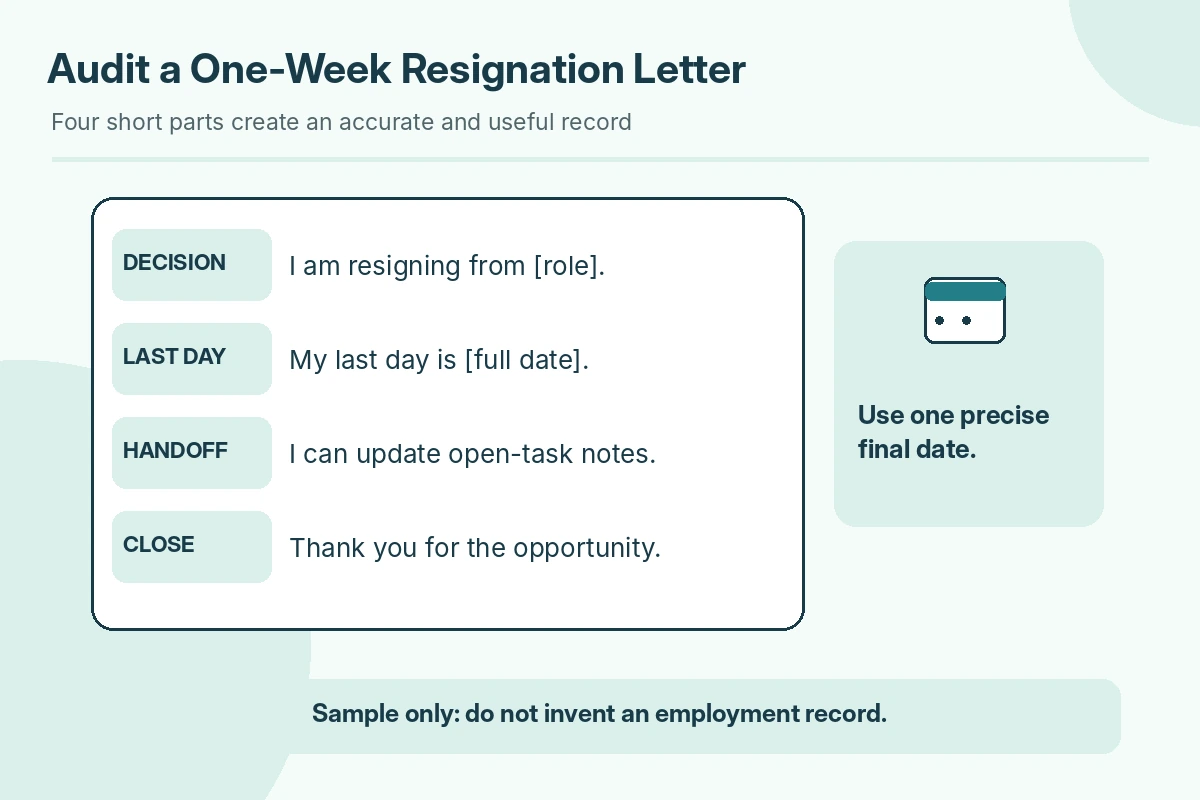
Use a direct opening: “I am resigning from my role as [position]; my last working day will be [date].” Add a short thank-you tied to the actual experience, one bounded transition sentence, and your name. A brief explanation such as “because of a personal scheduling change” is optional. You can be respectful without disclosing health, family or the identity of your next employer.
Hypothetical example: “Dear [Manager], please accept this as notice that I am resigning from my [Role] position. My last working day will be [Month Day, Year]. Thank you for the guidance and opportunities on this team. During my remaining scheduled shifts, I can document open requests and brief the assigned colleague on their status. Sincerely, [Name].” Replace every bracket with true information; this is not a real employee’s letter.
Choose What to Finish and What to Transfer
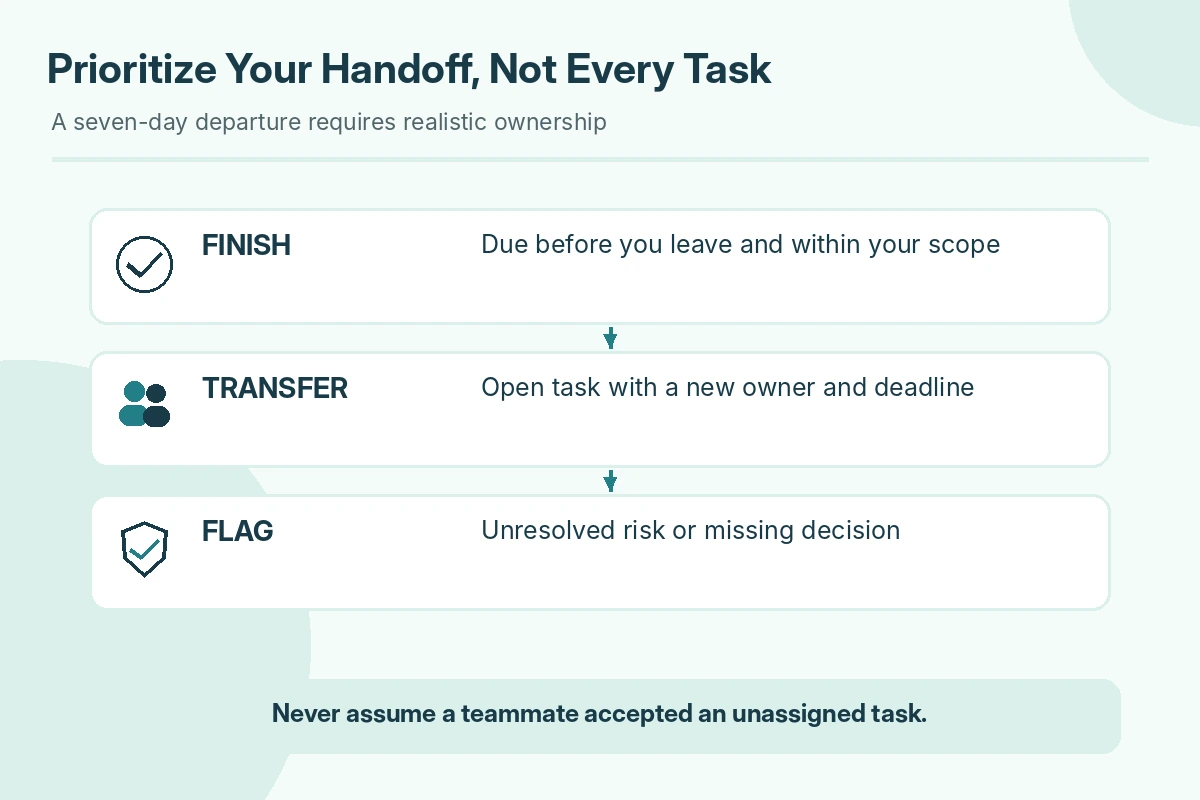
Write a three-column list before offering help: work you can complete safely, work requiring a new owner, and blockers needing a manager decision. For example, close tickets already within your responsibility, document the current status of pending requests, and identify customer commitments due after you leave. Avoid volunteering to authorize refunds, approvals or staffing decisions outside your role merely to make the departure appear smooth.
Ask your manager to confirm who owns open work after your final day. A handoff note should name tasks, deadlines, status, location of approved documentation and unresolved questions. Do not copy confidential files to a personal account, export an internal contact list or share passwords. If you cannot finish an item, reporting that fact before departure is more useful than a cheerful but inaccurate promise.
Notify the Right People in the Right Order
Where practicable, speak privately with your manager and follow with the formal letter or email to the correct recipient. Some organizations require HR notification or a portal action as well. A text or hallway conversation may create uncertainty about whether formal notice was received, so keep a copy of the approved written submission and request clarification if you receive no acknowledgment.
Do not make a public announcement to coworkers before the team has a suitable communication plan. Your manager may need to arrange a replacement contact or change shift coverage. If colleagues ask why you are leaving, a short truthful answer is sufficient. You do not need to reveal a personal situation to defend the timing, and you should not criticize coworkers in a document likely to be stored with employment records.
Plan the Final Seven Days Without Overpromising
On day one, deliver notice and confirm the final shift; next, inventory urgent work and identify owners; then prepare approved handoff notes; toward the end, verify return of keys, equipment and access items with the responsible team. This is an optional planning sequence, not a universal employer policy. Adjust it to the real schedule and any directions from HR or your supervisor.
If you are asked to remain available after your departure, do not casually agree to unpaid support or continued system access. Clarify the request through the employer’s approved processes. Similarly, ask HR directly about remaining pay, benefits and final paperwork; avoid relying on a standard notice template as legal guidance about those topics, which can vary by jurisdiction and terms of employment.
Review the Notice Before Sending It
Check spelling of the manager’s name, current job title, last day and whether the date matches what you discussed. Remove phrases like “I will make sure everything is finished” unless that is actually possible. If you have a new start date, keep it separate from the final date at the old job rather than assuming there cannot be an overlap or a change in the schedule.
Use short-notice career guidance as a structural reference, not a guarantee of employer agreement. Your letter is successful as a piece of communication when it clearly records the decision, timing and realistic next steps. Whether the employer accepts a particular notice period or imposes contract-specific consequences cannot be determined from a generic sample.
How We Research Professional Resignation Guidance
This guide draws on one-week notice guidance, UNLV Career Services, short-notice career guidance. These sources support practical communication, notice structure or, where applicable, clinical responsibility. They do not confirm an individual contract, a legal notice period, a facility policy or an invented candidate’s experience. Public source pages were checked on October 26, 2026.
All templates and scenarios are explicitly hypothetical and must be rewritten with your actual dates, duties and recipients. Treat the original diagrams as decision aids, not legal or clinical directives. This site makes no claim of a paid referral or affiliated employer. Review the affiliate disclosure.
Explore Related Career Guides
- One-Month Resignation Notice Letter: Dates, Sample, and Transition Plan
- Short Notice Resignation Letter With a Realistic Handover Plan
- Immediate Resignation Letter: What to Say When You Cannot Give Notice
- Resignation Letter: Clear Templates and a Professional Handoff Plan
- Retirement Resignation Letter: Last Day, Handoff, and Benefits
No. Review employer policy, any agreement and profession-specific obligations; seven days is a scenario, not a universal rule.
You may acknowledge inconvenience politely, but the essential information is your decision, exact last day and feasible handoff.
Schedules vary. State the full date of your last working day and clarify shift coverage instead of relying on a vague count.
Often yes, but follow the actual workplace process and keep confirmation that the intended recipient received it.
Document their status, flag deadlines and ask the manager to assign a new owner rather than promising completion.