
Quick answer: A teacher resignation letter should clearly state the teaching position, school or district, intended last employment date, and recipient. Before sending it, check your current contract, district board policy, state rules, and any required release process. A school-year contract can make a generic two-week template misleading. Keep the letter brief and prepare classroom materials and student records only through authorized school systems.
Check Your Contract Before Choosing the Date
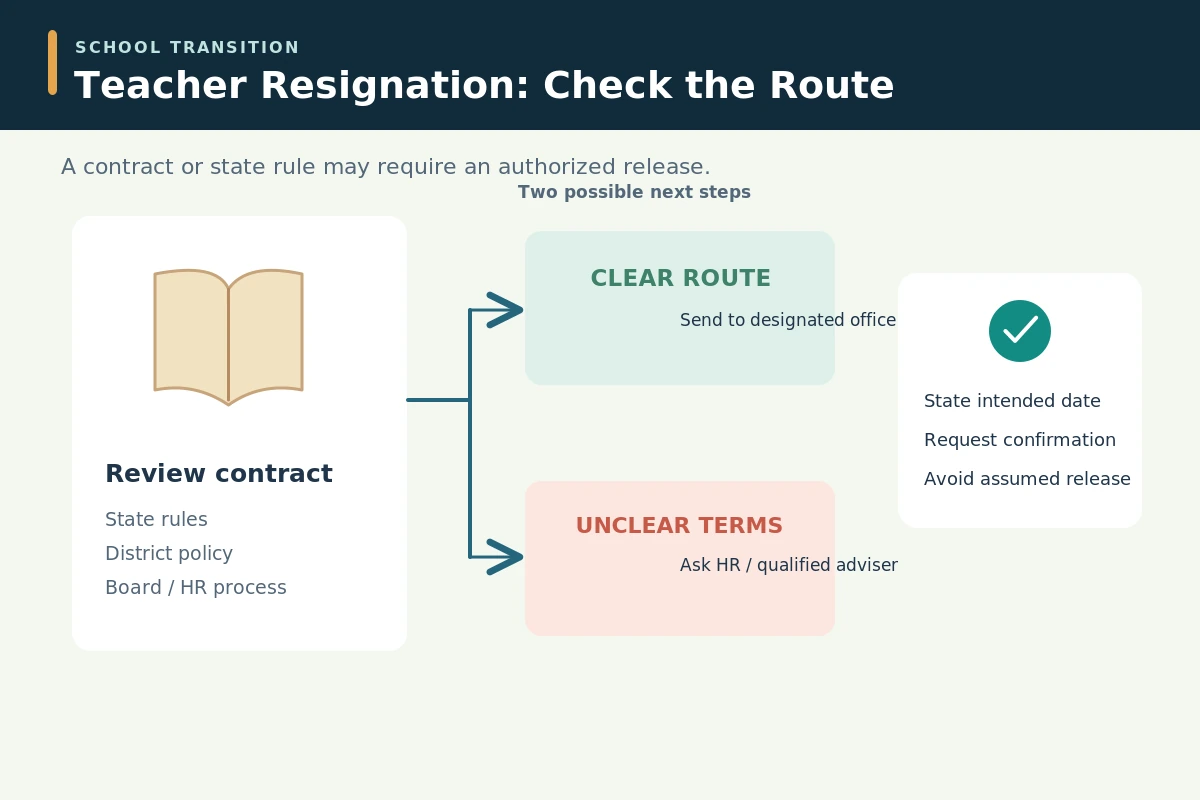
Start with the signed employment agreement, current contract term, and district resignation procedure. Identify the person authorized to receive notice or approve release, any relevant board process, and the exact dates used by your school calendar. A principal may be a useful first contact but may not be the final decision-maker for a contracted educator; do not assume that an informal conversation completes the process.
Requirements vary sharply by state and contract type. For example, the Texas Education Agency educator FAQ discusses a 45-day-before-instruction resignation window and potential certification consequences for certain contract departures. That is a Texas-specific example, not a national notice requirement. If terms are unclear, consult the district HR office, your educators association, or an appropriate licensed adviser before committing to an exit date.
Address the Proper School Decision-Maker
Use the recipient specified in the district policy: that might be HR, the superintendent, the governing board or its designee, alongside an informational copy to your principal. In the salutation and subject, use the real role rather than a fabricated official title. Provide your full name, position, and campus so that the district can match the communication to its employment records.
Avoid treating the teacher’s resignation letter as a public note to families or students. A staff announcement is a separate, school-approved communication. Ask the appropriate administrator whether you should notify teaching partners or families, what language is approved, and when any announcement can occur. Notifying families prematurely can complicate class assignments and student support.
Use a Direct School-Specific Letter Sample
Hypothetical sample: “Dear [Authorized Recipient]: I am writing to submit my resignation from my position as [Teaching Position] at [School/District]. My requested last day of employment is [Month Day, Year], subject to any required district procedures or approvals. I will follow the approved transition plan for lesson materials and assigned records. Thank you for reviewing this notice. Sincerely, [Your Name].” Adapt the reference to approval only when your actual arrangement requires it.
A school-specific letter does not need a long narrative about classroom challenges, parent complaints, or your next employer. It should never identify individual students or disclose protected educational information. If you are requesting release from a binding contract or another special arrangement, make the request explicit and separate from any assumption that the district has already granted it.
Build a Transition Map for the Classroom
Inventory upcoming lesson plans, approved curriculum materials, assessment schedules, accommodations workflows, classroom equipment and projects that will remain open. Put a responsible school staff role next to each handoff item and state what requires administrator direction. Avoid promising that a substitute or new teacher has accepted responsibilities before the assignment is confirmed.
The usable handoff is not necessarily a large personal binder. A short index pointing to approved school systems can be safer and more current: “Unit plan in district curriculum folder,” “graded items in approved gradebook,” and “student-support questions to designated case manager.” If a resource includes student information, keep it in the secure district environment under its access rules.

Protect Student Records During the Departure
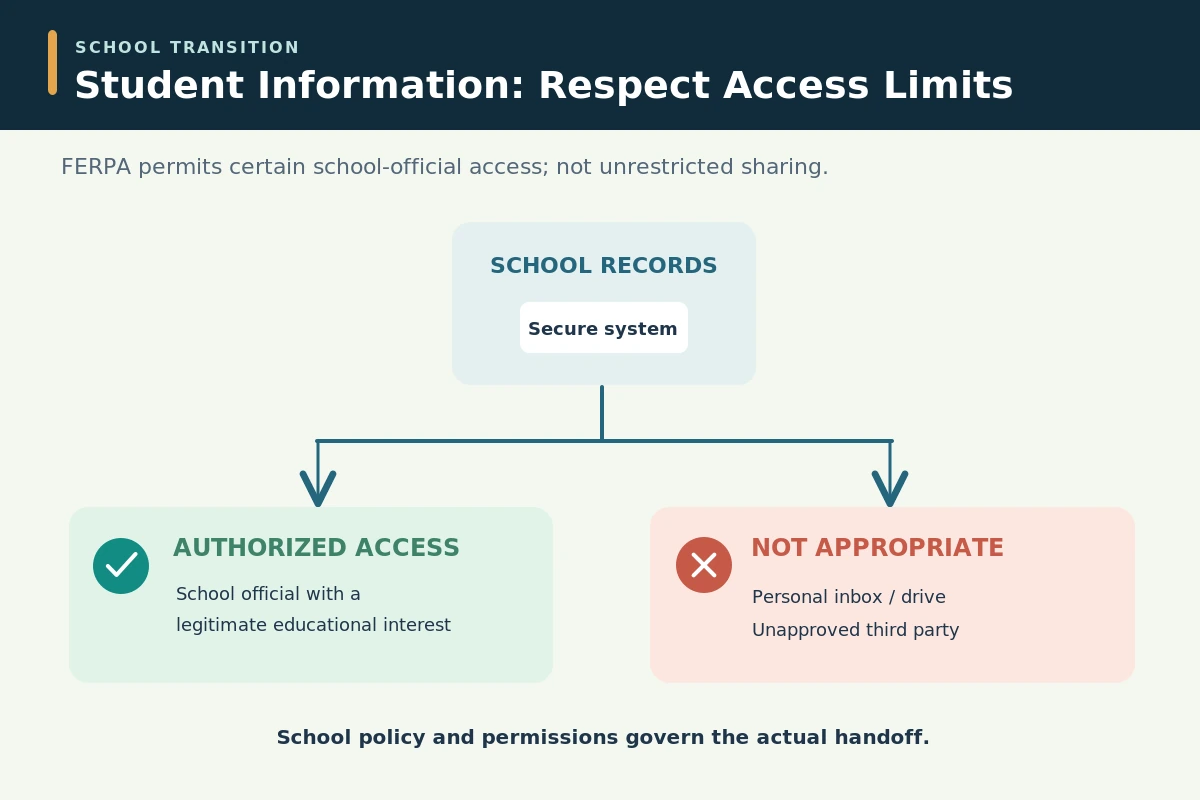
The U.S. Department of Education’s FERPA guidance says an education institution may disclose identifiable education-record information without consent to school officials it has identified as having legitimate educational interests. That does not mean any colleague, friend, or private account can receive a copy. The institution must follow its own access rules and applicable law.
Do not email student records to your personal address, copy individualized plans to a personal drive, or move files to a replacement teacher without authorization. Ask the school administration and records custodian who may access each system. The Department’s access-control guidance emphasizes limiting access to educational records needed for a staff member’s professional responsibility. This applies to the handoff diagram as well as the actual documents.
Distinguish Employment Date From Last Teaching Day
Your last day standing in front of students may differ from the final date of district employment. Training days, contract calendars, approved leave, grade completion and summer assignments can affect what the district records as the employment end. Put the date relevant to your formal resignation in the letter and ask HR to confirm how any separate final instructional day should be recorded.
If a district proposes an earlier or later transition date, do not quietly edit the school calendar in the resignation document and assume agreement. Request written confirmation from the authorized office. Use date labels such as “last instructional day” and “last employment day” rather than the ambiguous single phrase “last day,” especially when calendar periods do not align.
Keep Family Communication Within School Policy
Teachers naturally want families and students to feel supported, but the school should coordinate classroom announcements and substitute assignments. Share only what is authorized and necessary: who families may contact, where ongoing classwork will appear, and which established office answers scheduling questions. Never publicly explain a student’s individual service needs or speculate about staffing decisions.
A hypothetical family-facing message might say: “The school administration will share classroom transition information through official school channels.” That is not a replacement for a district-approved notice. Confirm accessibility, translation needs, and whether families need any action at all. The departure letter and the family announcement serve different audiences.
Ask HR to Confirm Required Exit Steps
Ask what district materials and devices must be returned, how course grades will be finalized, and which files remain under district control. Confirm payroll contact information and benefits administration procedures through district HR. The resignation letter itself should not claim unpaid leave treatment, benefit continuation, or license status without official review.
Keep a copy of your notice and any district response in an authorized manner. If your contract dispute, protected leave, or disciplinary process is involved, generic internet templates are inadequate; seek qualified local assistance. A well-written teacher resignation letter helps with clarity, but it cannot override contract terms, school-board procedures, or student-privacy obligations.
How We Research and Check Resignation Guidance
We reviewed the specific official U.S. employment and education authorities linked below on October 28, 2026, and compared their stated scopes with the hypothetical communication examples. General letter-design and handoff steps are editorial workflow recommendations, not claims that federal law dictates a resignation template. State rules, contracts, employer policies and school district procedures may alter a real decision. We do not know or verify your personal employment arrangement. Our affiliate disclosure explains site relationships; none of the links below is presented as a paid placement.
Primary sources: Texas Education Agency (The Texas Education Agency explains specific contract resignation timelines and possible certification consequences under Texas rules, illustrating why local checks matter.). U.S. Department of Education (The U.S. Department of Education limits education-record access without consent to school officials with legitimate educational interests.). U.S. Department of Education (The Department of Education instructs educational institutions to limit record access to employees with legitimate educational interests.).
Explore Related Career Guides
- Resignation Letter Due to Relocation: Explain the Move Without Oversharing
- Resignation Letter for Personal Reasons: A Decision Matrix and Example
- Resignation Letter for Personal Reasons: Privacy, Dates, and Examples
- Immediate Resignation Letter: Short Notice With Clear Next Steps
- Resignation During Probation: Check Notice Terms and Write a Clear Letter
No. Teaching contracts, state requirements and district processes vary. Check the signed agreement and applicable rules before setting a date; Texas, for example, has special educator contract provisions.
Follow the district’s official submission instructions. You may need to notify a principal while filing formal notice with HR, the superintendent, a board designee, or another authorized office.
Not to personal devices or private accounts. Use school-authorized systems and approved access permissions; FERPA restricts access and disclosure of identifiable education records.
Yes, school calendars and contract arrangements can distinguish instructional duties from employment dates. Ask the district to confirm both dates in writing if they differ.
Do not claim that approval is granted. Keep following the applicable process, request a written response and seek qualified local guidance when contract or certification consequences are possible.